## Logical Deduction Problem: Footballers and Fitness
### Overview
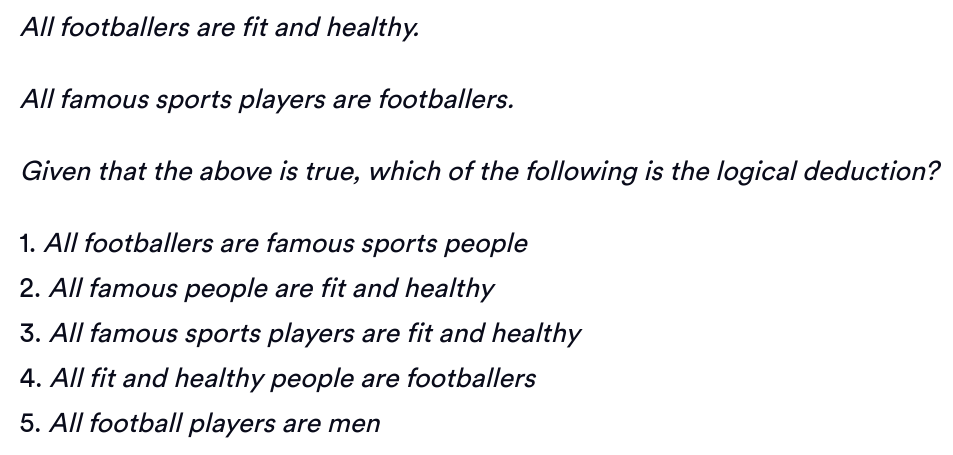
The image presents a logical deduction exercise with two premises and five potential conclusions. The task is to identify which conclusion logically follows from the given premises.
### Content Details
**Premises:**
1. "All footballers are fit and healthy."
2. "All famous sports players are footballers."
**Question:**
"Given that the above is true, which of the following is the logical deduction?"
**Options:**
1. All footballers are famous sports people
2. All famous people are fit and healthy
3. All famous sports players are fit and healthy
4. All fit and healthy people are footballers
5. All football players are men
### Key Observations
- **Premise 1** establishes a universal relationship: Footballers ⊆ Fit and Healthy People.
- **Premise 2** establishes another universal relationship: Famous Sports Players ⊆ Footballers.
- **Option 3** directly combines the two premises via syllogism: Famous Sports Players ⊆ Footballers ⊆ Fit and Healthy People → Famous Sports Players ⊆ Fit and Healthy People.
- **Options 1, 2, 4, and 5** are invalid:
- Option 1 reverses the subset relationship (Footballers ⊆ Famous Sports People ≠ Footballers ⊆ Famous Sports People).
- Option 2 introduces "famous people" (not limited to sports), which is not supported by the premises.
- Option 4 incorrectly generalizes "fit and healthy people" as a subset of footballers.
- Option 5 introduces "men," a category not mentioned in the premises.
### Interpretation
The problem tests syllogistic reasoning. The correct deduction (Option 3) follows from transitivity: If all famous sports players are footballers, and all footballers are fit and healthy, then all famous sports players must be fit and healthy. The other options either misapply subset relationships, introduce unsupported categories, or reverse logical flow. This exercise highlights the importance of strict adherence to premise boundaries in deductive reasoning.