## Diagram: Comparison of 3D Gaussian Splatting and FLoD-3DGS Rendering
### Overview
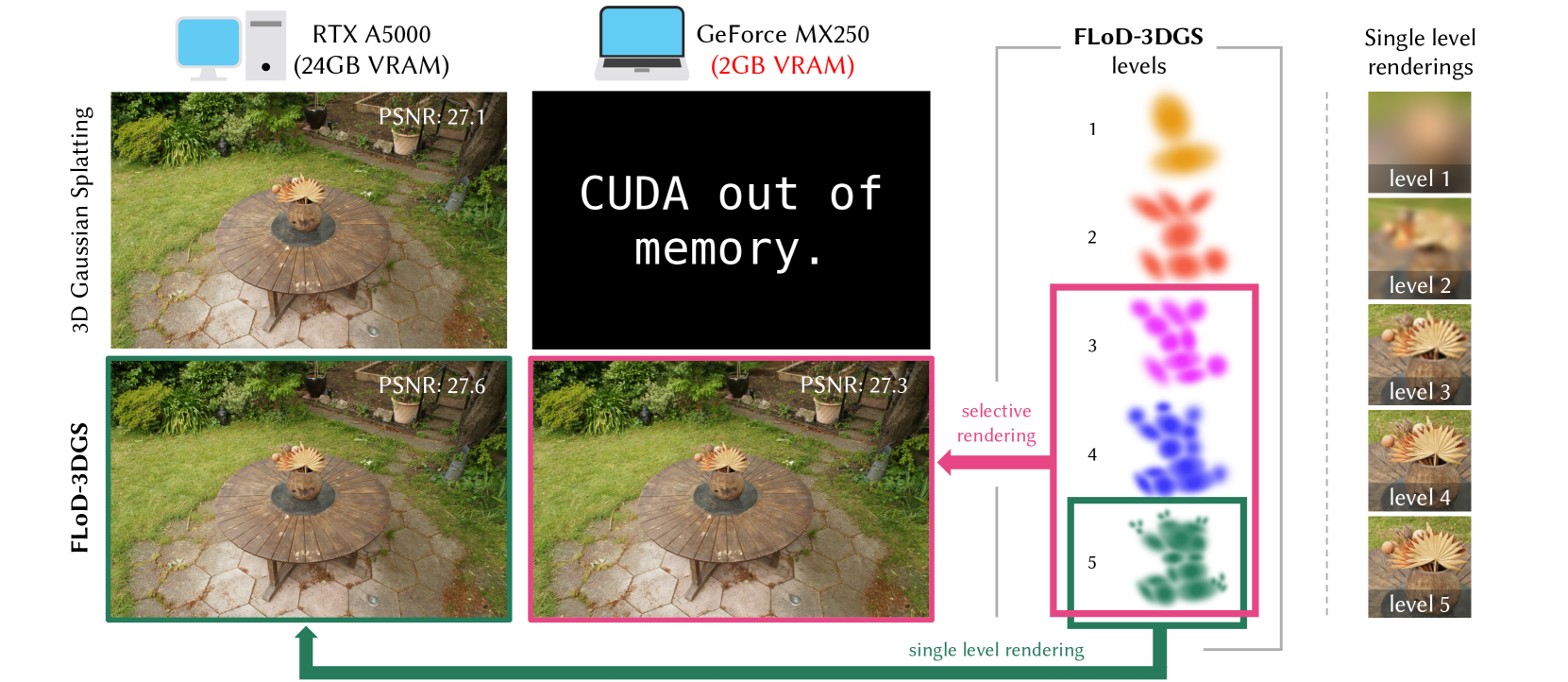
The image presents a comparison between 3D Gaussian Splatting and FLoD-3DGS rendering techniques, showcasing the performance of each method on different hardware configurations. It also illustrates the concept of FLoD-3DGS levels and their corresponding single-level renderings.
### Components/Axes
* **Hardware Configurations:**
* RTX A5000 (24GB VRAM) - Represented by a desktop computer icon.
* GeForce MX250 (2GB VRAM) - Represented by a laptop icon.
* **Rendering Techniques:**
* 3D Gaussian Splatting
* FLoD-3DGS
* **Performance Metric:**
* PSNR (Peak Signal-to-Noise Ratio) - Numerical values are provided for each rendering.
* **FLoD-3DGS Levels:**
* Levels 1 to 5 are displayed as blurred point clouds, each with a distinct color.
* **Single Level Renderings:**
* Visual representations of the scene rendered at each FLoD-3DGS level.
* **Arrows:**
* Green arrow indicating "single level rendering" from FLoD-3DGS to the bottom-left image.
* Pink arrow indicating "selective rendering" from FLoD-3DGS levels to the bottom-right image.
### Detailed Analysis
* **RTX A5000 (24GB VRAM):**
* 3D Gaussian Splatting: PSNR = 27.1
* FLoD-3DGS: PSNR = 27.6
* **GeForce MX250 (2GB VRAM):**
* 3D Gaussian Splatting: Displays "CUDA out of memory."
* FLoD-3DGS: PSNR = 27.3
* **FLoD-3DGS Levels:**
* Level 1: Orange point cloud.
* Level 2: Red point cloud.
* Level 3: Pink point cloud, enclosed in a pink box.
* Level 4: Blue point cloud, enclosed in a pink box.
* Level 5: Green point cloud, enclosed in a green box.
* **Single Level Renderings:**
* Level 1: Highly blurred image.
* Level 2: Slightly less blurred image.
* Level 3: Image with visible details.
* Level 4: Image with more defined details.
* Level 5: Image with the most defined details.
### Key Observations
* FLoD-3DGS achieves a higher PSNR than 3D Gaussian Splatting on the RTX A5000.
* 3D Gaussian Splatting fails to run on the GeForce MX250 due to memory limitations.
* FLoD-3DGS is able to run on the GeForce MX250, albeit with a lower PSNR than on the RTX A5000.
* The visual quality of the single-level renderings improves as the FLoD-3DGS level increases.
### Interpretation
The image demonstrates the advantages of FLoD-3DGS over 3D Gaussian Splatting, particularly in memory-constrained environments. FLoD-3DGS can run on a GPU with limited VRAM (GeForce MX250) where 3D Gaussian Splatting fails. The FLoD-3DGS levels illustrate a hierarchical representation of the scene, where lower levels provide a coarse approximation and higher levels offer finer details. The "selective rendering" suggests that FLoD-3DGS can adaptively choose the appropriate level of detail based on available resources or rendering requirements. The single level rendering shows how the level of detail increases as the level increases.