## Diagram: Rendering Technique Comparison and Performance Analysis
### Overview
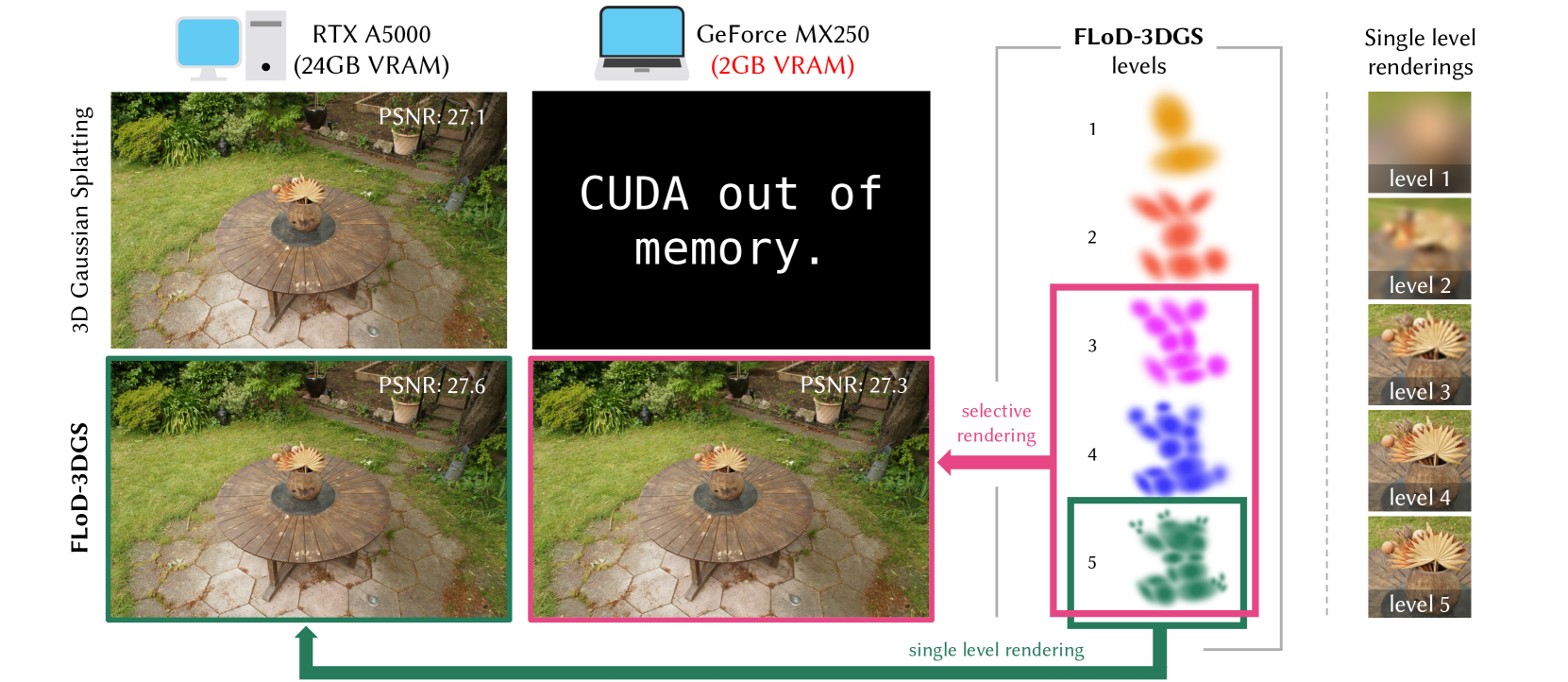
The diagram compares two 3D rendering techniques (3D Gaussian Splatting and FLoD-3DGS) across hardware configurations, showcasing performance metrics (PSNR values) and architectural differences. It includes hardware specifications, rendering workflows, and visual quality comparisons.
---
### Components/Axes
1. **Hardware Specifications** (Top-left):
- **RTX A5000**: 24GB VRAM (labeled in parentheses)
- **GeForce MX250**: 2GB VRAM (labeled in red parentheses)
- Visual representation: Icons of a desktop computer and laptop.
2. **Rendering Techniques** (Left column):
- **3D Gaussian Splatting**: Two images with PSNR values:
- Top image: PSNR 27.1
- Bottom image: PSNR 27.6
- **FLoD-3DGS**: Single image with PSNR 27.3, outlined in green.
3. **FLoD-3DGS Workflow** (Right flowchart):
- **Levels 1–5**: Color-coded regions (yellow, orange, pink, blue, green) representing progressive detail.
- **Selective Rendering**: Arrow from Level 5 (green) to "single level rendering" (bottom green arrow).
- **Single-Level Renderings** (Far-right column):
- Five images labeled Level 1 to Level 5, showing progressive clarity (blurry to sharp).
4. **Text Elements**:
- "CUDA out of memory" (black box with white text).
- "selective rendering" (arrow label in flowchart).
- "single level rendering" (bottom green arrow label).
---
### Detailed Analysis
1. **PSNR Values**:
- 3D Gaussian Splatting: 27.1 (top) and 27.6 (bottom).
- FLoD-3DGS: 27.3 (center image).
- All values are approximate, with uncertainty due to lack of error bars.
2. **Hardware Impact**:
- RTX A5000 (24GB VRAM) supports higher-resolution rendering (PSNR 27.6).
- GeForce MX250 (2GB VRAM) likely struggles with memory constraints ("CUDA out of memory" note).
3. **FLoD-3DGS Architecture**:
- Multi-level rendering (Levels 1–5) uses color-coded regions to denote detail progression.
- Selective rendering prioritizes Level 5 (green) for final output, suggesting adaptive quality control.
4. **Single-Level Renderings**:
- Level 1 (yellow): Blurry, low-detail.
- Level 5 (green): Sharp, high-detail.
- Spatial progression from top-left (blurry) to bottom-right (sharp).
---
### Key Observations
1. **PSNR Trends**:
- FLoD-3DGS (27.3) outperforms 3D Gaussian Splatting (27.1) but underperforms the higher-PSNR 3D Gaussian Splatting variant (27.6).
- Higher VRAM (RTX A5000) correlates with improved PSNR.
2. **Workflow Efficiency**:
- FLoD-3DGS balances quality and performance by rendering only the highest-detail level (Level 5) for final output.
3. **Hardware Limitations**:
- GeForce MX250’s 2GB VRAM is insufficient for full-resolution rendering, triggering memory errors.
---
### Interpretation
The diagram illustrates how FLoD-3DGS optimizes rendering by focusing computational resources on the most detailed level (Level 5), achieving competitive PSNR values despite hardware constraints. The RTX A5000’s larger VRAM enables higher-quality outputs, while the GeForce MX250’s limitations highlight the trade-offs between hardware capability and rendering efficiency. The selective rendering workflow suggests a design prioritizing adaptive quality over brute-force computation, making it suitable for resource-constrained environments.