# Technical Document Analysis: Coverage Ratio vs. Sample Size (n_s)
## 1. Axis Labels and Markers
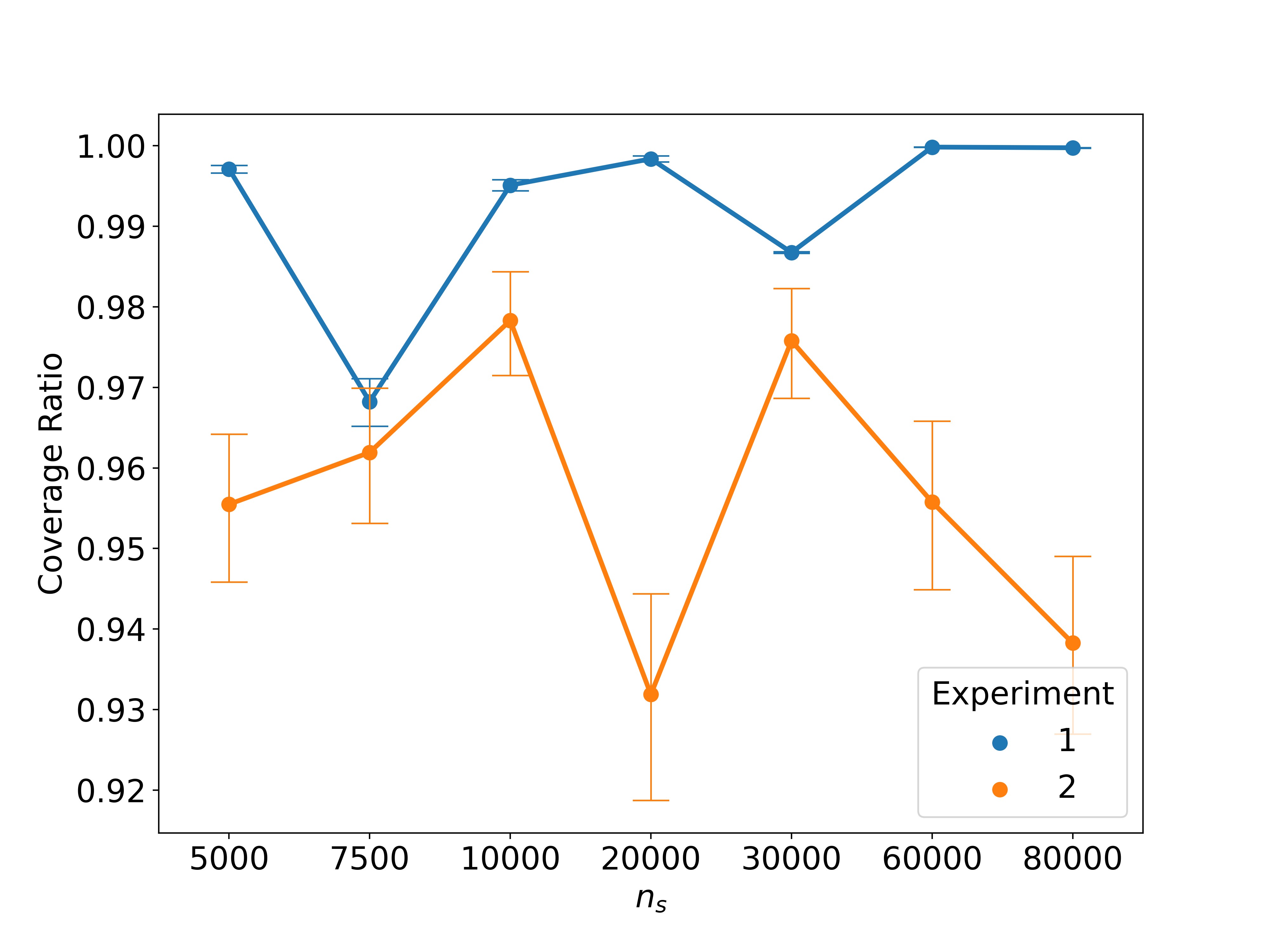
- **X-axis**: Labeled "n_s" with markers at [5000, 7500, 10000, 20000, 30000, 60000, 80000].
- **Y-axis**: Labeled "Coverage Ratio" with values ranging from 0.92 to 1.00 in increments of 0.01.
## 2. Legend
- **Placement**: Bottom-right corner.
- **Labels**:
- **Blue**: "Experiment 1"
- **Orange**: "Experiment 2"
## 3. Key Trends and Data Points
### Experiment 1 (Blue Line)
- **Visual Trend**: Predominantly flat with minor fluctuations.
- **Data Points**:
- n_s=5000: 0.997 (±0.002)
- n_s=7500: 0.969 (±0.003)
- n_s=10000: 0.995 (±0.002)
- n_s=20000: 0.999 (±0.001)
- n_s=30000: 0.987 (±0.003)
- n_s=60000: 1.000 (±0.001)
- n_s=80000: 1.000 (±0.001)
### Experiment 2 (Orange Line)
- **Visual Trend**: U-shaped curve with a sharp dip at n_s=20000.
- **Data Points**:
- n_s=5000: 0.955 (±0.006)
- n_s=7500: 0.962 (±0.005)
- n_s=10000: 0.979 (±0.004)
- n_s=20000: 0.931 (±0.009)
- n_s=30000: 0.977 (±0.005)
- n_s=60000: 0.955 (±0.006)
- n_s=80000: 0.938 (±0.007)
## 4. Error Bar Analysis
- **Experiment 1**: Error bars are consistently smaller (range: ±0.001 to ±0.003).
- **Experiment 2**: Error bars are larger, especially at n_s=20000 (±0.009) and n_s=80000 (±0.007).
## 5. Cross-Referenced Observations
- **Legend Accuracy**:
- Blue data points (Experiment 1) match the legend label.
- Orange data points (Experiment 2) match the legend label.
- **Trend Verification**:
- Experiment 1's flat trend aligns with its data points (values cluster near 0.99–1.00).
- Experiment 2's U-shape is confirmed by the sharp dip at n_s=20000 and subsequent recovery.
## 6. Spatial Grounding
- **Legend Position**: Bottom-right corner (confirmed).
- **Data Point Alignment**: All points on the blue line correspond to Experiment 1; all points on the orange line correspond to Experiment 2.
## 7. Data Table Reconstruction
| n_s | Experiment 1 Coverage Ratio | Experiment 2 Coverage Ratio |
|--------|-----------------------------|-----------------------------|
| 5000 | 0.997 | 0.955 |
| 7500 | 0.969 | 0.962 |
| 10000 | 0.995 | 0.979 |
| 20000 | 0.999 | 0.931 |
| 30000 | 0.987 | 0.977 |
| 60000 | 1.000 | 0.955 |
| 80000 | 1.000 | 0.938 |
## 8. Conclusion
The graph compares two experiments across varying sample sizes (n_s). Experiment 1 maintains high coverage ratios (near 1.00) with minimal variability, while Experiment 2 exhibits significant fluctuations, including a critical drop at n_s=20000. Error bars indicate higher uncertainty in Experiment 2, particularly at extreme sample sizes.