## Diagram: System Interaction Flow
### Overview
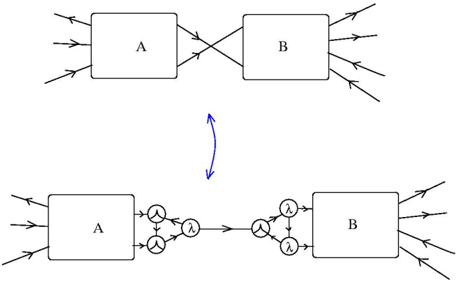
The image contains two diagrams illustrating the interaction between two components labeled **A** and **B**. The top diagram shows a direct bidirectional connection between A and B via crossing arrows. The bottom diagram introduces intermediate lambda (λ) symbols between A and B, with arrows indicating a sequential flow. A blue arrow connects the two diagrams, suggesting a transformation or process from the top to the bottom representation.
### Components/Axes
- **Top Diagram**:
- **Boxes**: Labeled **A** (left) and **B** (right).
- **Arrows**: Bidirectional (X-shaped) between A and B, indicating mutual interaction.
- **Bottom Diagram**:
- **Boxes**: Same labels **A** (left) and **B** (right).
- **Lambda Symbols (λ)**: Three instances (λ₁, λ₂, λ₃) placed between A and B.
- **Arrows**: Sequential flow from A → λ₁ → λ₂ → λ₃ → B.
- **Blue Arrow**: Connects the top and bottom diagrams, pointing downward.
### Detailed Analysis
- **Top Diagram**:
- Direct, unmediated interaction between A and B.
- Arrows suggest bidirectional data exchange or mutual dependency.
- **Bottom Diagram**:
- Lambda symbols (λ) act as intermediaries or processing steps.
- Sequential arrows imply a stepwise transformation or pipeline from A to B.
- The blue arrow indicates the top diagram is a simplified abstraction, while the bottom diagram represents a detailed implementation.
### Key Observations
1. The top diagram emphasizes direct coupling between A and B.
2. The bottom diagram introduces modularity via lambda functions, suggesting a layered or decomposed system.
3. The blue arrow implies the bottom diagram is a refined or expanded version of the top diagram.
### Interpretation
The diagrams likely represent a system design evolution:
- **Top Diagram**: A high-level view of two components interacting directly, possibly in a peer-to-peer or tightly coupled architecture.
- **Bottom Diagram**: A low-level view where interactions are mediated by lambda functions (e.g., event handlers, middleware, or transformation layers). This could reflect a shift toward modularity, scalability, or separation of concerns.
- The blue arrow symbolizes the transition from a conceptual model (top) to a technical implementation (bottom), highlighting the role of intermediate processes (λ) in bridging the two components.
No numerical data or trends are present. The focus is on structural relationships and process flow.