## Code Snippet: Lemma Definitions
### Overview
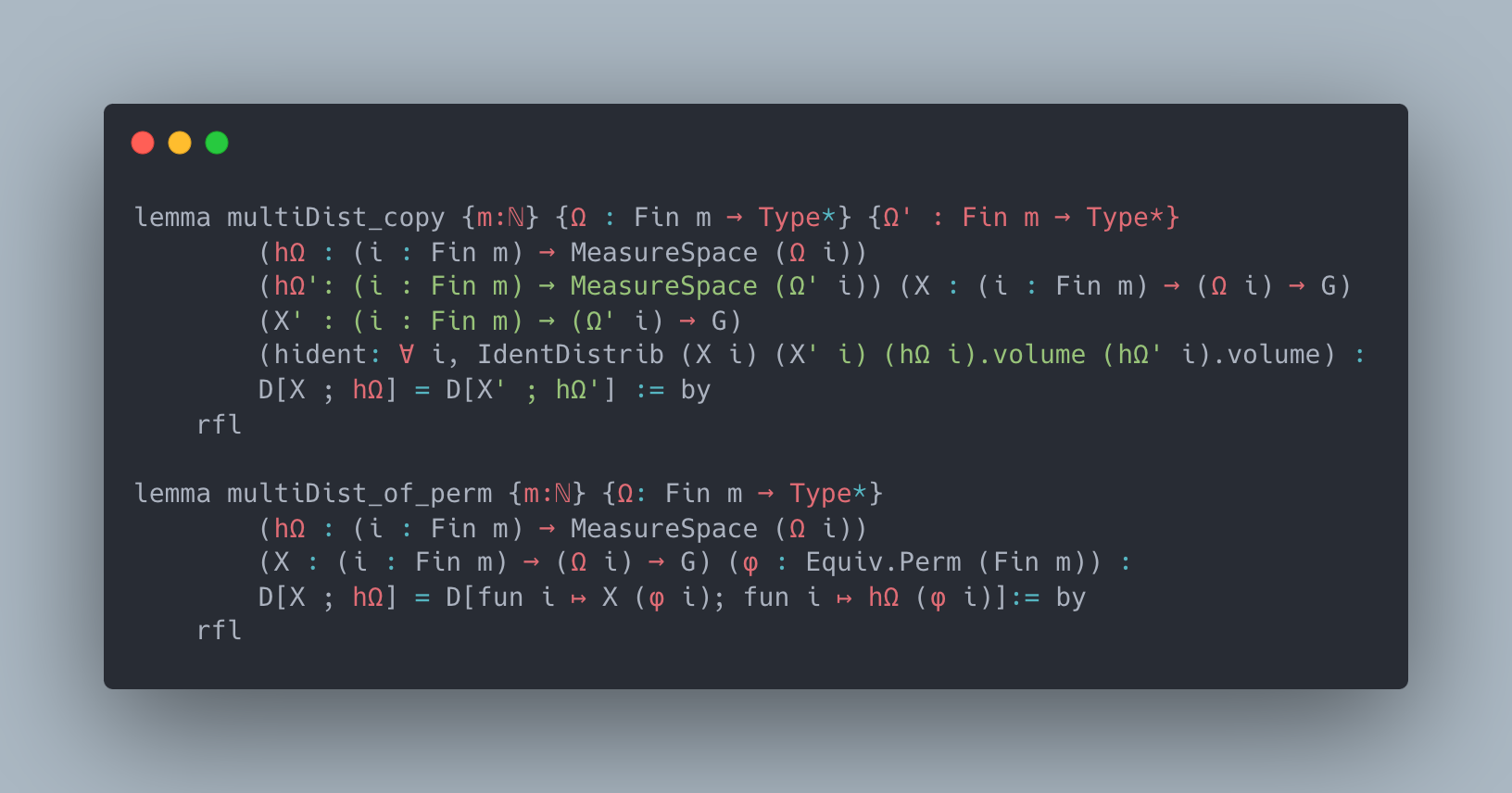
The image presents a code snippet containing two lemma definitions: `multiDist_copy` and `multiDist_of_perm`. These lemmas appear to be related to measure theory and probability, potentially within a formal verification context. The code is written in a language that supports dependent types and mathematical notation.
### Components/Axes
* **Lemma Definitions:** Two lemmas are defined: `multiDist_copy` and `multiDist_of_perm`.
* **Type Parameters:** Both lemmas use type parameters enclosed in curly braces `{}`.
* **Hypotheses:** Each lemma has hypotheses denoted by parentheses `()`.
* **Goal:** Each lemma has a goal, which is an equality denoted by `=`.
* **Proof:** Each lemma concludes with `:= by rfl`, indicating a proof by reflexivity.
### Detailed Analysis or ### Content Details
**Lemma 1: `multiDist_copy`**
* **Name:** `multiDist_copy`
* **Type Parameters:**
* `m:N`: `m` is of type `N` (likely natural numbers).
* `Ω : Fin m → Type*`: `Ω` is a function from `Fin m` (finite set of size `m`) to `Type*` (likely a type universe).
* `Ω' : Fin m → Type*`: `Ω'` is a function from `Fin m` to `Type*`.
* **Hypotheses:**
* `hΩ : (i : Fin m) → MeasureSpace (Ω i)`: `hΩ` states that for each `i` in `Fin m`, `Ω i` is a `MeasureSpace`.
* `hΩ' : (i : Fin m) → MeasureSpace (Ω' i)`: `hΩ'` states that for each `i` in `Fin m`, `Ω' i` is a `MeasureSpace`.
* `X' : (i : Fin m) → (Ω' i) → G`: `X'` is a function that takes an index `i` in `Fin m` and an element of `Ω' i` and returns an element of type `G`.
* `X : (i : Fin m) → (Ω i) → G`: `X` is a function that takes an index `i` in `Fin m` and an element of `Ω i` and returns an element of type `G`.
* `hident: ∀ i, IdentDistrib (X i) (X' i) (hΩ i).volume (hΩ' i).volume`: `hident` states that for all `i`, `X i` and `X' i` are identically distributed with respect to the volumes of `hΩ i` and `hΩ' i`.
* **Goal:** `D[X; hΩ] = D[X'; hΩ']`
* **Proof:** `:= by rfl`
**Lemma 2: `multiDist_of_perm`**
* **Name:** `multiDist_of_perm`
* **Type Parameters:**
* `m:N`: `m` is of type `N` (likely natural numbers).
* `Ω : Fin m → Type*`: `Ω` is a function from `Fin m` to `Type*`.
* **Hypotheses:**
* `hΩ : (i : Fin m) → MeasureSpace (Ω i)`: `hΩ` states that for each `i` in `Fin m`, `Ω i` is a `MeasureSpace`.
* `X : (i : Fin m) → (Ω i) → G`: `X` is a function that takes an index `i` in `Fin m` and an element of `Ω i` and returns an element of type `G`.
* `φ : Equiv.Perm (Fin m)`: `φ` is a permutation of `Fin m`.
* **Goal:** `D[X; hΩ] = D[fun i ↦ X (φ i); fun i ↦ hΩ (φ i)]`
* **Proof:** `:= by rfl`
### Key Observations
* Both lemmas involve measure spaces and functions defined over finite sets.
* The `multiDist_copy` lemma relates two distributions `D` when the underlying measure spaces are different but identically distributed.
* The `multiDist_of_perm` lemma relates a distribution `D` to a distribution where the index `i` is permuted by `φ`.
* The proofs are trivial (reflexivity), suggesting that the core logic is embedded in the definitions of `D`, `MeasureSpace`, `IdentDistrib`, and `Equiv.Perm`.
### Interpretation
The code snippet defines two lemmas related to distributions and measure spaces. The `multiDist_copy` lemma likely states that if two sets of random variables are identically distributed, then their distributions are equal. The `multiDist_of_perm` lemma likely states that the distribution is invariant under permutation of the indices. These lemmas are likely used in a formal verification setting to prove properties about probabilistic programs or systems. The use of `rfl` suggests that these lemmas are definitional equalities or that the proof is handled by a tactic that automatically simplifies the goal to reflexivity.