\n
## Code Block: Lemma Definitions
### Overview
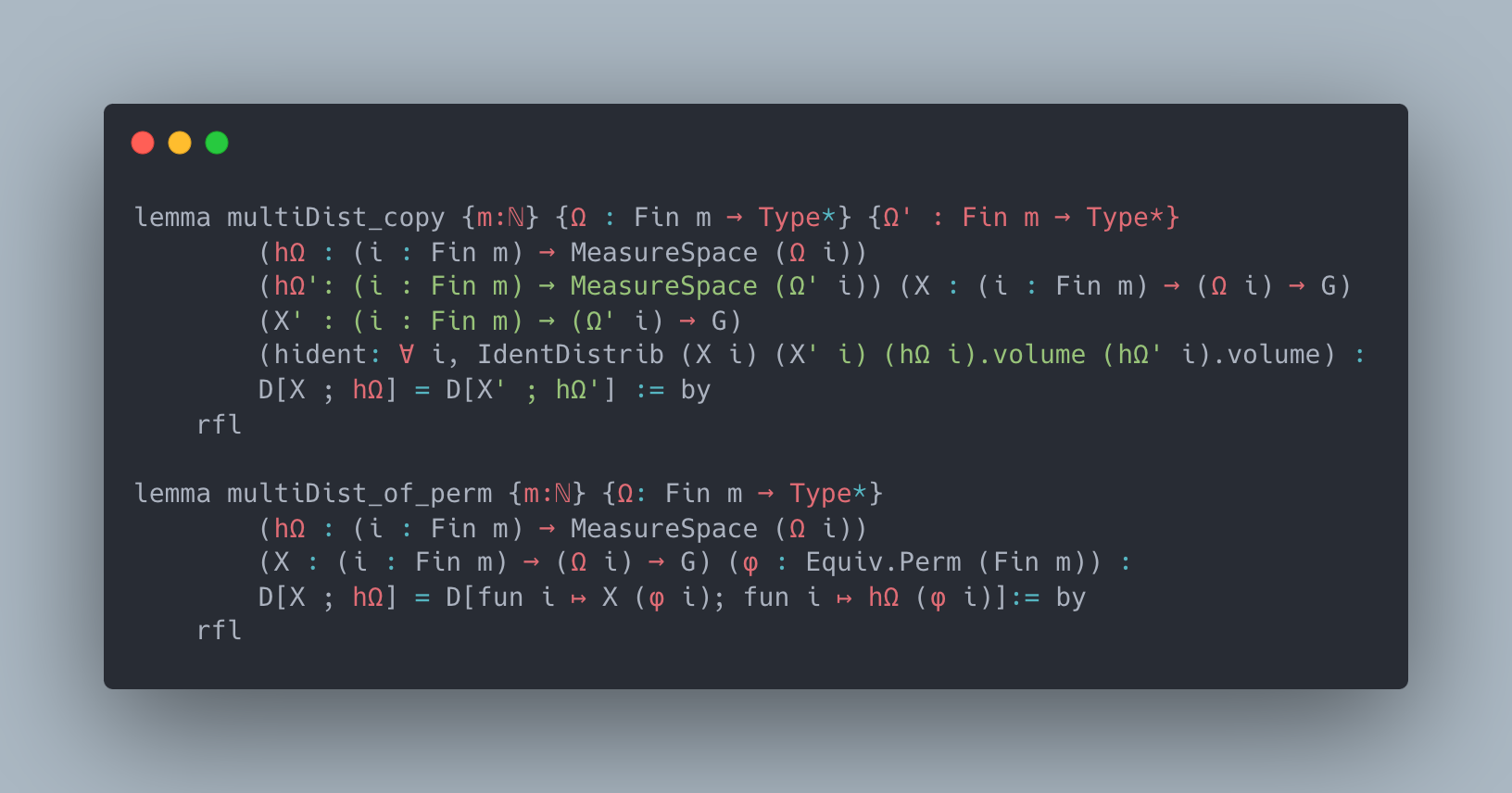
The image displays a code block containing two lemma definitions written in a formal language, likely a proof assistant like Coq or Lean. The code defines mathematical concepts related to measure spaces and distributions. The code is presented in a monospaced font on a dark background.
### Components/Axes
There are no axes or charts in this image. The components are purely textual. The code consists of:
* Lemma names: `multiDist_copy` and `multiDist_of_perm`
* Variable declarations with type annotations (e.g., `{m:ℕ}`, `(i : Fin m)`)
* Hypotheses (e.g., `hΩ`, `hΩ'`)
* Goal statements (e.g., `D[X ; hΩ] = D[X' ; hΩ']`)
* Tactics (e.g., `rfl`)
* Mathematical symbols (e.g., `∀`, `∈`, `MeasureSpace`, `IdentDistrib`, `volume`)
There are three colored dots at the top-left of the image: red, orange, and green. These do not appear to be related to the code itself.
### Detailed Analysis or Content Details
**Lemma `multiDist_copy`:**
```
lemma multiDist_copy {m:ℕ} {Ω : Fin m → Type} {Ω' : Fin m → Type}
(hΩ : (i : Fin m) → MeasureSpace (Ω i))
(hΩ' : (i : Fin m) → MeasureSpace (Ω' i))
(X : (i : Fin m) → (Ω i) → G)
(X' : (i : Fin m) → (Ω' i) → G)
(hident: ∀ i, IdentDistrib (X i) (X' i) (hΩ i).volume (hΩ' i).volume) :
D[X ; hΩ] = D[X' ; hΩ'] := by
rfl
```
* `{m:ℕ}`: A set of natural numbers.
* `{Ω : Fin m → Type}`: A function mapping elements of `Fin m` to types.
* `{Ω' : Fin m → Type}`: A function mapping elements of `Fin m` to types.
* `hΩ : (i : Fin m) → MeasureSpace (Ω i)`: A hypothesis stating that for each `i` in `Fin m`, `Ω i` is a measure space.
* `hΩ' : (i : Fin m) → MeasureSpace (Ω' i)`: A hypothesis stating that for each `i` in `Fin m`, `Ω' i` is a measure space.
* `X : (i : Fin m) → (Ω i) → G`: A function mapping each `i` in `Fin m` and an element of `Ω i` to an element of type `G`.
* `X' : (i : Fin m) → (Ω' i) → G`: A function mapping each `i` in `Fin m` and an element of `Ω' i` to an element of type `G`.
* `hident: ∀ i, IdentDistrib (X i) (X' i) (hΩ i).volume (hΩ' i).volume`: A hypothesis stating that for all `i`, `X i` and `X' i` are identically distributed with respect to the volumes of `hΩ i` and `hΩ' i`.
* `D[X ; hΩ] = D[X' ; hΩ']`: The goal statement, asserting that the distribution of `X` with respect to `hΩ` is equal to the distribution of `X'` with respect to `hΩ'`.
* `rfl`: A tactic indicating that the goal is proven by reflexivity (i.e., the two sides are syntactically equal).
**Lemma `multiDist_of_perm`:**
```
lemma multiDist_of_perm {m:ℕ} {Ω : Fin m → Type}
(hΩ : (i : Fin m) → MeasureSpace (Ω i))
(X : (i : Fin m) → (Ω i) → G) (φ : Equiv.Perm (Fin m)) :
D[X ; hΩ] = D[fun i → X (φ i); fun i → hΩ (φ i)] := by
rfl
```
* `{m:ℕ}`: A set of natural numbers.
* `{Ω : Fin m → Type}`: A function mapping elements of `Fin m` to types.
* `hΩ : (i : Fin m) → MeasureSpace (Ω i)`: A hypothesis stating that for each `i` in `Fin m`, `Ω i` is a measure space.
* `X : (i : Fin m) → (Ω i) → G`: A function mapping each `i` in `Fin m` and an element of `Ω i` to an element of type `G`.
* `φ : Equiv.Perm (Fin m)`: A permutation of the indices `Fin m`.
* `D[X ; hΩ] = D[fun i → X (φ i); fun i → hΩ (φ i)]`: The goal statement, asserting that the distribution of `X` with respect to `hΩ` is equal to the distribution of `X` composed with `φ` with respect to `hΩ` composed with `φ`.
* `rfl`: A tactic indicating that the goal is proven by reflexivity.
### Key Observations
The code defines lemmas related to the preservation of distributions under certain transformations. `multiDist_copy` deals with changing the underlying measure spaces while maintaining identical distributions, and `multiDist_of_perm` deals with permuting the indices. The use of the `rfl` tactic suggests that these lemmas are based on definitional equality.
### Interpretation
These lemmas are likely part of a larger theory of probability and measure theory within a formal proof system. They establish fundamental properties of distributions, allowing for reasoning about their behavior under changes in measure spaces or index permutations. The `IdentDistrib` predicate in `multiDist_copy` is crucial, ensuring that the distributions are truly equivalent before asserting equality. The `Equiv.Perm` type in `multiDist_of_perm` indicates that the permutation is an equivalence, preserving the structure of the underlying space. These lemmas are building blocks for more complex proofs involving distributions and measure spaces. The code is highly abstract and requires a strong background in mathematical logic and measure theory to fully understand.