## Chart Type: Line Chart - Proportion of Flips by Iteration for Qwen2.5-14B
### Overview
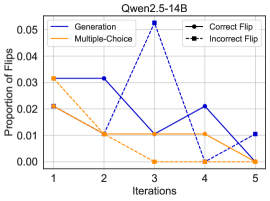
This image displays a line chart titled "Qwen2.5-14B" which illustrates the "Proportion of Flips" across five "Iterations" for four different metrics: "Generation", "Multiple-Choice", "Correct Flip", and "Incorrect Flip". The chart uses distinct colors, line styles, and markers to differentiate between the four data series.
### Components/Axes
The chart is a 2D line plot with the following components:
* **Title**: Located at the top-center of the chart, the title is "Qwen2.5-14B".
* **X-axis**:
* **Label**: "Iterations", positioned horizontally below the axis.
* **Range**: From 1 to 5.
* **Markers**: Integer values 1, 2, 3, 4, 5 are marked and labeled.
* **Y-axis**:
* **Label**: "Proportion of Flips", positioned vertically along the left side of the axis.
* **Range**: From 0.00 to 0.05.
* **Markers**: Labeled at 0.00, 0.01, 0.02, 0.03, 0.04, 0.05.
* **Legend**: Located in the top-left corner of the plot area. It defines the four data series:
* **Generation**: Represented by a solid blue line with square markers.
* **Multiple-Choice**: Represented by a solid orange line with circular markers.
* **Correct Flip**: Represented by a dashed blue line with circular markers.
* **Incorrect Flip**: Represented by a dashed orange line with square markers.
### Detailed Analysis
The chart tracks the "Proportion of Flips" for four distinct categories over five iterations.
1. **Generation (Solid Blue Line, Square Markers)**:
* **Trend**: Starts high, dips significantly, rises, then dips again.
* **Data Points**:
* Iteration 1: Approximately 0.032
* Iteration 2: Approximately 0.031
* Iteration 3: Approximately 0.010
* Iteration 4: Approximately 0.021
* Iteration 5: Approximately 0.010
2. **Multiple-Choice (Solid Orange Line, Circular Markers)**:
* **Trend**: Starts at a moderate level, dips, remains relatively flat, then drops to zero.
* **Data Points**:
* Iteration 1: Approximately 0.021
* Iteration 2: Approximately 0.010
* Iteration 3: Approximately 0.010
* Iteration 4: Approximately 0.010
* Iteration 5: Approximately 0.000
3. **Correct Flip (Dashed Blue Line, Circular Markers)**:
* **Trend**: Starts high, dips, then shows a sharp peak before dropping to zero.
* **Data Points**:
* Iteration 1: Approximately 0.031
* Iteration 2: Approximately 0.010
* Iteration 3: Approximately 0.053 (Peak value)
* Iteration 4: Approximately 0.000
* Iteration 5: Approximately 0.000
4. **Incorrect Flip (Dashed Orange Line, Square Markers)**:
* **Trend**: Starts at a moderate level, dips, remains at zero for two iterations, then rises.
* **Data Points**:
* Iteration 1: Approximately 0.021
* Iteration 2: Approximately 0.010
* Iteration 3: Approximately 0.000
* Iteration 4: Approximately 0.000
* Iteration 5: Approximately 0.010
### Key Observations
* The "Correct Flip" metric exhibits the highest proportion of flips, peaking at approximately 0.053 in Iteration 3, significantly higher than any other metric at any point.
* Both "Correct Flip" and "Incorrect Flip" drop to zero at Iteration 4, though "Incorrect Flip" recovers to 0.010 in Iteration 5, while "Correct Flip" remains at zero.
* "Multiple-Choice" proportion of flips consistently decreases or remains flat after Iteration 1, reaching zero by Iteration 5.
* "Generation" shows more fluctuation than "Multiple-Choice", with a notable dip at Iteration 3 and a slight recovery at Iteration 4.
* At Iteration 2, all four metrics converge to a similar proportion of flips, around 0.010 to 0.011.
* At Iteration 3, there's a stark divergence: "Correct Flip" peaks, "Generation" and "Multiple-Choice" are low and equal, and "Incorrect Flip" drops to zero.
### Interpretation
The chart provides insights into the behavior of the "Qwen2.5-14B" model across different iterations, likely representing stages of training, fine-tuning, or evaluation. The "Proportion of Flips" could refer to instances where the model's output changes from a correct to incorrect answer, or vice-versa, or a change in prediction confidence/category.
The dramatic peak in "Correct Flip" at Iteration 3 suggests a phase where the model underwent a significant number of changes that resulted in correct outcomes. This could indicate a critical learning or refinement step. However, this is immediately followed by "Correct Flip" dropping to zero, implying that after this peak, the model either stabilized its correct predictions or stopped making "flips" that resulted in correct answers.
Conversely, "Incorrect Flip" drops to zero at Iteration 3 and 4, which is positive, suggesting the model is not making changes that lead to incorrect answers during these iterations. The slight rise in "Incorrect Flip" at Iteration 5, while "Correct Flip" remains at zero, could be a concerning sign of potential degradation or new errors emerging in the final iteration.
The "Generation" and "Multiple-Choice" lines, which likely represent overall performance or different task types, show more stable but generally decreasing or fluctuating trends. The "Multiple-Choice" task appears to stabilize at a low flip rate and eventually reaches zero, suggesting the model becomes very consistent (or consistently wrong without flipping) on this task. The "Generation" task shows more variability, indicating ongoing adjustments or less stable performance compared to "Multiple-Choice".
Overall, the data suggests a dynamic process where the model's behavior regarding "flips" changes significantly across iterations, with a particularly impactful event occurring around Iteration 3 for "Correct Flip" and a potential shift in error patterns at Iteration 5. The interplay between "Correct Flip" and "Incorrect Flip" is crucial for understanding the model's learning trajectory and stability.