## Diagram: Robotic Policy Learning with World Model and VLM Reward
### Overview
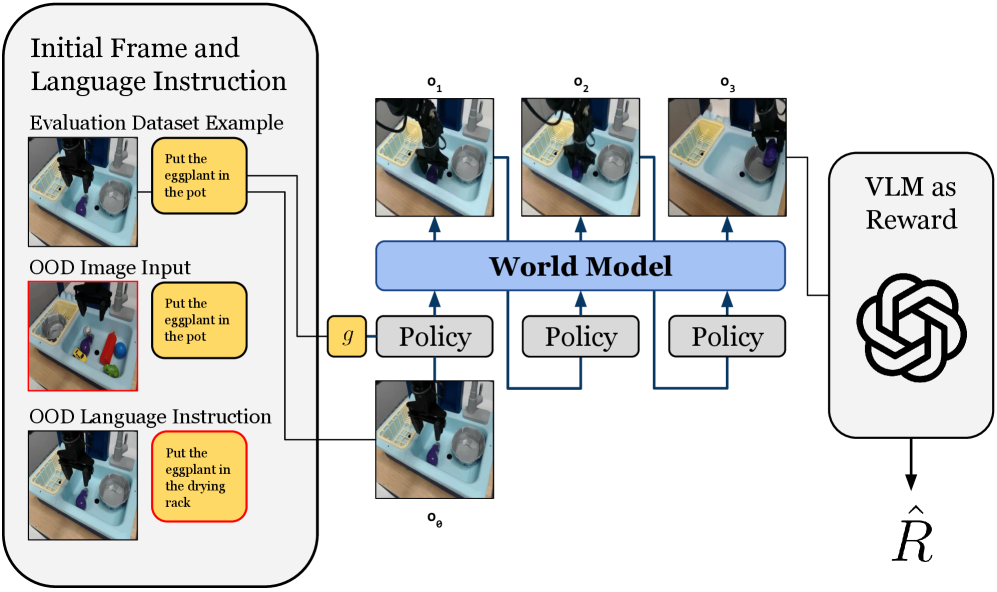
This diagram illustrates a system for robotic policy learning, likely in the context of instruction following and out-of-distribution (OOD) generalization. It depicts how an initial frame and language instruction are processed, fed into a policy and world model to generate a sequence of observations, and then evaluated by a Vision-Language Model (VLM) to derive a reward. The diagram highlights different types of input examples, including standard evaluation examples and OOD scenarios for both image and language inputs.
### Components/Axes
The diagram is structured into three main conceptual regions:
1. **Left Region: Input and Instruction Processing** (enclosed in a large rounded rectangle)
* **Title:** "Initial Frame and Language Instruction"
* **Sub-section 1: "Evaluation Dataset Example"**
* **Image:** A robotic arm positioned over a light blue tray. The tray contains a silver pot, a yellow drying rack, and a small purple object. The robotic arm's gripper is open, positioned above the purple object.
* **Text Box (yellow, right of image):** "Put the eggplant in the pot"
* **Connection:** An arrow points from this text box to a horizontal line that leads to the `g` component in the central region.
* **Sub-section 2: "OOD Image Input"**
* **Image (with red border):** A robotic arm positioned over a light blue tray. The tray contains a silver pot, a yellow drying rack, a small purple object, a red cylindrical object, a yellow toy car, and a green cylindrical object. The robotic arm's gripper is open, positioned above the purple object. This image contains more objects than the "Evaluation Dataset Example."
* **Text Box (yellow, with red border, right of image):** "Put the eggplant in the pot"
* **Connection:** An arrow points from this text box to the same horizontal line that leads to the `g` component.
* **Sub-section 3: "OOD Language Instruction"**
* **Image:** A robotic arm positioned over a light blue tray. The tray contains a silver pot, a yellow drying rack, and a small purple object. The robotic arm's gripper is open, positioned above the purple object. This image is visually identical to the "Evaluation Dataset Example" image.
* **Text Box (yellow, with red border, right of image):** "Put the eggplant in the drying rack"
* **Connection:** An arrow points from this text box to the same horizontal line that leads to the `g` component.
2. **Central Region: World Model and Policy Execution**
* **Component `g` (yellow square):** Located centrally, receiving input from the language instructions on the left.
* **Component "Policy" (three grey rounded rectangles):** Arranged horizontally below the "World Model."
* The first "Policy" receives input from `g` and from `o_0`.
* Subsequent "Policy" components receive input from the preceding "Policy" component.
* **Component "World Model" (blue rounded rectangle):** Located centrally above the "Policy" components.
* Receives input from each "Policy" component.
* **Observation Images:**
* **`o_0` (bottom-left of central region):** An image of a robotic arm over a light blue tray, containing a silver pot, a yellow drying rack, and a small purple object. The robotic arm's gripper is closed, holding the purple object, which is positioned above the pot. This image represents an initial state or observation.
* **`o_1` (top-left of central region):** An image of a robotic arm over a light blue tray, containing a silver pot, a yellow drying rack, and a small purple object. The robotic arm's gripper is open, and the purple object is now inside the silver pot. This represents a subsequent observation.
* **`o_2` (top-middle of central region):** An image identical to `o_1`.
* **`o_3` (top-right of central region):** An image of a robotic arm over a light blue tray, containing a silver pot, a yellow drying rack, and a small purple object. The robotic arm's gripper is open, and the purple object is inside the silver pot. This image is also identical to `o_1` and `o_2`.
* **Flow (Arrows):**
* An arrow from `g` points to the first "Policy."
* An arrow from `o_0` points to the first "Policy."
* An arrow from the first "Policy" points to the "World Model."
* An arrow from the "World Model" points to `o_1`.
* An arrow from the first "Policy" points to the second "Policy."
* An arrow from the second "Policy" points to the "World Model."
* An arrow from the "World Model" points to `o_2`.
* An arrow from the second "Policy" points to the third "Policy."
* An arrow from the third "Policy" points to the "World Model."
* An arrow from the "World Model" points to `o_3`.
* A horizontal line connects `o_1`, `o_2`, and `o_3` to the "VLM as Reward" component on the right.
3. **Right Region: Reward Calculation**
* **Component "VLM as Reward" (large rounded rectangle):**
* **Text:** "VLM as Reward"
* **Logo:** A complex, multi-loop knot-like symbol, resembling the OpenAI logo.
* **Connection:** Receives input from the sequence of observations (`o_1`, `o_2`, `o_3`).
* **Output `R̂`:** An arrow points downwards from "VLM as Reward" to the symbol `R̂` (R-hat), representing the estimated reward.
### Detailed Analysis
The diagram illustrates a closed-loop system for robotic task execution and evaluation.
The **Left Region** serves as the input interface, providing an initial visual state (frame) and a natural language instruction. Three distinct input scenarios are presented:
1. **Evaluation Dataset Example:** A standard task where the instruction "Put the eggplant in the pot" is given, and the initial image shows a setup with a pot, drying rack, and a purple object (implied to be the "eggplant").
2. **OOD Image Input:** This scenario tests the system's robustness to visual variations. The instruction "Put the eggplant in the pot" remains the same, but the initial image contains additional, distracting objects (red cylinder, yellow car, green cylinder) not present in the standard evaluation setup. The red border around the image and text box explicitly marks this as "Out-of-Distribution."
3. **OOD Language Instruction:** This scenario tests the system's ability to handle novel instructions. The initial image is identical to the standard evaluation example, but the instruction is changed to "Put the eggplant in the drying rack." The red border around the text box highlights this OOD language.
The **Central Region** models the robot's interaction with the environment.
* The `g` component represents the goal or instruction derived from the language input.
* `o_0` is the initial observation, showing the robot holding the purple object above the pot.
* The "Policy" components represent the robot's decision-making process, taking the current observation (`o_0` for the first policy, or the previous policy's state for subsequent policies) and the goal (`g`) to determine an action.
* The "World Model" predicts the next observation (`o_1`, `o_2`, `o_3`) based on the action taken by the "Policy." This forms a sequential rollout or simulation of the robot's actions and their environmental consequences.
* The images `o_1`, `o_2`, `o_3` all depict the purple object successfully placed inside the silver pot, suggesting that the policy, in this simulated sequence, successfully executed the instruction "Put the eggplant in the pot."
The **Right Region** is responsible for evaluating the success of the executed task.
* The "VLM as Reward" component takes the sequence of observations (`o_1`, `o_2`, `o_3`) as input. A VLM (Vision-Language Model) is used to assess how well the observed sequence of states aligns with the given language instruction.
* The output `R̂` is the estimated reward, indicating the VLM's judgment of task completion and correctness.
### Key Observations
* The diagram clearly distinguishes between standard evaluation inputs and "Out-of-Distribution" (OOD) inputs, indicated by red borders, for both image content and language instructions. This suggests a focus on generalization capabilities.
* The `g` component acts as a central point for language instruction input, feeding into the policy.
* The "Policy" and "World Model" operate in a loop, generating a sequence of predicted observations (`o_1`, `o_2`, `o_3`) from an initial state (`o_0`). This represents a planning or simulation phase.
* The VLM is explicitly used as a reward function, implying that task success is evaluated by a model capable of understanding both visual states and natural language goals.
* The images `o_1`, `o_2`, `o_3` are identical, suggesting that the "World Model" predicts a stable final state after the initial action, or that these are snapshots of the same successful outcome.
### Interpretation
This diagram outlines a robust framework for training and evaluating robotic agents, particularly in tasks requiring language understanding and visual perception. The core idea is to use a "World Model" to simulate future states based on a "Policy's" actions, guided by a language instruction (`g`). This simulation allows for planning or generating potential outcomes without real-world interaction.
The "VLM as Reward" component is critical. Instead of relying on hand-engineered reward functions, a powerful Vision-Language Model is leveraged to provide a semantic understanding of task completion. This means the VLM can assess if the observed sequence of actions and states (e.g., `o_1`, `o_2`, `o_3`) successfully fulfills the given instruction (e.g., "Put the eggplant in the pot"). This approach allows for more flexible and human-like evaluation of complex tasks.
The inclusion of "OOD Image Input" and "OOD Language Instruction" examples highlights the system's aim to generalize beyond its training data. The system is designed to handle situations where the visual environment is cluttered or different from what it has seen before, or where the instructions are phrased in novel ways. The red borders emphasize these challenging scenarios, suggesting that the system's performance on these OOD examples is a key metric for its effectiveness.
In essence, the system takes a goal, simulates a sequence of actions and observations, and then uses a VLM to determine how well the simulated outcome achieves the goal, providing a reward signal (`R̂`) that can be used to train or refine the "Policy" and "World Model." This architecture is characteristic of modern reinforcement learning approaches that integrate large pre-trained models for better generalization and semantic understanding.