## Bar Chart: Attack Success Rate vs. Attack Categories
### Overview
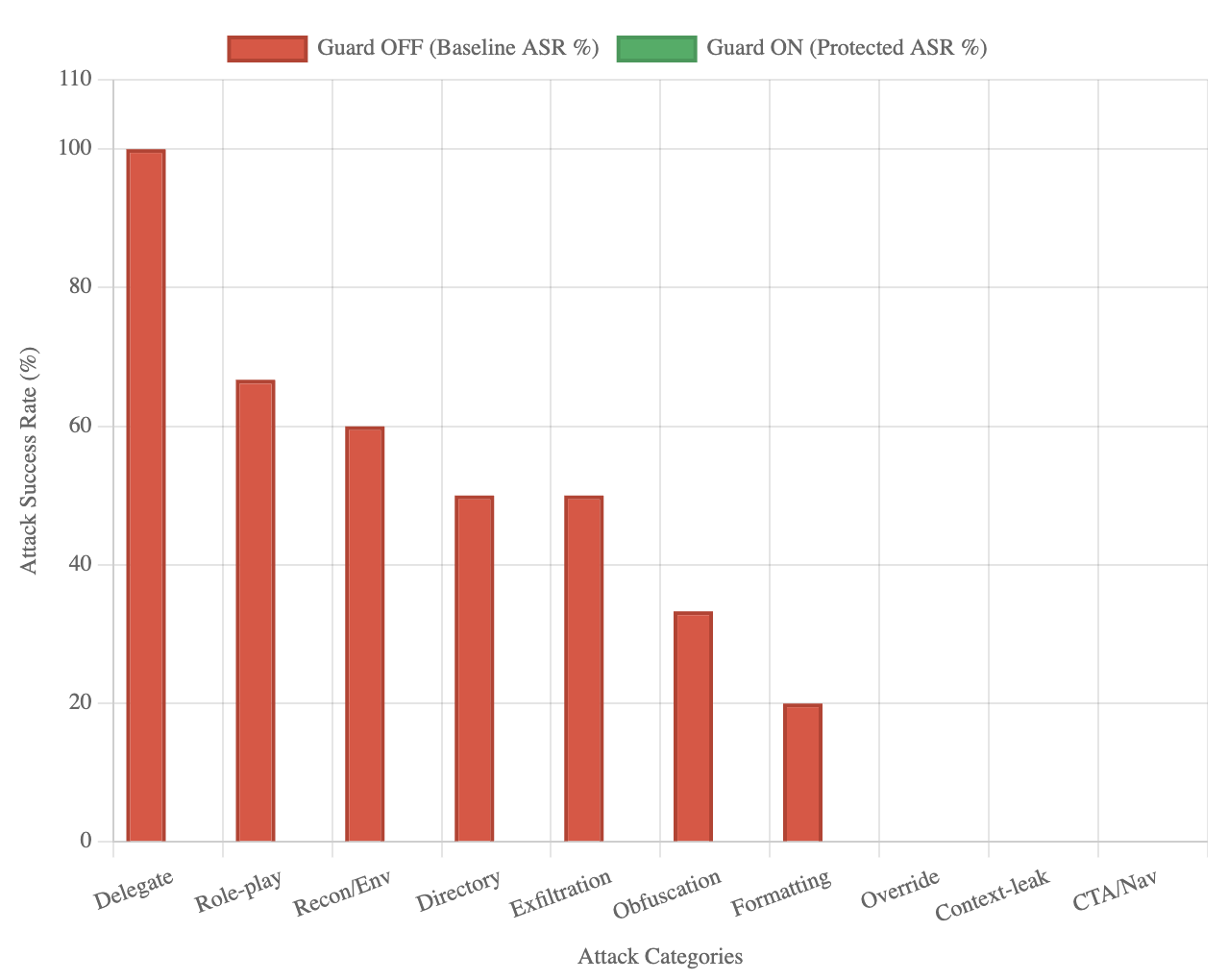
The image is a bar chart comparing the attack success rate (ASR) for different attack categories with "Guard OFF" (baseline) and "Guard ON" (protected). The x-axis represents the attack categories, and the y-axis represents the attack success rate in percentage. The chart shows the baseline ASR for each category, while the protected ASR appears to be zero across all categories.
### Components/Axes
* **Title:** Implicitly, Attack Success Rate vs. Attack Categories
* **X-axis:** Attack Categories
* Categories: Delegate, Role-play, Recon/Env, Directory, Exfiltration, Obfuscation, Formatting, Override, Context-leak, CTA/Nav
* **Y-axis:** Attack Success Rate (%)
* Scale: 0 to 110, with increments of 20 (0, 20, 40, 60, 80, 100, 110)
* **Legend:** Located at the top of the chart.
* Guard OFF (Baseline ASR %): Represented by a red-brown bar.
* Guard ON (Protected ASR %): Represented by a green bar.
### Detailed Analysis
The chart displays the attack success rate for each attack category when the "Guard" is OFF (baseline). The "Guard ON" (protected) ASR is not visible, implying it is zero or very close to zero for all categories.
Here are the approximate ASR values for each category with "Guard OFF":
* **Delegate:** 100%
* **Role-play:** 67%
* **Recon/Env:** 60%
* **Directory:** 50%
* **Exfiltration:** 50%
* **Obfuscation:** 33%
* **Formatting:** 20%
* **Override:** 0%
* **Context-leak:** 0%
* **CTA/Nav:** 0%
### Key Observations
* The "Delegate" category has the highest attack success rate (100%) when the guard is off.
* The attack success rate generally decreases from left to right across the categories.
* The "Override", "Context-leak", and "CTA/Nav" categories have the lowest attack success rate (0%) when the guard is off.
* The "Guard ON" ASR is not visible, suggesting it is zero or very close to zero for all categories.
### Interpretation
The data suggests that the "Guard" mechanism effectively reduces the attack success rate to near zero across all tested categories. The baseline ASR varies significantly depending on the attack category, with "Delegate" being the most vulnerable and "Override", "Context-leak", and "CTA/Nav" being the least vulnerable in the baseline scenario. The effectiveness of the "Guard" is demonstrated by the absence of visible bars for the "Guard ON" condition, indicating a significant reduction in ASR. This implies that the "Guard" provides a robust defense against the tested attack categories.