\n
## Educational Material: Music Theory Problem & Solution
### Overview
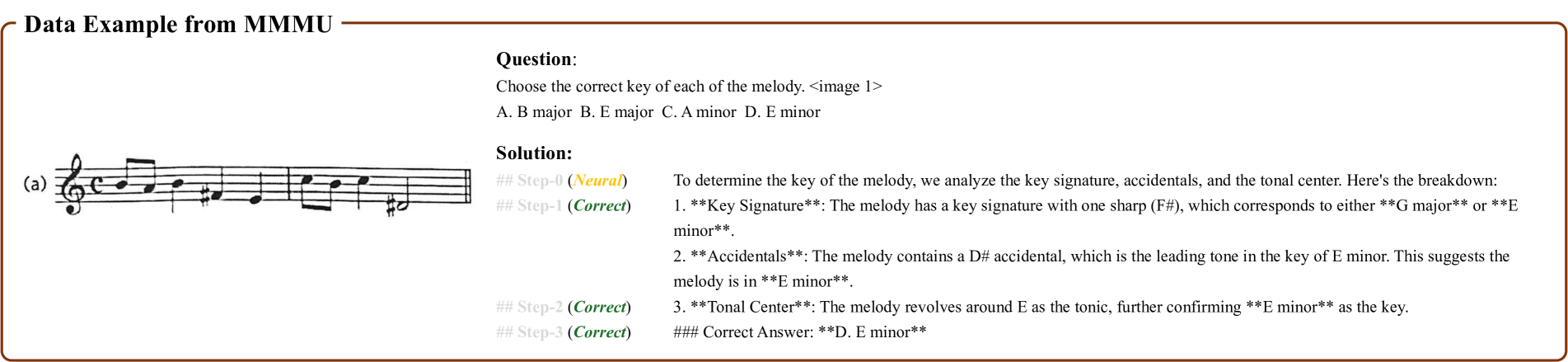
The image presents a music theory problem and its step-by-step solution. It includes a musical staff with notes, a multiple-choice question asking for the key of the melody, and a detailed solution explaining the reasoning.
### Components/Axes
The image is structured into three main sections:
1. **Musical Notation:** A staff with notes representing a melody.
2. **Question:** A multiple-choice question with four options: A. B major, B. E major, C. A minor, D. E minor.
3. **Solution:** A breakdown of the solution into steps, labeled as Step-0, Step-1, Step-2, and Step-3. Each step is further categorized as either "Neural" or "Correct".
### Content Details
**Musical Notation:**
The musical staff displays a melody with a key signature of one sharp (F#). The notes appear to be primarily within the range of a fifth, centered around E.
**Question:**
"Choose the correct key of each of the melody. <Image 1>"
Options:
A. B major
B. E major
C. A minor
D. E minor
**Solution:**
* **Step-0 (Neural):** "To determine the key of the melody, we analyze the key signature, accidentals, and the tonal center. Here's the breakdown:"
* **Step-1 (Correct):** "**Key Signature**": The melody has a key signature with one sharp (F#), which corresponds to either "**G major**" or "**E minor**".
* **Step-2 (Correct):** "**Accidentals**": The melody contains a D# accidental, which is the leading tone in the key of E minor. This suggests the melody is in "**E minor**".
* **Step-3 (Correct):** "**Tonal Center**": The melody revolves around E as the tonic, further confirming "**E minor**" as the key.
* **Correct Answer:** "**D. E minor**"
### Key Observations
The solution methodically breaks down the process of key identification. It starts with the key signature, then considers accidentals, and finally confirms the tonal center. The presence of the D# accidental is crucial in determining the key as E minor rather than G major.
### Interpretation
This material is designed to teach students how to determine the key of a melody. It emphasizes a systematic approach, starting with the key signature and then refining the possibilities based on accidentals and tonal center. The use of "Neural" and "Correct" labels suggests a learning process where the student might initially attempt to solve the problem intuitively ("Neural") before being guided to the correct solution. The step-by-step explanation provides a clear and logical pathway to understanding the underlying principles of music theory. The image demonstrates a pedagogical approach to music theory, focusing on analytical skills and problem-solving. The inclusion of the musical notation allows for direct application of the concepts being taught.