## Musical Notation Analysis: Key Identification
### Overview
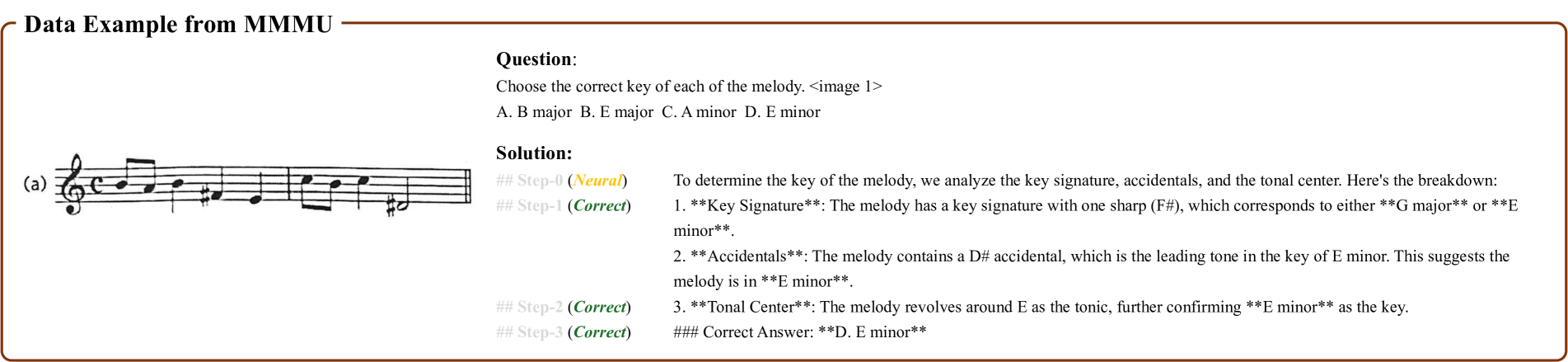
The image presents a musical staff with a melody labeled (a), accompanied by a multiple-choice question asking to identify the key of the melody. The solution provides a step-by-step analysis of the key signature, accidentals, and tonal center to determine the correct answer.
### Components/Axes
- **Musical Staff**:
- Contains a treble clef and a key signature with **one sharp** (F#).
- Notes include a **D# accidental**.
- **Question Text**:
- "Choose the correct key of each of the melody."
- Options:
- A. B major
- B. E major
- C. A minor
- D. E minor
- **Solution Steps**:
1. **Key Signature**: One sharp (F#) → corresponds to **G major** or **E minor**.
2. **Accidentals**: Presence of **D#** (leading tone in E minor).
3. **Tonal Center**: Melody revolves around **E** as the tonic.
4. **Final Answer**: **D. E minor**.
### Detailed Analysis
- **Key Signature**:
- One sharp (F#) eliminates B major (which has two sharps) and E major (three sharps).
- Remaining candidates: G major or E minor.
- **Accidentals**:
- D# is the leading tone in E minor (scale degree 7).
- This accidental strongly suggests the key is **E minor**.
- **Tonal Center**:
- The melody emphasizes E as the tonic, resolving to E minor.
### Key Observations
- The combination of **F#** in the key signature and **D#** as an accidental confirms **E minor** as the key.
- No other options (B major, E major, A minor) align with the key signature and accidental usage.
### Interpretation
The analysis demonstrates how key signatures, accidentals, and tonal center collectively determine a melody’s key. The presence of F# (key signature) and D# (leading tone) eliminates major keys and non-E minor candidates. The tonal focus on E solidifies **E minor** as the correct answer. This reflects foundational music theory principles, where key signatures and accidentals work in tandem to establish harmonic identity.
# Correct Answer: **D. E minor**