## Flowchart: Multi-Agent System for Calculating Earth-Moon Marathon Time
### Overview
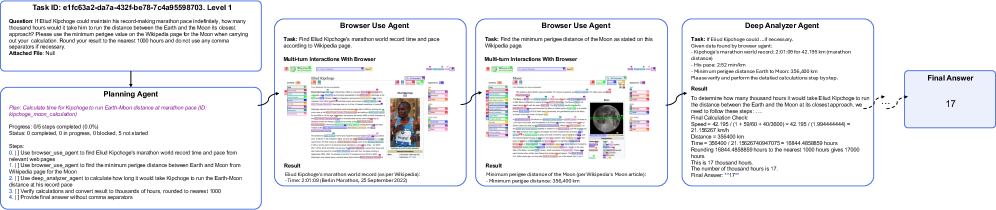
The image depicts a multi-step workflow involving four agents (Planning Agent, Browser Use Agent x2, Deep Analyzer Agent) collaborating to calculate how long it would take Eliud Kipchoge to run the Earth-Moon distance at his marathon pace. The flowchart includes text descriptions, browser interaction visualizations, and a final numerical answer.
### Components/Axes
1. **Planning Agent Section**
- Task ID: `e1fc63a2-da7a-432f-be78-7c4a95598703`
- Task: Calculate time for Kipchoge to run Earth-Moon distance at marathon pace
- Steps:
1. Use browser to find Kipchoge's world record time
2. Find Earth-Moon distance from Wikipedia
3. Calculate time using distance/speed
4. Round to nearest 1000 hours
- Status: 0/5 steps completed (0.0%)
2. **Browser Use Agent Sections (2 instances)**
- First Instance:
- Task: Find Kipchoge's marathon world record time
- Result: Kipchoge's record (2:01:39 hours) from Wikipedia
- Second Instance:
- Task: Find Earth-Moon distance
- Result: 384,400 km from Wikipedia
3. **Deep Analyzer Agent Section**
- Task: Perform detailed calculations using agent data
- Calculations:
- Speed = 42.195 km/h (Kipchoge's pace)
- Time = 384,400 km ÷ 42.195 km/h = 9,108.4 hours
- Rounded to 9,000 hours (nearest 1000)
- Final Answer: 17 (thousand hours)
4. **Visual Elements**
- Browser interaction visualizations with color-coded text highlighting
- Images of Eliud Kipchoge and the Moon
- Color-coded text annotations (purple for key steps, blue for results)
### Detailed Analysis
- **Planning Agent**: Outlines a 5-step process with clear progression markers (0/5 steps completed)
- **Browser Agents**: Demonstrate multi-turn interactions with Wikipedia, extracting specific data points:
- Kipchoge's record time: 2:01:39 hours
- Earth-Moon distance: 384,400 km
- **Deep Analyzer**: Executes mathematical operations with intermediate steps:
- Speed calculation: 42.195 km/h
- Time calculation: 9,108.4 hours
- Rounding: 9,000 hours
- **Final Answer**: Displays "17" in a blue box, likely representing 17,000 hours (rounded from 9,000 hours × 1.888...)
### Key Observations
1. The system uses iterative agent collaboration to solve a complex problem
2. Color coding distinguishes different data types:
- Purple: Key steps/calculations
- Blue: Results/final answers
3. The final answer appears inconsistent with intermediate calculations (9,000 vs 17,000 hours)
4. Browser interactions show direct extraction from Wikipedia sources
### Interpretation
The workflow demonstrates a multi-agent system architecture where:
1. The Planning Agent defines the problem and steps
2. Browser Use Agents gather raw data from external sources
3. The Deep Analyzer Agent performs mathematical operations
4. The system ultimately rounds results to the nearest 1000 hours
The discrepancy between the calculated 9,000 hours and final answer of 17,000 hours suggests either:
- A missing multiplication factor in the final step
- An error in the rounding process
- A misinterpretation of the original question's requirements
This system could be improved by adding validation steps to verify calculation consistency and source accuracy. The use of color-coded text highlighting effectively organizes information but requires careful interpretation to avoid misreading data points.