## Diagram: LOC PRUNING Process
### Overview
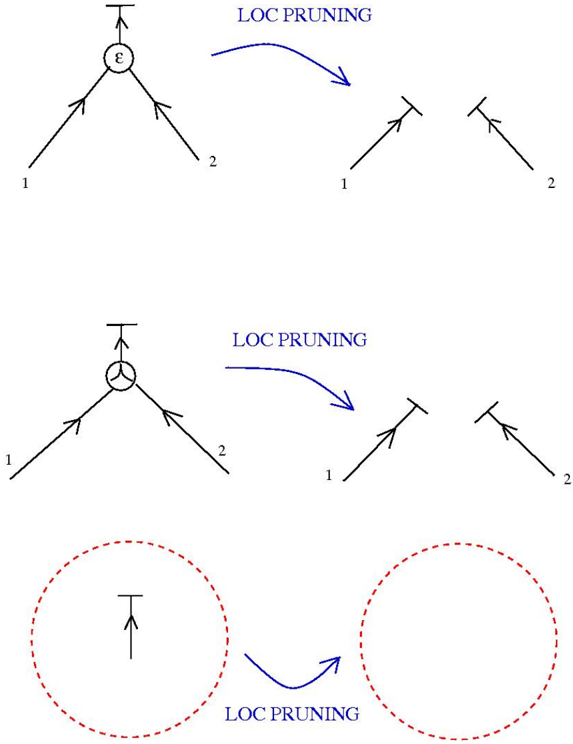
The image depicts a two-stage process labeled "LOC PRUNING" involving hierarchical structures. It shows a transformation from complex branching systems to simplified configurations through iterative pruning operations. The diagram uses directional arrows, labeled components, and geometric shapes to represent the workflow.
### Components/Axes
1. **Upper Section**:
- **Left Diagram**:
- Central circle labeled "ε" (epsilon)
- Two downward arrows labeled "1" and "2"
- Vertical line with bidirectional arrow (top-down)
- **Right Diagram**:
- Two isolated vertical lines labeled "1" and "2"
- No central connecting node
- **Connecting Element**: Blue curved arrow labeled "LOC PRUNING" between left and right diagrams
2. **Lower Section**:
- Two red dashed circles connected by a blue curved arrow labeled "LOC PRUNING"
- Each circle contains:
- Vertical line with unidirectional arrow (top-down)
- No branching elements
### Detailed Analysis
- **Upper Left Diagram**: Represents an initial hierarchical structure with a central node (ε) distributing outputs to two branches (1 and 2). The bidirectional arrow suggests potential feedback or bidirectional relationships.
- **Upper Right Diagram**: Shows the result of pruning, where the central node is removed, leaving only the two branches (1 and 2) as independent entities.
- **Lower Section**: Illustrates a further simplification stage where the pruned branches are encapsulated in isolated circular structures with unidirectional flow, suggesting finalized or stabilized states.
### Key Observations
1. **Pruning Mechanism**: The blue "LOC PRUNING" arrows indicate a systematic removal of intermediate nodes (ε) while preserving terminal branches (1 and 2).
2. **Structural Simplification**: Each pruning step reduces complexity:
- Stage 1: Removes central node (ε)
- Stage 2: Encapsulates branches in isolated structures
3. **Flow Direction**: All arrows point downward, emphasizing a top-down processing or decision-making flow.
### Interpretation
This diagram likely represents a computational or algorithmic process for optimizing hierarchical structures. The "LOC PRUNING" operation appears to:
1. Eliminate redundant decision points (ε)
2. Preserve essential pathways (1 and 2)
3. Stabilize the system through encapsulation (red circles)
The progression from complex branching to isolated components suggests an optimization strategy that balances efficiency (reduced complexity) with functionality (preserved critical paths). The use of bidirectional arrows in the initial stage versus unidirectional arrows in the final stage may indicate a transition from exploratory to deterministic processing.
No numerical data or quantitative metrics are present in the diagram. The focus is entirely on structural relationships and transformation logic rather than measurable values.