## Diagram: Two-Stage Key-Value Retrieval System
### Overview
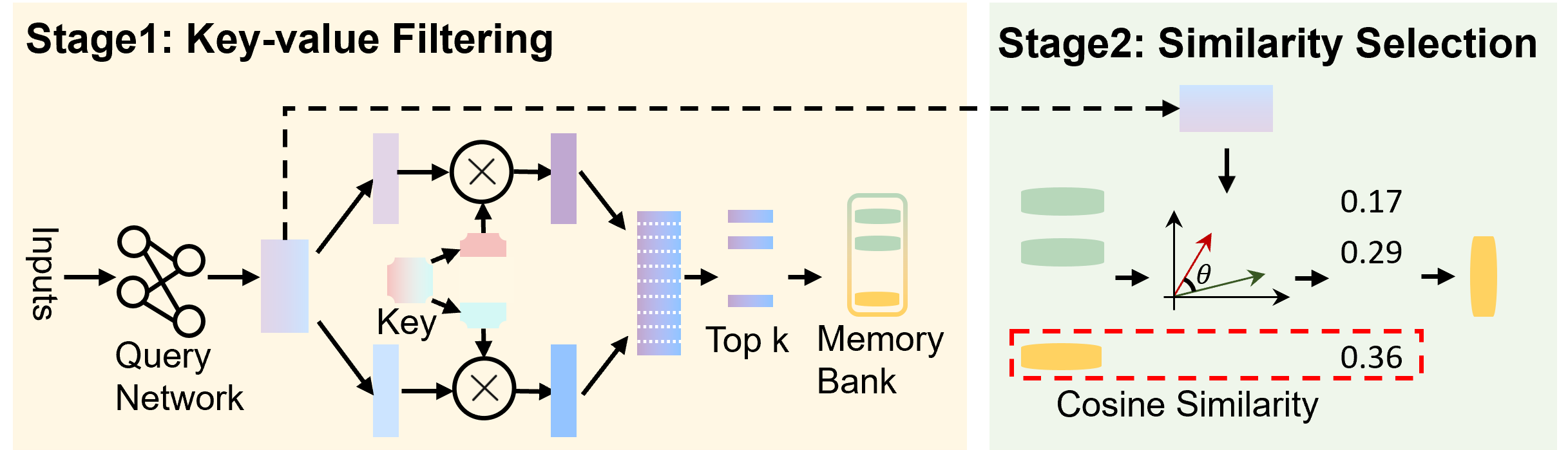
The diagram illustrates a two-stage process for key-value retrieval, combining neural network operations with similarity-based selection. Stage 1 involves key-value filtering through a query network, while Stage 2 uses cosine similarity to select optimal matches from a memory bank.
### Components/Axes
1. **Stage 1: Key-Value Filtering**
- **Inputs**: Feed into a Query Network (represented by interconnected circles)
- **Key**: Generated through XOR operations (⊗ symbols)
- **Memory Bank**: Contains three stored entries (green, blue, yellow bars)
- **Top k**: Selection mechanism for memory bank entries
2. **Stage 2: Similarity Selection**
- **Cosine Similarity**: Calculated between query key and memory entries
- **Similarity Values**: 0.17 (green), 0.29 (blue), 0.36 (yellow)
- **Selection Threshold**: Red dashed box highlights 0.36 as optimal match
### Detailed Analysis
1. **Stage 1 Flow**
- Inputs → Query Network → Key Generation (via XOR operations)
- Key interacts with Memory Bank to retrieve Top k entries
- Memory Bank visualized as three colored bars (green, blue, yellow)
2. **Stage 2 Flow**
- Memory Bank entries compared to query key
- Cosine similarity scores calculated (0.17, 0.29, 0.36)
- Highest similarity (0.36) highlighted with red dashed box
3. **Color Coding**
- Green (0.17) → Low similarity
- Blue (0.29) → Moderate similarity
- Yellow (0.36) → Highest similarity (selected match)
### Key Observations
1. The system prioritizes matches with cosine similarity >0.3 (highlighted threshold)
2. Memory Bank contains three distinct entries with varying similarity scores
3. Query key generation involves non-linear operations (XOR gates)
4. Similarity scores show a clear gradient from lowest to highest match
### Interpretation
This diagram represents a hybrid neural-memory architecture where:
1. **Query Processing**: The Query Network transforms inputs into structured keys through XOR operations, suggesting binary feature extraction
2. **Memory Retrieval**: The Memory Bank stores pre-computed values, with similarity scores indicating match quality
3. **Selection Mechanism**: The red dashed box around 0.36 implies a confidence threshold for valid matches
4. **Efficiency Tradeoff**: Top-k selection balances computational cost with match quality
The architecture appears optimized for scenarios requiring:
- Fast similarity-based retrieval
- Non-linear feature extraction from inputs
- Confidence-based selection of memory matches
The cosine similarity metric (ranging 0-1) provides a standardized measure for comparing query keys against stored memory entries, with the highest value (0.36) representing the most semantically relevant match in this particular example.