\n
## Diagram: Communication Policy Flow
### Overview
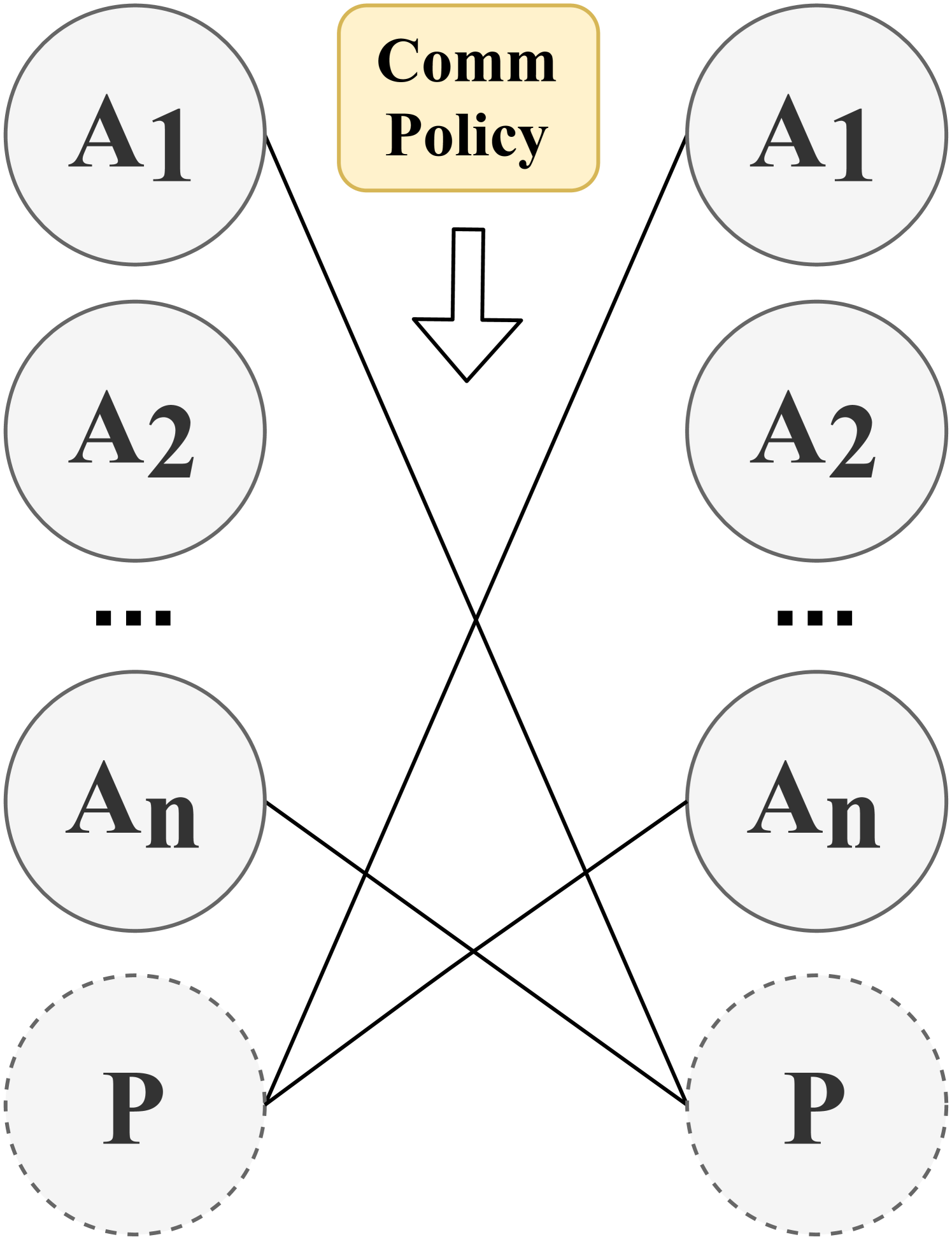
The image is a diagram illustrating a communication policy flow between multiple agents (A1, A2,...An) and a principal (P). The diagram depicts a one-way flow of policy from a central "Comm Policy" block to two sets of agents, and then a connection from each agent to a principal.
### Components/Axes
The diagram consists of the following components:
* **Comm Policy:** A rectangular block at the top-center labeled "Comm Policy".
* **Agents (A1, A2,...An):** Three sets of circular nodes labeled "A1", "A2", and "An" (with ellipses indicating more agents exist). The first set is on the left, the second on the right.
* **Principal (P):** Two circular nodes at the bottom, enclosed in dashed circles, labeled "P".
* **Arrows:** Solid arrows pointing from "Comm Policy" to each agent in both sets. Dashed arrows point from each agent to each "P" node.
### Detailed Analysis or Content Details
The diagram shows a policy distribution scheme.
* The "Comm Policy" block has a downward-pointing arrow indicating a policy is being disseminated.
* The policy is distributed to two identical sets of agents: A1, A2, and An. The ellipsis (...) suggests there are more agents than those explicitly labeled.
* Each agent (A1, A2, An) is connected to both "P" nodes via dashed lines. This suggests each agent communicates with both principals.
* The dashed lines connecting the agents to the principals indicate a communication channel, potentially reporting or action execution.
* The two "P" nodes suggest redundancy or parallel processing.
### Key Observations
* The diagram illustrates a broadcast-style policy distribution.
* The use of two sets of agents and two principals suggests a distributed or replicated system.
* The dashed lines indicate a different type of relationship between agents and principals compared to the solid lines from the policy.
### Interpretation
The diagram likely represents a system where a central communication policy is distributed to multiple agents. These agents then interact with two principals, potentially for reporting, action execution, or validation. The duplication of agents and principals suggests a fault-tolerant or scalable architecture. The solid lines from the "Comm Policy" represent a clear, directed flow of information, while the dashed lines represent a more flexible, two-way communication channel. The diagram doesn't provide specific details about the policy itself or the nature of the interaction between agents and principals, but it outlines the structural relationships within the system. The use of "n" suggests a variable number of agents, making the system adaptable to different scales.