## Diagram: Hebbian/Homeostatic Plasticity and Complementary Learning Systems (CLS) Theory
### Overview
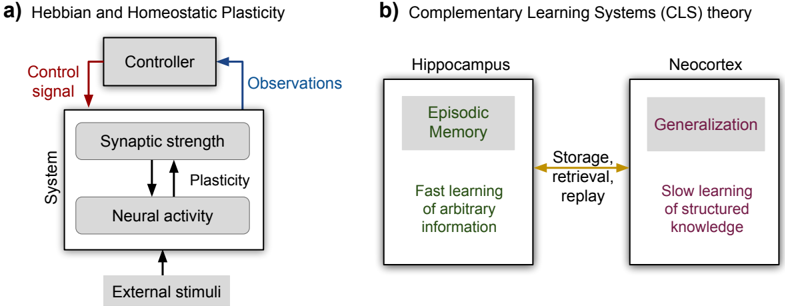
The image presents two interconnected models of neural learning mechanisms:
1. **Hebbian and Homeostatic Plasticity** (Section a): A feedback loop involving synaptic strength, neural activity, and external stimuli.
2. **Complementary Learning Systems (CLS)** (Section b): A dual-system model where the hippocampus and neocortex interact for memory consolidation.
### Components/Axes
#### Section a: Hebbian and Homeostatic Plasticity
- **Controller**:
- Receives **Control signal** (red arrow) and sends **Observations** (blue arrow).
- Positioned at the top of the diagram.
- **Synaptic strength**:
- Central node with bidirectional **Plasticity** (black arrow) to/from **Neural activity**.
- Positioned between Controller and Neural activity.
- **Neural activity**:
- Bottom node influenced by **External stimuli** (black arrow).
- **External stimuli**:
- Input at the bottom of the diagram.
#### Section b: Complementary Learning Systems (CLS)
- **Hippocampus**:
- Contains **Episodic Memory** (green text).
- Functions: **Fast learning of arbitrary information**, **Storage, retrieval, replay** (yellow bidirectional arrow).
- Positioned on the left.
- **Neocortex**:
- Contains **Generalization** (purple text).
- Functions: **Slow learning of structured knowledge**.
- Positioned on the right.
- **Arrows**:
- Bidirectional yellow arrow between Hippocampus and Neocortex labeled **Storage, retrieval, replay**.
### Detailed Analysis
#### Section a: Hebbian and Homeostatic Plasticity
- **Controller**: Acts as a regulatory node, adjusting synaptic strength based on observations.
- **Synaptic strength**:
- Modulated by **Plasticity** (black arrow), which adjusts based on neural activity.
- Influenced by **Control signal** (red) and **Observations** (blue).
- **Neural activity**:
- Driven by **External stimuli** (black arrow) and modulated by synaptic strength.
#### Section b: Complementary Learning Systems (CLS)
- **Hippocampus**:
- Specializes in rapid, flexible learning of episodic memories.
- Replays stored memories to the neocortex via bidirectional interaction.
- **Neocortex**:
- Consolidates hippocampal inputs into structured, generalized knowledge through slow learning.
- **Interaction**:
- The hippocampus and neocortex form a feedback loop, enabling memory consolidation and knowledge integration.
### Key Observations
1. **Directional flows**:
- In Section a, control signals and observations create a closed-loop system for synaptic adjustment.
- In Section b, bidirectional arrows emphasize dynamic interaction between hippocampus and neocortex.
2. **Color coding**:
- Red (Control signal), blue (Observations), black (Plasticity/External stimuli), yellow (Storage/retrieval), purple (Generalization).
3. **Temporal dynamics**:
- Hippocampus handles fast learning; neocortex handles slow, structured learning.
### Interpretation
- **Hebbian/Homeostatic Plasticity**:
- Illustrates how synaptic strength is dynamically regulated by external stimuli and feedback from neural activity. The Controller ensures homeostasis by adjusting plasticity based on observations.
- **CLS Theory**:
- Highlights the complementary roles of the hippocampus (rapid, flexible memory) and neocortex (slow, structured knowledge). The bidirectional interaction suggests memory replay during rest or sleep, transferring hippocampal memories to the neocortex for long-term storage.
- **Implications**:
- The models explain how biological systems balance rapid adaptation (Hebbian plasticity) with stable, generalized knowledge (neocortical learning).
- The CLS framework aligns with findings on sleep-dependent memory consolidation, where hippocampal-neocortical dialogue strengthens structured knowledge.
No numerical data or outliers present. The diagram emphasizes conceptual relationships over quantitative metrics.