## Diagram: Hebbian and Homeostatic Plasticity and Complementary Learning Systems (CLS) Theory
### Overview
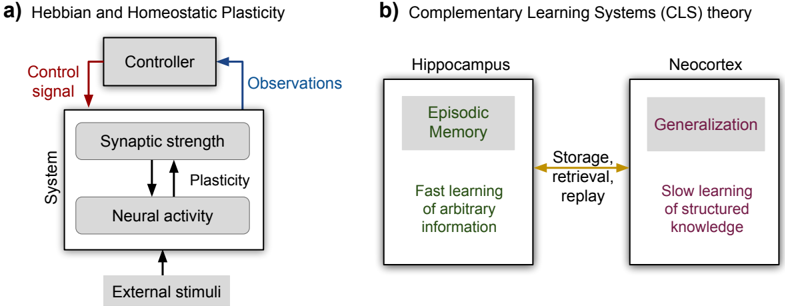
The image presents two diagrams side-by-side. The left diagram (a) illustrates Hebbian and Homeostatic Plasticity, showing the interaction between external stimuli, neural activity, synaptic strength, and a controller. The right diagram (b) depicts the Complementary Learning Systems (CLS) theory, focusing on the roles of the hippocampus and neocortex in learning and memory.
### Components/Axes
**Diagram a) Hebbian and Homeostatic Plasticity:**
* **Title:** Hebbian and Homeostatic Plasticity
* **Components:**
* Controller (top center): A rectangular box labeled "Controller".
* System (center): A larger rectangular box labeled "System" containing "Synaptic strength" (top) and "Neural activity" (bottom).
* External stimuli (bottom): A rectangular box labeled "External stimuli".
* **Connections/Flow:**
* "External stimuli" connects to "Neural activity" via an upward arrow.
* "Neural activity" and "Synaptic strength" are connected by bidirectional arrows labeled "Plasticity".
* "Synaptic strength" is connected to "Controller" via a blue arrow labeled "Observations".
* "Controller" is connected to "System" via a red arrow labeled "Control signal".
**Diagram b) Complementary Learning Systems (CLS) theory:**
* **Title:** Complementary Learning Systems (CLS) theory
* **Components:**
* Hippocampus (left): A rectangular box labeled "Hippocampus" containing "Episodic Memory" (top) and "Fast learning of arbitrary information" (bottom).
* Neocortex (right): A rectangular box labeled "Neocortex" containing "Generalization" (top) and "Slow learning of structured knowledge" (bottom).
* **Connections/Flow:**
* "Hippocampus" and "Neocortex" are connected by a bidirectional arrow labeled "Storage, retrieval, replay".
### Detailed Analysis or ### Content Details
**Diagram a) Hebbian and Homeostatic Plasticity:**
* The "Controller" receives "Observations" from the "System" (specifically, "Synaptic strength") and sends a "Control signal" back to the "System".
* "External stimuli" influence "Neural activity", which in turn affects "Synaptic strength" through "Plasticity".
* The "System" encapsulates the interaction between "Synaptic strength" and "Neural activity".
**Diagram b) Complementary Learning Systems (CLS) theory:**
* The "Hippocampus" is associated with "Episodic Memory" and "Fast learning of arbitrary information".
* The "Neocortex" is associated with "Generalization" and "Slow learning of structured knowledge".
* The bidirectional arrow between the "Hippocampus" and "Neocortex" indicates the transfer of information for "Storage, retrieval, replay".
### Key Observations
* Diagram a) focuses on the dynamic interaction between a controller and a system, highlighting the role of plasticity in adapting synaptic strength based on neural activity and external stimuli.
* Diagram b) emphasizes the complementary roles of the hippocampus and neocortex in learning, with the hippocampus facilitating fast learning of specific information and the neocortex enabling slow learning and generalization.
### Interpretation
The diagrams illustrate two different but related concepts in neuroscience. Diagram a) describes a feedback loop where a controller modulates a system's synaptic strength based on observations of neural activity and external stimuli. This represents a basic model of how the brain can adapt to changing conditions. Diagram b) presents a higher-level view of learning, showing how the hippocampus and neocortex work together to acquire and consolidate knowledge. The hippocampus is responsible for quickly encoding new experiences, while the neocortex gradually extracts patterns and generalizations from these experiences. The bidirectional connection between the two regions suggests that information is constantly being transferred and refined. Together, these diagrams provide a glimpse into the complex mechanisms underlying learning and memory in the brain.