## Diagram: Neural Learning System Models
### Overview
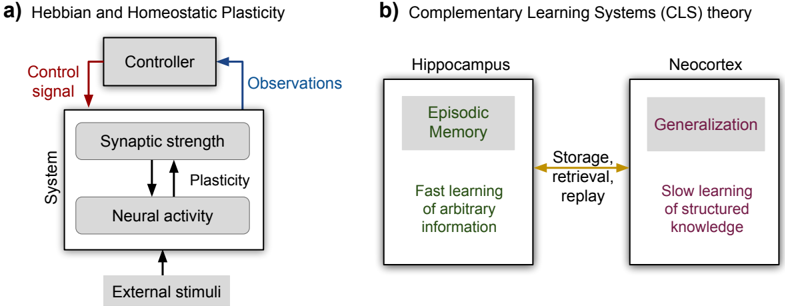
The image presents two conceptual diagrams illustrating theories of neural learning and plasticity. Diagram **a)** depicts a control system model for Hebbian and Homeostatic Plasticity, showing a feedback loop between a controller and a neural system. Diagram **b)** illustrates the Complementary Learning Systems (CLS) theory, contrasting the roles of the Hippocampus and Neocortex in memory and learning.
### Components/Axes
The image is divided into two distinct panels, labeled **a)** and **b)**.
**Panel a) - Hebbian and Homeostatic Plasticity:**
* **Title:** "Hebbian and Homeostatic Plasticity" (top-left).
* **Main Components:**
* **Controller:** A rectangular box at the top.
* **System:** A larger rectangular box below the Controller.
* **Internal System Components:**
* **Synaptic strength:** A box within the System.
* **Neural activity:** A box within the System, below "Synaptic strength."
* **Arrows & Labels (with color coding):**
* **Control signal:** A **red arrow** pointing from the **Controller** down to the **System**.
* **Observations:** A **blue arrow** pointing from the **System** up to the **Controller**.
* **Plasticity:** A label next to two vertical, bidirectional arrows connecting **Synaptic strength** and **Neural activity**.
* **External stimuli:** A box at the bottom with an arrow pointing up into the **Neural activity** box.
**Panel b) - Complementary Learning Systems (CLS) theory:**
* **Title:** "Complementary Learning Systems (CLS) theory" (top-center).
* **Main Components:**
* **Hippocampus:** A large rectangular box on the left.
* **Neocortex:** A large rectangular box on the right.
* **Internal Hippocampus Components:**
* **Episodic Memory:** A gray-shaded box at the top.
* **Fast learning of arbitrary information:** Green text below the gray box.
* **Internal Neocortex Components:**
* **Generalization:** A gray-shaded box at the top.
* **Slow learning of structured knowledge:** Purple text below the gray box.
* **Connection:**
* A **yellow, double-headed arrow** connects the two main boxes.
* **Label:** "Storage, retrieval, replay" is written above the yellow arrow.
### Detailed Analysis
**Panel a) Flow Analysis:**
The diagram describes a closed-loop control system.
1. **External stimuli** provide input to the **Neural activity** component.
2. **Neural activity** and **Synaptic strength** interact bidirectionally, a process labeled as **Plasticity**.
3. The state of the **System** (encompassing neural activity and synaptic strength) is sent as **Observations** (blue arrow) to the **Controller**.
4. The **Controller** processes these observations and sends a **Control signal** (red arrow) back to the **System**, presumably to modulate its state, completing the feedback loop.
**Panel b) Component Analysis:**
The diagram contrasts two learning systems with specialized functions.
* **Hippocampus:** Characterized by **"Fast learning of arbitrary information"** (green text). Its primary function is **Episodic Memory**.
* **Neocortex:** Characterized by **"Slow learning of structured knowledge"** (purple text). Its primary function is **Generalization**.
* **Interaction:** The systems are linked via processes of **"Storage, retrieval, replay"** (yellow arrow), indicating that information is transferred between the fast-learning hippocampus and the slow-learning neocortex for consolidation.
### Key Observations
1. **Color-Coded Semantics:** Colors are used functionally. In panel a), red and blue distinguish control signals from observational feedback. In panel b), green and purple text visually separate the core attributes of the two learning systems.
2. **Structural Contrast:** Panel a) is a dynamic, cyclical flow diagram. Panel b) is a static, comparative block diagram.
3. **Hierarchy:** Both diagrams use containment (boxes within boxes) to show hierarchy. The "System" in a) contains its sub-components. "Episodic Memory" and "Generalization" are presented as core functions within their respective brain region boxes.
4. **Bidirectional Arrows:** Both diagrams feature bidirectional arrows (for "Plasticity" in a and the connection in b), emphasizing mutual interaction and feedback rather than one-way flow.
### Interpretation
These diagrams provide a conceptual framework for understanding adaptive learning in neural systems.
* **Diagram a)** models **homeostatic regulation**. It suggests that learning (plasticity) is not a passive process but an actively controlled one. The "Controller" could represent homeostatic mechanisms that adjust synaptic strengths or neural excitability to maintain stable system function in response to external stimuli and internal observations. This is a **cybernetic view** of neural plasticity.
* **Diagram b)** presents the influential **Complementary Learning Systems theory**. It posits that efficient learning requires two systems with different temporal scales and specializations:
* The **hippocampus** acts as a rapid encoder, capturing specific experiences (episodic memories) quickly but without structure.
* The **neocortex** learns slowly, extracting statistical regularities and general rules from many experiences to build structured knowledge.
* The **yellow arrow** is critical: it represents the process (often thought to occur during sleep) where hippocampal memories are "replayed" and gradually integrated into neocortical networks. This division of labor solves the **stability-plasticity dilemma**—how to learn new things without catastrophically forgetting old knowledge.
**Together, the diagrams address complementary aspects of learning:** **a)** focuses on the **internal control dynamics** within a learning system, while **b)** focuses on the **architectural division of labor** between specialized systems for optimal learning and memory consolidation.