## Diagram: Audio Processing System Architecture
### Overview
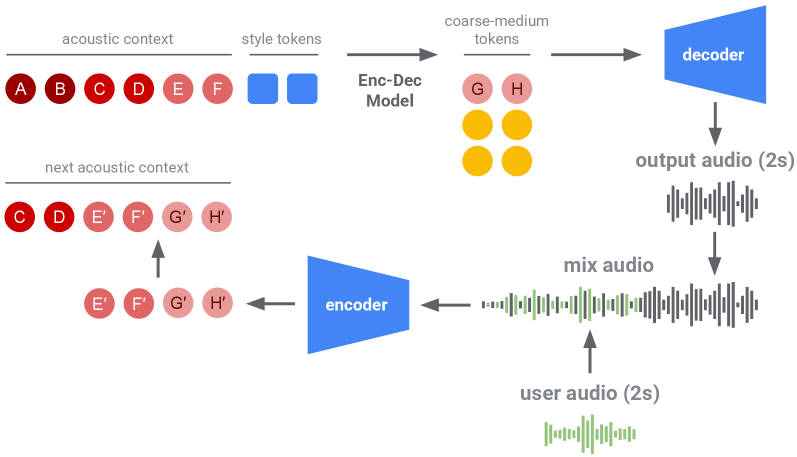
The diagram illustrates a multi-stage audio processing system with encoder-decoder architecture. It shows the flow of acoustic context through style tokens, coarse-medium token generation, and audio output generation. The system includes explicit components for acoustic context modeling, style token processing, and audio synthesis.
### Components/Axes
1. **Acoustic Context**:
- Top row labeled "acoustic context" with 6 circular tokens (A-F) in red-to-pink gradient
- Bottom row labeled "next acoustic context" with 6 circular tokens (C-H') in lighter red-to-pink gradient
2. **Style Tokens**:
- Two blue square tokens labeled "style tokens" between acoustic context rows
3. **Coarse-Medium Tokens**:
- Four yellow circular tokens (G-H) arranged in 2x2 grid
4. **Processing Units**:
- "Encoder" (blue trapezoid) receiving next acoustic context
- "Decoder" (blue parallelogram) producing output audio
- "Enc-Dec Model" (central processing unit) connecting style tokens to coarse-medium tokens
5. **Audio Streams**:
- "User audio (2s)" (green waveform)
- "Mix audio" (combined waveform)
- "Output audio (2s)" (final waveform)
### Spatial Grounding
- **Top Section**: Acoustic context (A-F) → Style tokens → Coarse-medium tokens (G-H)
- **Bottom Section**: Next acoustic context (E'-H') → Encoder → Mix audio
- **Central**: Enc-Dec Model bridges style tokens and coarse-medium tokens
- **Right Side**: Decoder produces output audio from mixed inputs
### Detailed Analysis
1. **Token Progression**:
- Acoustic context (A-F) transforms into style tokens (blue squares)
- Style tokens feed into Enc-Dec Model to generate coarse-medium tokens (G-H)
- Next acoustic context (E'-H') flows through encoder to create mix audio
2. **Color Coding**:
- Red-to-pink gradient for acoustic context tokens (darker = earlier in sequence)
- Blue for style tokens and processing units
- Yellow for coarse-medium tokens
- Green for user audio input
3. **Temporal Flow**:
- Left-to-right progression through processing stages
- Feedback loop from next acoustic context to encoder
### Key Observations
1. The system uses a hybrid approach combining discrete tokens (A-F) with continuous audio processing
2. The Enc-Dec Model acts as a critical bridge between symbolic representation (style tokens) and audio generation
3. User audio input (2s) is mixed with processed acoustic context before final output
4. Output audio duration matches input duration (2s) suggesting real-time processing capability
### Interpretation
This architecture demonstrates a sophisticated audio synthesis system that:
1. **Context Modeling**: Maintains acoustic context through token sequences (A-F → E'-H')
2. **Style Transfer**: Encodes style information through discrete tokens (blue squares)
3. **Audio Generation**: Uses encoder-decoder architecture for temporal audio modeling
4. **Personalization**: Incorporates user audio input for adaptive synthesis
The system appears designed for applications requiring:
- Real-time audio generation
- Style transfer capabilities
- Context-aware synthesis
- User input integration
The color-coded token progression suggests a hierarchical processing approach where symbolic representations (A-F) are gradually transformed into audio-ready features (G-H) through the Enc-Dec Model. The mixing of user audio indicates potential for interactive or adaptive audio generation systems.