## [Diagram]: Book Transforming into a Maze
### Overview
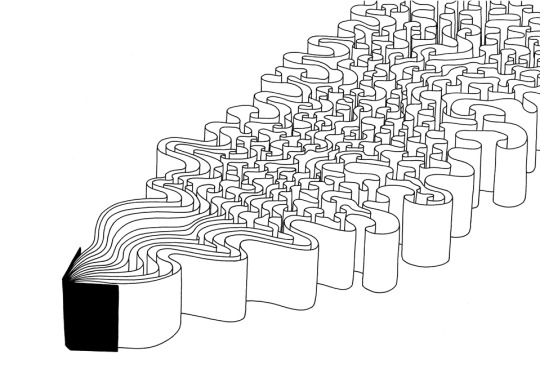
The image is a black and white line drawing depicting a conceptual transformation. An open book, positioned at the bottom-left, has its pages seamlessly morphing into the walls of an intricate, three-dimensional maze that expands diagonally towards the top-right of the frame. The illustration uses clean, continuous lines to show the progression from a structured, bound object into a complex, labyrinthine structure.
### Components/Axes
* **Primary Component (Source):** An open book. The left cover is solid black. The pages are shown as a series of parallel, curved lines emanating from the book's spine.
* **Primary Component (Transformation):** The lines representing the book's pages extend outward and upward, curving and intersecting to form the walls of a maze.
* **Primary Component (Result):** A complex, multi-layered maze structure. It features numerous pathways, dead ends, and junctions, creating a sense of depth and complexity.
* **Spatial Layout:** The transformation flows from the bottom-left corner (the book) to the top-right corner (the densest part of the maze). The maze occupies the majority of the image space, particularly the upper and right portions.
* **Text/Labels:** There is no textual information, labels, titles, or annotations present in the image.
### Detailed Analysis
* **Visual Flow:** The diagram illustrates a clear, directional flow. The parallel lines of the book's pages act as the origin point. These lines diverge, converge, and bend at right angles to construct the maze's corridors and walls.
* **Maze Structure:** The maze is not a simple, flat grid. It is rendered with perspective, giving it a three-dimensional quality. The walls have thickness, and the pathways recede into the background, suggesting a vast and complicated network.
* **Line Work:** The entire image is composed of uniform black lines on a white background. There is no shading, color, or variation in line weight to indicate depth beyond the perspective drawing itself.
### Key Observations
1. **Seamless Metamorphosis:** The most striking feature is the seamless visual transition. There is no clear boundary where the book ends and the maze begins; one concept literally grows out of the other.
2. **Increasing Complexity:** The structure becomes progressively more complex as it moves away from the book. The area nearest the book has longer, more parallel "page" lines, while the top-right is a dense tangle of short walls and frequent turns.
3. **Order to Chaos:** The image presents a strong visual metaphor moving from a symbol of contained, linear knowledge (a book) to a symbol of complexity, confusion, or exploration (a maze).
### Interpretation
This diagram is a powerful visual metaphor, not a data-driven chart. Its meaning is interpretive and symbolic.
* **What it Suggests:** The image suggests that stories, knowledge, or information contained within a book can unfold into something vastly more complex and labyrinthine. It could represent the journey of reading, where a simple narrative leads the reader through a complex plot. Alternatively, it might symbolize how a single idea or piece of research can branch out into an intricate field of study with many paths and dead ends.
* **Relationship of Elements:** The book is the foundational source. The maze is the experiential or intellectual outcome. The direct physical connection between them implies that the complexity is inherent to or generated by the source material.
* **Notable Anomalies:** The primary "anomaly" is the conceptual fusion itself. The image defies real-world physics to make a philosophical point. The lack of an exit or entrance in the visible maze structure emphasizes the idea of being immersed in complexity rather than solving it.
* **Underlying Message:** The diagram likely comments on the nature of narrative, learning, or information. It posits that engaging with a text is not a passive, linear activity but an active navigation through a complex, constructed world. The viewer is invited to consider whether the maze is a trap, a challenge, or a landscape of infinite possibility emerging from the book.