## Diagram: Maze-like Structure with Book
### Overview
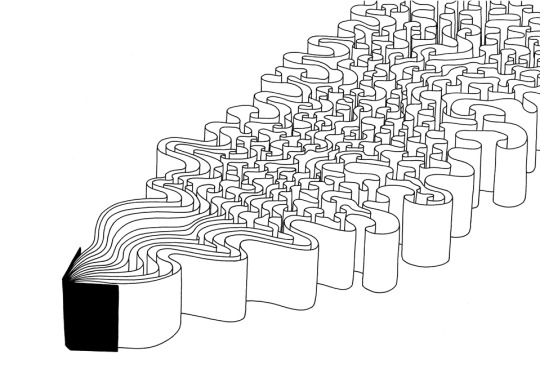
The image depicts a black-and-white line drawing of a complex, labyrinthine structure resembling a maze. The maze is composed of interconnected, winding paths that increase in density and complexity toward the right side of the image. On the left side, a rectangular object resembling a book is illustrated, with its pages represented by curved, overlapping lines that transition into the maze. The background is plain white, emphasizing the contrast between the black lines and the white space.
### Components/Axes
- **Book**: Positioned on the far left, the book is depicted as a vertical rectangle with a black spine (left edge) and white pages. The pages are illustrated with curved, overlapping lines that extend into the maze.
- **Maze**: The maze consists of numerous thin, black lines forming a network of interconnected paths. The paths vary in width and direction, creating a sense of depth and complexity. No explicit labels, axes, or legends are present in the image.
- **Flow Direction**: The maze appears to originate from the book's pages, suggesting a conceptual or metaphorical connection between the book and the labyrinthine structure.
### Detailed Analysis
- **Book**: The book is rendered with a simple, stylized design. The black spine (left edge) is solid, while the pages are represented by a series of curved, overlapping lines. These lines transition smoothly into the maze, implying that the book's content is the source or origin of the maze.
- **Maze**: The maze is composed of hundreds of thin, black lines that form a dense, interconnected network. The paths are irregular in shape, with no clear start or end point. The complexity increases toward the right side of the image, where the lines become more tightly packed and less distinguishable.
- **Perspective**: The use of overlapping lines and varying line thickness creates a sense of depth, as if the maze recedes into the background. The absence of shading or color reinforces the stark, minimalist aesthetic.
### Key Observations
- **No Textual Elements**: The image contains no labels, axis titles, legends, or textual annotations. All information is conveyed through visual elements (lines, shapes, and spatial relationships).
- **Increasing Complexity**: The maze's density and intricacy grow progressively toward the right, suggesting a metaphorical "journey" or "exploration" that becomes more challenging as one moves away from the book.
- **Ambiguity of Purpose**: The maze lacks a clear exit or destination, which may symbolize the open-ended nature of knowledge, the complexity of problem-solving, or the infinite possibilities within a structured system.
### Interpretation
The image likely serves as a metaphor for the relationship between knowledge (represented by the book) and the complexity of understanding or exploration (represented by the maze). The book's pages transitioning into the maze suggest that the act of reading or learning initiates a journey into a vast, interconnected system of ideas. The absence of an exit implies that the process of exploration is ongoing, with no definitive endpoint. The stark, minimalist design emphasizes the abstract nature of the concept, focusing on the interplay between structure (the maze) and its origin (the book). The lack of textual elements reinforces the idea that the image is intended to evoke interpretation rather than convey explicit data.