## Network Diagram: Unlabeled Node-Edge Structure
### Overview
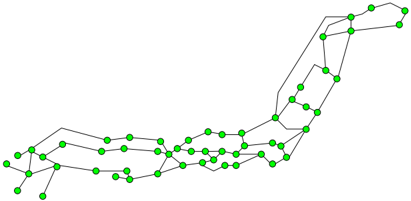
The image depicts a network diagram composed of green circular nodes connected by black lines. No textual labels, legends, or axis markers are visible. The nodes are densely clustered in the central region, with some extending outward in a radial pattern. The edges form a complex web, particularly in the central area, with sparser connections toward the periphery.
### Components/Axes
- **Nodes**: Green circular markers distributed across the diagram.
- **Edges**: Black lines connecting nodes, varying in density and direction.
- **No legends, axis titles, or textual annotations** are present.
### Detailed Analysis
- **Node Distribution**:
- Approximately 50–70 nodes are visible, with the highest concentration (30–40 nodes) in the central region.
- Nodes taper off in density toward the edges, with 10–15 nodes in the outermost regions.
- **Edge Patterns**:
- Central nodes exhibit high connectivity (degree >5), forming a dense mesh.
- Peripheral nodes have lower connectivity (degree 1–3), suggesting hierarchical or scale-free topology.
- **Spatial Layout**:
- Nodes are positioned in a roughly linear gradient from left (origin) to right (termination), with branching clusters in the upper and lower regions.
### Key Observations
1. **Central Hub Dominance**: The core region acts as a hub, with nodes and edges densely packed.
2. **Peripheral Sparsity**: Outer nodes are isolated, connected only to adjacent nodes or the central cluster.
3. **No Textual Metadata**: Absence of labels, legends, or axis markers prevents direct interpretation of node/edge semantics.
### Interpretation
The diagram likely represents a **scale-free network** or **hierarchical system**, where central nodes serve as critical connectors (e.g., infrastructure hubs, social influencers). The lack of labels obscures specific context, but the structure suggests:
- **Robustness**: Central hubs may indicate resilience to peripheral node failures.
- **Vulnerability**: Over-reliance on central nodes could create systemic risks if hubs fail.
- **Potential Applications**: Urban transportation networks, neural pathways, or organizational hierarchies.
No numerical data or categorical labels are available for further analysis. The diagram emphasizes structural relationships over quantitative metrics.