## Code Comparison: LLM vs. LLM + APOLLO
### Overview
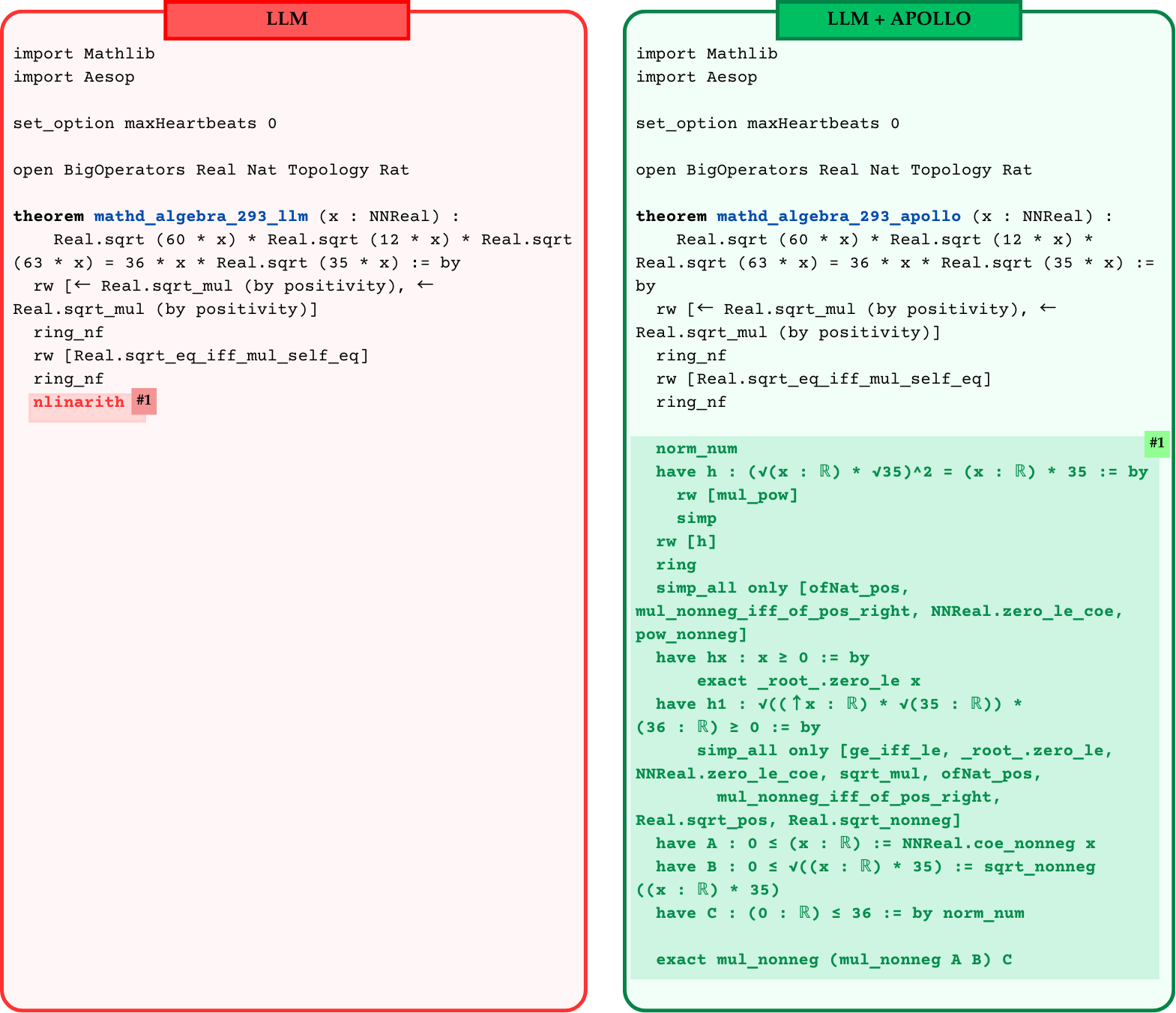
The image presents a side-by-side comparison of code snippets, likely from a formal verification system. The left side is labeled "LLM" and the right side is labeled "LLM + APOLLO". Both snippets define a theorem related to real number algebra, but the "LLM + APOLLO" version includes additional steps and lemmas to aid in the proof.
### Components/Axes
* **Titles:**
* Left: "LLM" (red background)
* Right: "LLM + APOLLO" (green background)
* **Code:** The code snippets are written in a language similar to Lean or Coq, used for formal mathematical proofs.
* **Comments/Annotations:** Both sides contain comments and annotations, such as "#1" in the bottom right corner of each code block.
### Detailed Analysis or ### Content Details
**Left Side (LLM):**
* **Imports:**
* `import Mathlib`
* `import Aesop`
* **Options:**
* `set_option maxHeartbeats 0`
* **Open:**
* `open BigOperators Real Nat Topology Rat`
* **Theorem Definition:**
* `theorem mathd_algebra_293_llm (x : NNReal) :`
* `Real.sqrt (60 * x) * Real.sqrt (12 * x) * Real.sqrt (63 * x) = 36 * x * Real.sqrt (35 * x) := by`
* **Proof Steps:**
* `rw [Real.sqrt_mul (by positivity), ← Real.sqrt_mul (by positivity)]`
* `ring_nf`
* `rw [Real.sqrt_eq_iff_mul_self_eq]`
* `ring_nf`
* `nlinarith #1`
**Right Side (LLM + APOLLO):**
* **Imports:**
* `import Mathlib`
* `import Aesop`
* **Options:**
* `set_option maxHeartbeats 0`
* **Open:**
* `open BigOperators Real Nat Topology Rat`
* **Theorem Definition:**
* `theorem mathd_algebra_293_apollo (x : NNReal) :`
* `Real.sqrt (60 * x) * Real.sqrt (12 * x) * Real.sqrt (63 * x) = 36 * x * Real.sqrt (35 * x) := by`
* **Proof Steps:**
* `rw [Real.sqrt_mul (by positivity), ← Real.sqrt_mul (by positivity)]`
* `ring_nf`
* `rw [Real.sqrt_eq_iff_mul_self_eq]`
* `ring_nf`
* **Additional Proof Steps (norm_num block):**
* `norm_num`
* `have h: (√(x : R) * √35)^2 = (x : R) * 35 := by rw [mul_pow]`
* `simp`
* `rw [h]`
* `ring`
* `simp_all only [ofNat_pos, mul_nonneg_iff_of_pos_right, NNReal.zero_le_coe, pow_nonneg]`
* `have hx: x ≥ 0 := by exact _root_.zero_le x`
* `have h1: √((↑x : R) * √(35: R)) * (36: R) ≥ 0 := by`
* `simp_all only [ge_iff_le, _root_.zero_le, NNReal.zero_le_coe, sqrt_mul, ofNat_pos, mul_nonneg_iff_of_pos_right, Real.sqrt_pos, Real.sqrt_nonneg]`
* `have A: 0 ≤ (x : R) := NNReal.coe_nonneg x`
* `have B: 0 ≤ √((x: R) * 35) := sqrt_nonneg ((x: R) * 35)`
* `have C: (0: R) ≤ 36 := by norm_num`
* `exact mul_nonneg (mul_nonneg A B) C`
### Key Observations
* Both sides define the same theorem, but the "LLM + APOLLO" version includes a more detailed proof using the `norm_num` tactic and several supporting lemmas.
* The "LLM" version relies on the `nlinarith` tactic, which likely performs more automated reasoning.
* The "#1" annotation appears on both sides, potentially indicating a specific goal or step in a larger proof.
### Interpretation
The comparison highlights the difference in proof strategies between using a large language model (LLM) alone versus using an LLM augmented with a tool like APOLLO. The "LLM + APOLLO" version demonstrates a more explicit and step-by-step proof, potentially making it easier to understand and verify. The LLM version relies on a more powerful tactic (`nlinarith`), which might be less transparent but more concise. The data suggests that combining LLMs with specialized tools can lead to more robust and verifiable formal proofs.