\n
## Code Snippets: LLM vs LLM + APOLLO
### Overview
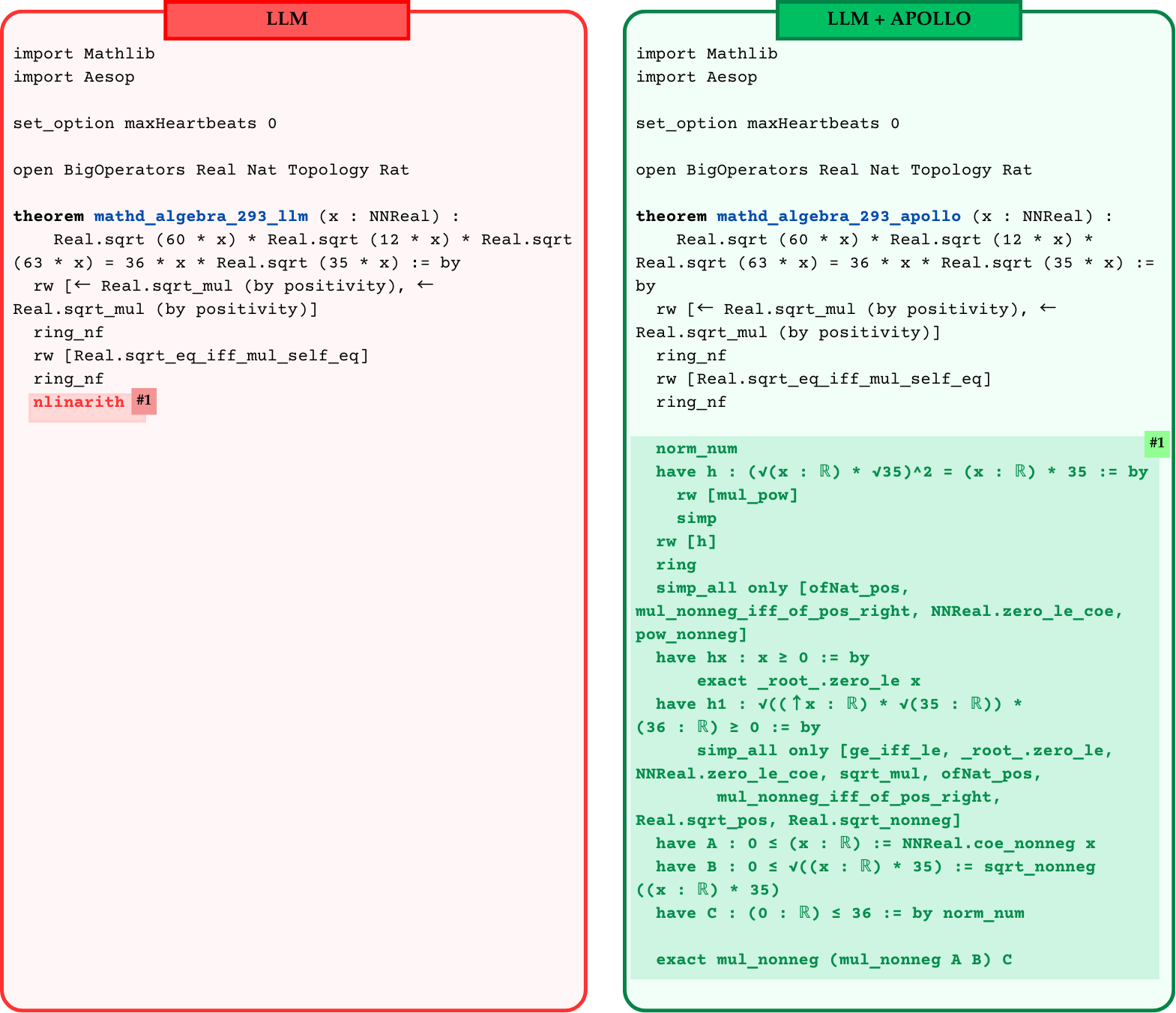
The image presents two code snippets, labeled "LLM" on the left and "LLM + APOLLO" on the right. Both snippets appear to be written in a formal mathematical/programming language, likely related to theorem proving or formal verification. They both contain similar initial lines, but diverge significantly in their subsequent content. The code is densely packed with mathematical notation and function calls.
### Components/Axes
There are no axes or traditional chart components. The image consists entirely of text-based code. The two code blocks are visually separated by a vertical line. Each block has a header indicating "LLM" or "LLM + APOLLO". Both blocks contain lines starting with keywords like `import`, `set_option`, `open`, `theorem`, `rw`, `ring_nf`, `nlinarith`, `have`, `simp`, `exact`, and `norm_num`.
### Detailed Analysis or Content Details
**Left Block (LLM):**
* `import Mathlib`
* `import Aesop`
* `set_option maxHeartbeats 0`
* `open BigOperators Real Nat Topology Rat`
* `theorem mathd_algebra_293_llm (x : NNReal) : Real.sqrt(60 * x) * Real.sqrt(12 * x) * Real.sqrt(63 * x) = 36 * x * Real.sqrt(35 * x) := by`
* `rw [← Real.sqrt_mul (by positivity), ← Real.sqrt_mul (by positivity)]`
* `ring_nf`
* `rw [Real.sqrt_eq_iff mul_self_eq]`
* `ring_nf`
* `nlinarith [#1`
**Right Block (LLM + APOLLO):**
* `import Mathlib`
* `import Aesop`
* `set_option maxHeartbeats 0`
* `open BigOperators Real Nat Topology Rat`
* `theorem mathd_algebra_293_apollo (x : NNReal) : Real.sqrt(60 * x) * Real.sqrt(12 * x) * Real.sqrt(63 * x) = 36 * x * Real.sqrt(35 * x) := by`
* `rw [← Real.sqrt_mul (by positivity), ← Real.sqrt_mul (by positivity)]`
* `ring_nf`
* `rw [Real.sqrt_eq_iff mul_self_eq]`
* `ring_nf`
* `norm_num`
* `have h : (√(x : ℝ) * √35)^2 = (x : ℝ) * 35 := by`
* `rw [mul_pow]`
* `simp`
* `ring`
* `simp_all only [ofNat_pos, mul_nonneg_iff_of_pos_right, NNReal.zero_le_coe, pow_nonneg]`
* `have hx : x ≥ 0 := by`
* `exact _root_zero_le_x`
* `have h1 : √(√(x : ℝ) * √(35 : ℝ)) * (36 : ℝ) ≥ 0 := by`
* `simp_all only [ge_iff_le, _root_zero_le, NNReal.zero_le_coe, sqrt_mul, ofNat_pos, mul_nonneg_iff_of_pos_right, Real.sqrt_pos, Real.sqrt_nonneg]`
* `have A : 0 ≤ √(x : ℝ) := NNReal.coe_nonneg x`
* `have B : 0 ≤ √(35 : ℝ) := sqrt_nonneg (35 : ℝ)`
* `have C : (0 : ℝ) ≤ 36 := by norm_num`
* `exact mul_nonneg (mul_nonneg A B) C`
### Key Observations
The code snippets are very similar at the beginning, suggesting a common starting point. The "LLM + APOLLO" block contains significantly more lines of code and introduces new variables (e.g., `h`, `hx`, `h1`, `A`, `B`, `C`) and more complex logical steps. The "LLM + APOLLO" block appears to be attempting a more detailed or complete proof of the theorem. The presence of `norm_num` in the right block suggests a normalization step. The `#1` at the end of the left block might indicate a reference to a specific tactic or goal within the theorem proving environment.
### Interpretation
The image demonstrates a comparison between two approaches to proving a mathematical theorem. The "LLM" block represents a simpler, potentially incomplete attempt, while the "LLM + APOLLO" block represents a more sophisticated approach, likely leveraging additional tools or tactics (represented by "APOLLO") to achieve a more rigorous or complete proof. The increased complexity in the "LLM + APOLLO" block suggests that the theorem requires more detailed reasoning and manipulation to be proven effectively. The code snippets are likely part of a larger system for automated theorem proving, where the goal is to verify the correctness of mathematical statements using computer-assisted methods. The differences between the two blocks highlight the challenges and trade-offs involved in designing and implementing such systems. The use of `simp`, `ring`, and `norm_num` suggests simplification, ring arithmetic, and numerical normalization are being employed as proof strategies.