## Bar Chart: Best-of-8 vs. ProcessBench Performance
### Overview
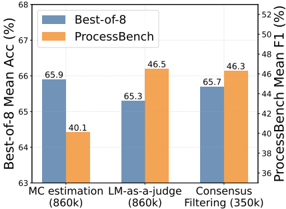
The image is a bar chart comparing the performance of "Best-of-8" and "ProcessBench" across three different methods: "MC estimation," "LM-as-a-judge," and "Consensus Filtering." The chart displays the mean accuracy (Acc) for Best-of-8 and the mean F1 score for ProcessBench.
### Components/Axes
* **Title:** Implicitly, the chart compares the performance of Best-of-8 and ProcessBench.
* **X-axis:** Categorical axis representing the three methods: "MC estimation (860k)," "LM-as-a-judge (860k)," and "Consensus Filtering (350k)." The numbers in parentheses likely represent the number of samples used for each method.
* **Left Y-axis:** "Best-of-8 Mean Acc (%)" with a scale from 63 to 68.
* **Right Y-axis:** "ProcessBench Mean F1 (%)" with a scale from 36 to 52.
* **Legend:** Located at the top-left of the chart.
* Blue: "Best-of-8"
* Orange: "ProcessBench"
### Detailed Analysis
* **MC estimation (860k):**
* Best-of-8 (Blue): Approximately 65.9%
* ProcessBench (Orange): Approximately 40.1%
* **LM-as-a-judge (860k):**
* Best-of-8 (Blue): Approximately 65.3%
* ProcessBench (Orange): Approximately 46.5%
* **Consensus Filtering (350k):**
* Best-of-8 (Blue): Approximately 65.7%
* ProcessBench (Orange): Approximately 46.3%
### Key Observations
* Best-of-8 consistently outperforms ProcessBench in terms of mean accuracy across all three methods.
* ProcessBench achieves its highest F1 score with the "LM-as-a-judge" method.
* The performance gap between Best-of-8 and ProcessBench is largest for "MC estimation."
### Interpretation
The chart suggests that the "Best-of-8" approach is generally more accurate than "ProcessBench" across the tested methods. The "MC estimation" method seems to be particularly challenging for "ProcessBench," resulting in a significantly lower F1 score compared to "Best-of-8." The similar performance of "ProcessBench" on "LM-as-a-judge" and "Consensus Filtering" suggests these methods might be more suitable for "ProcessBench" compared to "MC estimation." The sample sizes (860k vs. 350k) might also play a role in the observed performance differences, potentially indicating that "Consensus Filtering" is more efficient in terms of data usage.