## System Architecture Diagram: Perception, Reasoning, and Rule Execution Framework
### Overview
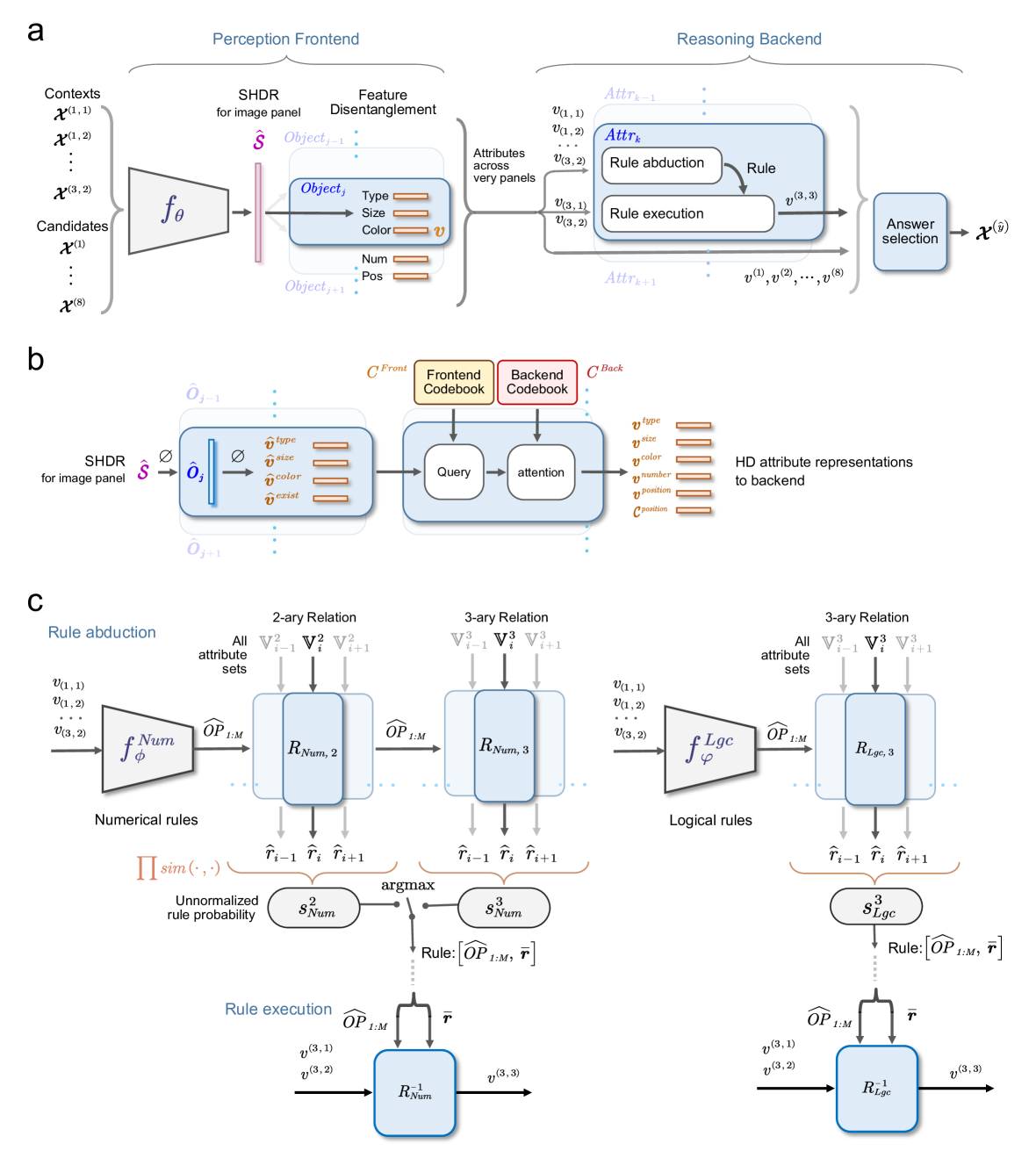
The image presents a three-part technical diagram illustrating a cognitive system architecture. Part A shows the system's frontend-backend structure, Part B details attribute processing components, and Part C demonstrates rule-based reasoning mechanisms. The diagrams use standardized flowchart notation with color-coded components and directional arrows indicating information flow.
### Components/Axes
**Part A (Frontend-Backend Structure):**
- **Perception Frontend:**
- Input: Contexts (X₁₁, X₁₂, X₃₂), Candidates (X₁, X₈)
- Processing: SHDR (Spatial Hierarchical Density Representation), Feature disentanglement
- Output: Object attributes (Type, Size, Color, Position)
- **Reasoning Backend:**
- Components: Rule abduction, Rule execution
- Output: Answer selection (X̂_y)
**Part B (Attribute Processing):**
- Input: SHDR (Ŝ)
- Components:
- Frontend Codebook (C_Front)
- Backend Codebook (C_Back)
- Query & Attention mechanisms
- Output: High-dimensional (HD) attribute representations
**Part C (Rule-Based Reasoning):**
- **Rule Abduction:**
- Input: Numerical rules (f_φ), Attribute sets (V², V³)
- Components:
- 2-ary Relation (R_Num,2)
- 3-ary Relation (R_Num,3)
- Output: Unnormalized rule probabilities (s_Num², s_Num³)
- **Rule Execution:**
- Input: Logical rules (f_Lgc)
- Components:
- 3-ary Relation (R_Lgc,3)
- Rule execution module (R⁻¹_Num, R⁻¹_Lgc)
- Output: Final attribute values (v₃₁, v₃₂, v₃₃)
### Detailed Analysis
**Part A Flow:**
1. Contextual information (X) → SHDR processing → Feature disentanglement
2. Disentangled features → Attribute extraction (Type, Size, Color, Position)
3. Attributes → Rule abduction → Rule execution → Final answer selection
**Part B Flow:**
1. SHDR (Ŝ) → Frontend Codebook (C_Front) → Query generation
2. Query → Attention mechanism → Backend Codebook (C_Back)
3. HD attribute representations generated through this pipeline
**Part C Mechanisms:**
- **Numerical Rules:**
- Attribute sets (V², V³) → 2-ary/3-ary relations
- Probability calculation: argmax(s_Num², s_Num³)
- **Logical Rules:**
- Attribute sets (V³) → 3-ary relations
- Probability calculation: s_Lgc³
- Both pathways converge through rule execution modules
### Key Observations
1. **Modular Design:** Clear separation between perception (frontend) and reasoning (backend) components
2. **Attribute Hierarchy:** Attributes progress from basic features (Type, Size) to complex representations (HD attributes)
3. **Rule Integration:** Dual pathways for numerical and logical rule processing
4. **Temporal Flow:** Information flows sequentially from perception through reasoning to final output
5. **Color Coding:**
- Blue: Core processing modules
- Yellow: Frontend components
- Red: Backend components
- Orange: Rule-related elements
### Interpretation
This architecture demonstrates a hybrid cognitive system combining:
1. **Perceptual Processing:** Initial context analysis and feature extraction
2. **Attribute Representation:** Multi-level feature disentanglement and HD representation
3. **Rule-Based Reasoning:** Dual-path integration of numerical and logical inference
4. **Decision Making:** Final answer selection through rule execution
The system appears designed for complex pattern recognition and decision-making tasks, with explicit mechanisms for:
- Contextual awareness (multiple context inputs)
- Feature abstraction (from raw data to HD attributes)
- Multi-modal rule application (numerical + logical)
- Probabilistic inference (unnormalized rule probabilities)
Notable design choices include the use of both 2-ary and 3-ary relational processing, suggesting capability to handle both binary and ternary relationships in reasoning tasks. The attention mechanism in Part B implies dynamic feature weighting during processing.