## Diagram: Comparison of Prompting Strategies
### Overview
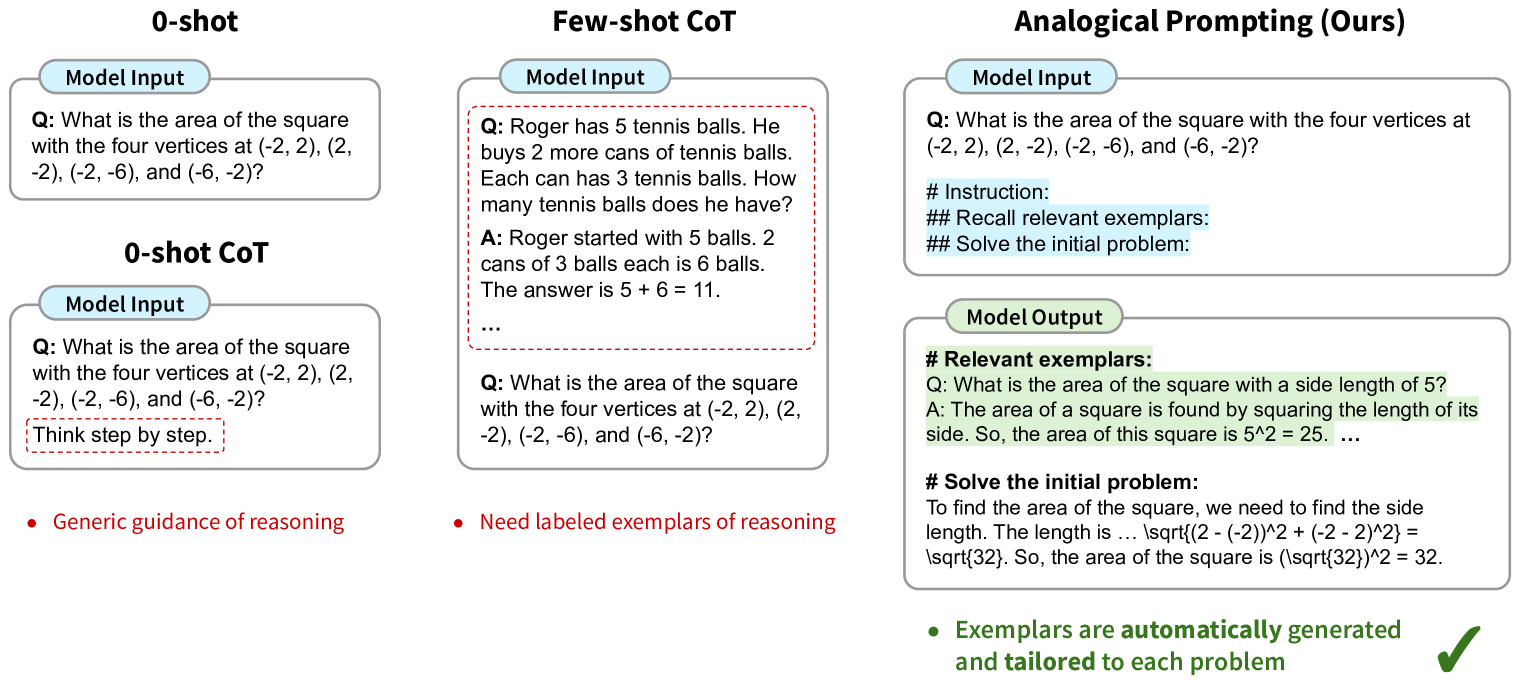
This diagram illustrates the evolution and differences between four distinct prompting methodologies for Large Language Models (LLMs): 0-shot, 0-shot Chain-of-Thought (CoT), Few-shot CoT, and Analogical Prompting. The diagram contrasts the input requirements and reasoning processes of these methods, highlighting the limitations of manual prompting versus the automated nature of the "Analogical Prompting" approach.
### Components/Axes
The diagram is organized into three vertical columns representing the different prompting strategies:
* **Left Column:** Contains "0-shot" and "0-shot CoT".
* **Middle Column:** Contains "Few-shot CoT".
* **Right Column:** Contains "Analogical Prompting (Ours)".
Annotations are color-coded:
* **Red text/dashed boxes:** Indicate limitations or manual requirements.
* **Green text/highlighting:** Indicate advantages or automated features.
---
### Detailed Analysis
#### 1. 0-shot (Left, Top)
* **Model Input Box:**
* "Q: What is the area of the square with the four vertices at (-2, 2), (2, -2), (-2, -6), and (-6, -2)?"
#### 2. 0-shot CoT (Left, Bottom)
* **Model Input Box:**
* "Q: What is the area of the square with the four vertices at (-2, 2), (2, -2), (-2, -6), and (-6, -2)?"
* [Red dashed box surrounding:] "Think step by step."
* **Annotation (Red):** "• Generic guidance of reasoning"
#### 3. Few-shot CoT (Middle)
* **Model Input Box:**
* [Red dashed box surrounding:] "Q: Roger has 5 tennis balls. He buys 2 more cans of tennis balls. Each can has 3 tennis balls. How many tennis balls does he have? A: Roger started with 5 balls. 2 cans of 3 balls each is 6 balls. The answer is 5 + 6 = 11. ..."
* "Q: What is the area of the square with the four vertices at (-2, 2), (2, -2), (-2, -6), and (-6, -2)?"
* **Annotation (Red):** "• Need labeled exemplars of reasoning"
#### 4. Analogical Prompting (Ours) (Right)
* **Model Input Box:**
* "Q: What is the area of the square with the four vertices at (-2, 2), (2, -2), (-2, -6), and (-6, -2)?"
* "# Instruction:"
* [Green highlighted:] "## Recall relevant exemplars:"
* [Green highlighted:] "## Solve the initial problem:"
* **Model Output Box:**
* [Green highlighted:] "# Relevant exemplars:"
* [Green highlighted:] "Q: What is the area of the square with a side length of 5? A: The area of a square is found by squaring the length of its side. So, the area of this square is 5^2 = 25. ..."
* "# Solve the initial problem:"
* "To find the area of the square, we need to find the side length. The length is ... \sqrt{(2 - (-2))^2 + (-2 - 2)^2} = \sqrt{32}. So, the area of the square is (\sqrt{32})^2 = 32."
* **Annotation (Green):** "• Exemplars are automatically generated and tailored to each problem" (accompanied by a green checkmark).
---
### Key Observations
* **Progression of Complexity:** The diagram shows a progression from simple, unguided prompts (0-shot) to prompts requiring manual, domain-specific examples (Few-shot CoT), and finally to a self-contained, automated process (Analogical Prompting).
* **Manual vs. Automated:** The red annotations for the first three methods emphasize the "cost" of these methods: either they lack specific guidance (0-shot CoT) or they require the user to manually provide labeled examples (Few-shot CoT).
* **Self-Generation:** The "Analogical Prompting" section is the only one featuring green indicators, signifying that the model itself generates the relevant examples, thereby removing the burden from the user.
### Interpretation
The data suggests that "Analogical Prompting" is presented as a superior methodology because it solves the "exemplar bottleneck." In traditional Few-shot CoT, a user must manually curate examples relevant to the specific problem at hand. The diagram demonstrates that Analogical Prompting automates this by instructing the model to first "Recall relevant exemplars" and then "Solve the initial problem." This creates a self-improving loop where the model tailors its own reasoning context to the specific problem, rather than relying on generic instructions or static, pre-provided examples.