\n
## Diagram: Analogy of Prompting Techniques
### Overview
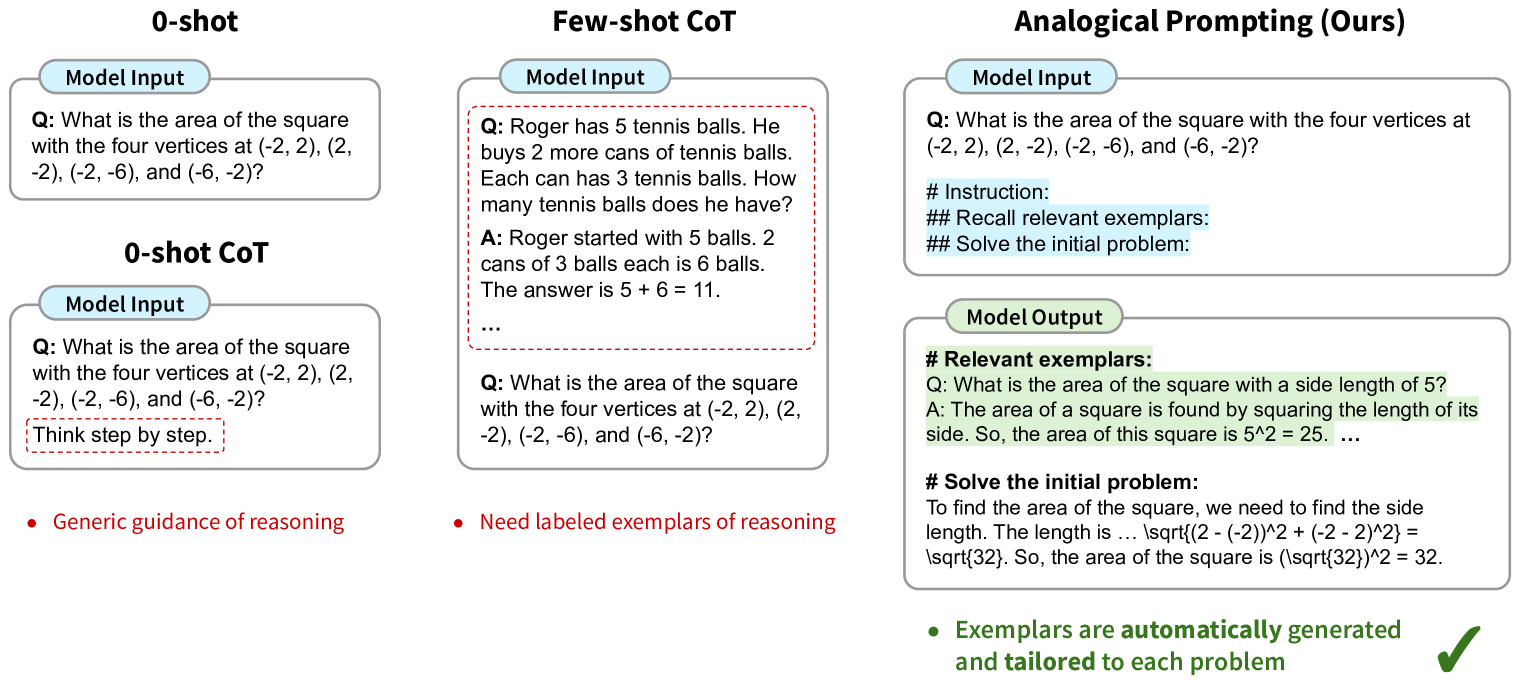
The image presents a diagram comparing three different prompting techniques for Large Language Models (LLMs): 0-shot, Few-shot CoT (Chain of Thought), and Analogical Prompting (labeled as "Ours"). Each technique is illustrated with a "Model Input" and, for Few-shot CoT and Analogical Prompting, a "Model Output" section. The diagram highlights the differences in how each technique approaches problem-solving.
### Components/Axes
The diagram is structured into three main columns, each representing a prompting technique. Within each column, there are two sections: "Model Input" and, where applicable, "Model Output". There are also two smaller boxes at the bottom of the first two columns labeled "Generic guidance of reasoning" and "Needed exemplars of reasoning" respectively. A green checkmark and text "Exemplars are automatically generated and tailored to each problem" are present in the bottom right corner.
### Detailed Analysis or Content Details
**0-shot:**
* **Model Input:** "Q: What is the area of the square with the four vertices at (-2, 2), (2, -2), (-2, -6), and (-6, -2)?"
**Few-shot CoT:**
* **Model Input 1:** "Q: Roger has 5 tennis balls. He buys 2 more cans of tennis balls. Each can has 3 tennis balls. How many tennis balls does he have?"
* **Model Output 1:** "A: Roger started with 5 balls. 2 cans of 3 balls each is 6 balls. The answer is 5 + 6 = 11."
* **Model Input 2:** "Q: What is the area of the square with the four vertices at (-2, 2), (2, -2), (-2, -6), and (-6, -2)?"
**Analogical Prompting (Ours):**
* **Model Input:** "Q: What is the area of the square with the four vertices at (-2, 2), (2, -2), (-2, -6), and (-6, -2)?"
* **Model Output:**
* "# Instruction: ## Recall relevant exemplars: ## Solve the initial problem:"
* "# Relevant exemplars: Q: What is the area of a square with a side length of 5? A: The area of a square is found by squaring the length of its side. So, the area of this square is 5^2 = 25. ..."
* "# Solve the initial problem: To find the area of the square, we need to find the side length. The length is ...sqrt((-2-2)^2 + (-2-2)^2) = sqrt(32). So, the area of the square is (sqrt(32))^2 = 32."
**Bottom Boxes:**
* **Left Box:** "Generic guidance of reasoning"
* **Middle Box:** "Needed exemplars of reasoning"
* **Right Box:** "Exemplars are automatically generated and tailored to each problem" (with a green checkmark)
### Key Observations
* 0-shot prompting directly asks the question without providing any examples.
* Few-shot CoT provides an example problem and its solution before presenting the target question.
* Analogical Prompting also provides an example, but it's framed as "relevant exemplars" and includes an explicit instruction to recall them and solve the initial problem.
* The "Ours" method highlights the automatic generation of tailored exemplars, indicated by the green checkmark.
* The Few-shot CoT method requires manually curated exemplars.
### Interpretation
The diagram illustrates a progression in prompting techniques for LLMs. 0-shot relies solely on the model's pre-existing knowledge. Few-shot CoT enhances performance by providing a single example of reasoning. The "Analogical Prompting (Ours)" technique aims to improve upon this by automatically generating relevant examples, potentially leading to more accurate and efficient problem-solving. The green checkmark emphasizes the key advantage of this approach: the automation of exemplar creation, which addresses the limitation of manual curation in Few-shot CoT. The diagram suggests that the "Ours" method is designed to leverage analogies to improve the model's reasoning capabilities. The inclusion of "# Instruction", "# Relevant exemplars", and "# Solve the initial problem" in the output of the "Ours" method demonstrates a structured approach to problem-solving. The diagram is a visual representation of a research or development effort focused on improving LLM performance through more sophisticated prompting strategies.