## [Diagram Type]: Comparative Prompting Strategies for Language Models
### Overview
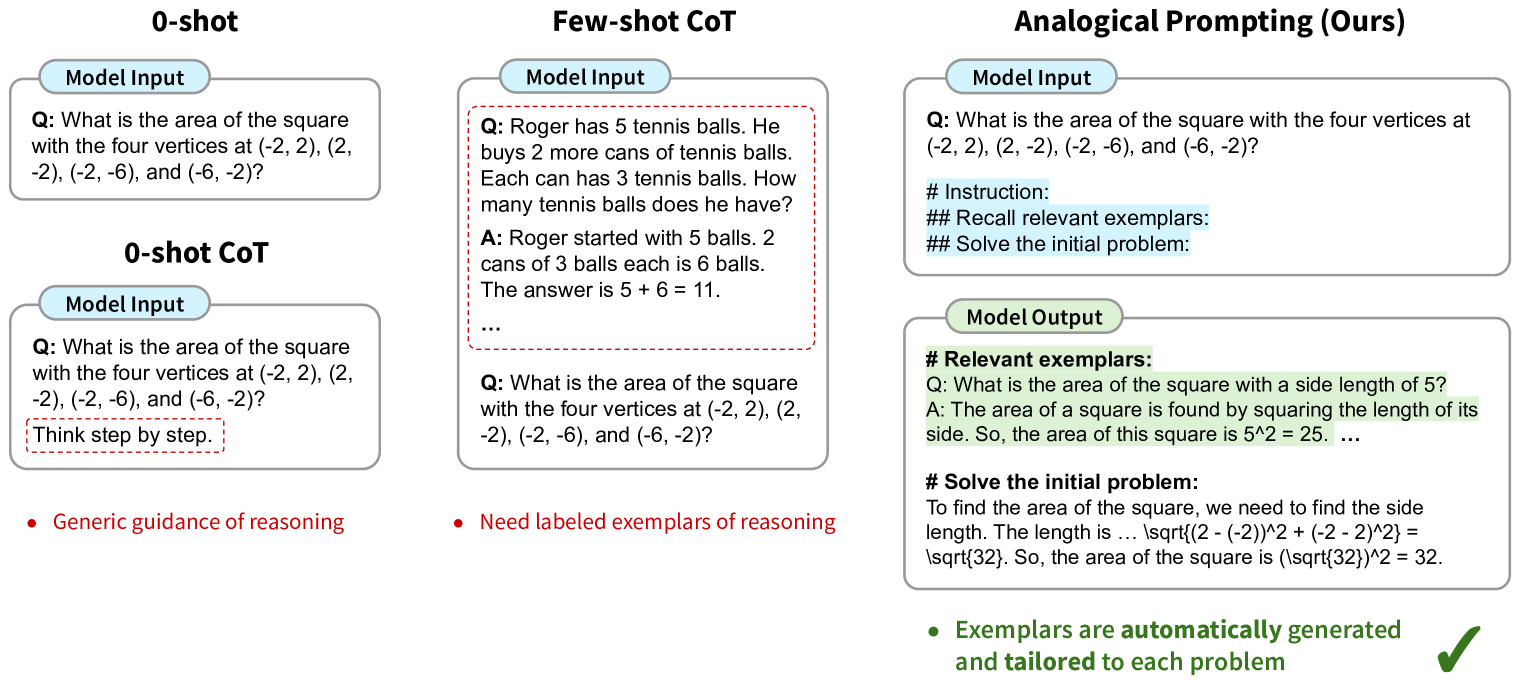
The image is a **comparative diagram** illustrating three prompting strategies for a language model: *0-shot*, *Few-shot Chain-of-Thought (CoT)*, and *Analogical Prompting (labeled “Ours”)*. It contrasts how each method structures model input (and output, for Analogical Prompting) to elicit reasoning, with brief descriptions of their approaches.
### Components/Sections
The diagram is divided into three vertical sections (left, middle, right), each representing a prompting strategy:
#### 1. Left: 0-shot and 0-shot CoT
- **0-shot**:
- *Model Input*: A question: *“What is the area of the square with the four vertices at (-2, 2), (2, -2), (-2, -6), and (-6, -2)?”* (no additional guidance).
- **0-shot CoT**:
- *Model Input*: The same square-area question, with a red dashed box containing: *“Think step by step.”*
- Below: A red bullet: *“Generic guidance of reasoning”* (describes the approach: prompting with generic “step-by-step” guidance).
#### 2. Middle: Few-shot CoT
- *Model Input*:
- First, a labeled exemplar (a different problem with reasoning):
*“Q: Roger has 5 tennis balls. He buys 2 more cans of tennis balls. Each can has 3 tennis balls. How many tennis balls does he have?
A: Roger started with 5 balls. 2 cans of 3 balls each is 6 balls. The answer is 5 + 6 = 11.”*
- Then, the target square-area question: *“What is the area of the square with the four vertices at (-2, 2), (2, -2), (-2, -6), and (-6, -2)?”*
- Below: A red bullet: *“Need labeled exemplars of reasoning”* (describes the approach: using human-provided, labeled exemplars to guide reasoning).
#### 3. Right: Analogical Prompting (Ours)
- *Model Input*:
- The square-area question, with instructions:
*“# Instruction:
## Recall relevant exemplars:
## Solve the initial problem:”*
- *Model Output*:
- *“# Relevant exemplars:
Q: What is the area of the square with a side length of 5?
A: The area of a square is found by squaring the length of its side. So, the area of this square is \( 5^2 = 25 \). ...”*
- *“# Solve the initial problem:
To find the area of the square, we need to find the side length. The length is ... \( \sqrt{(2 - (-2))^2 + (-2 - 2)^2} = \sqrt{32} \). So, the area of the square is \( (\sqrt{32})^2 = 32 \).”*
- Below: A green bullet: *“Exemplars are automatically generated and tailored to each problem”* (with a green checkmark, emphasizing the innovation).
### Detailed Analysis
- **0-shot**: No reasoning guidance—only the question.
- **0-shot CoT**: Adds *generic* guidance (“Think step by step”) to prompt reasoning.
- **Few-shot CoT**: Uses *labeled exemplars* (human-provided, e.g., the tennis ball problem) to guide reasoning, then applies it to the target question.
- **Analogical Prompting**: Automatically generates *tailored exemplars* (e.g., a square with side length 5) and uses them to solve the target problem (calculating side length via distance formula, then area).
### Key Observations
- **0-shot**: Minimal guidance, relying on the model’s default reasoning.
- **0-shot CoT**: Generic “step-by-step” prompt (no problem-specific exemplars).
- **Few-shot CoT**: Requires human-provided, labeled exemplars (labor-intensive).
- **Analogical Prompting**: Automates exemplar generation (tailored to the problem), reducing manual effort and providing targeted guidance.
### Interpretation
This diagram highlights the evolution of prompting strategies for enhancing language model reasoning:
- *0-shot* is basic but lacks guidance.
- *0-shot CoT* adds generic guidance but is not problem-specific.
- *Few-shot CoT* uses labeled exemplars (effective but labor-intensive).
- *Analogical Prompting (Ours)* innovates by **automatically generating tailored exemplars**, enabling the model to recall relevant reasoning patterns (e.g., “square area = side²”) and apply them to new problems (e.g., calculating side length via distance formula).
The output for Analogical Prompting demonstrates successful reasoning transfer: the model recalls a relevant exemplar (square with side length 5) and applies its method (squaring side length) to the target problem (calculating side length via distance, then area). This reduces reliance on manual exemplar creation (as in Few-shot CoT) and provides more targeted guidance than generic 0-shot CoT.