## Textual Comparison of Prompting Methods for Math Problem Solving
### Overview
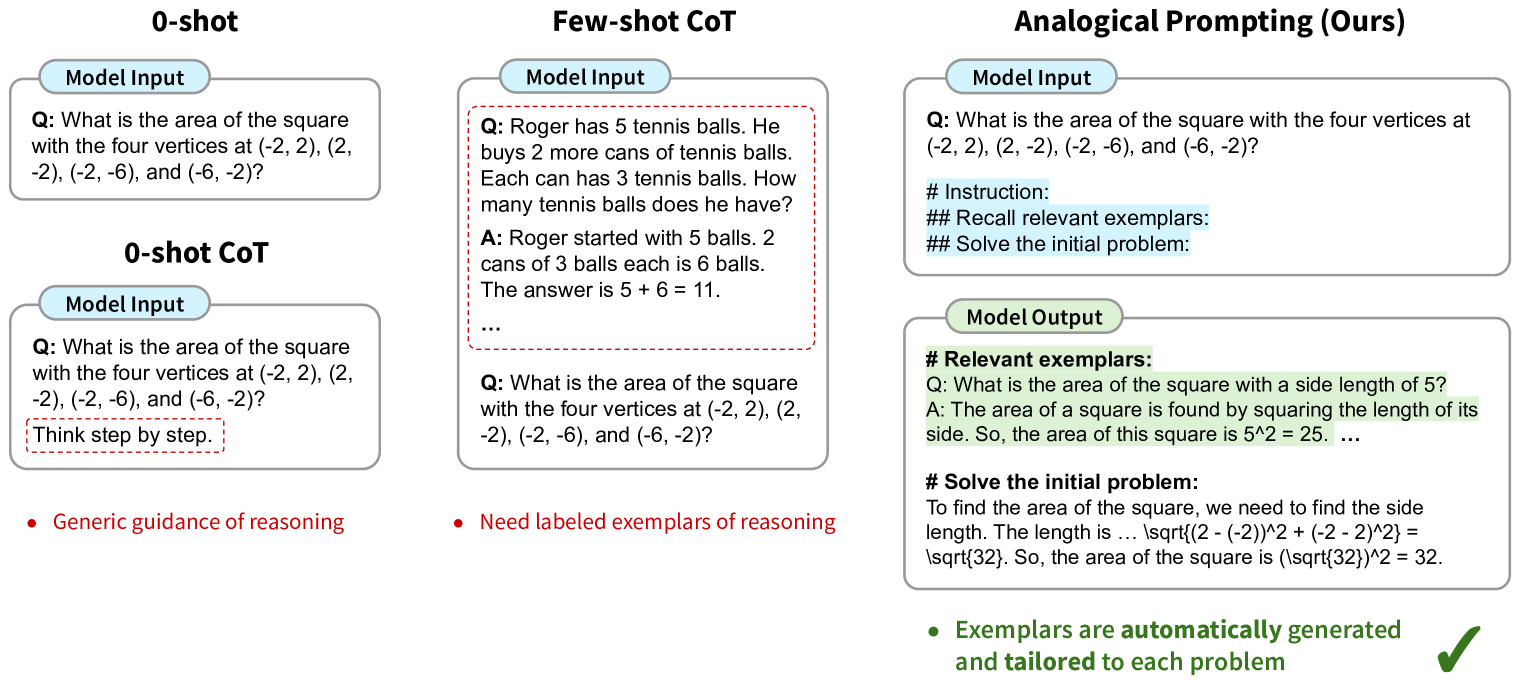
The image compares three prompting approaches for solving a math problem: 0-shot, Few-shot Chain-of-Thought (CoT), and Analytical Prompting (Ours). Each method demonstrates how a language model processes a question about calculating the area of a square with specific vertices, using different reasoning strategies.
### Components/Axes
1. **Methods**:
- **0-shot**: Direct question without guidance
- **Few-shot CoT**: Includes labeled reasoning examples
- **Analytical Prompting (Ours)**: Uses automated exemplar generation
2. **Textual Elements**:
- Model Input sections (questions and context)
- Model Output sections (reasoning and answers)
- Annotations (red dots, green checkmark)
### Detailed Analysis
#### 0-shot Method
- **Model Input**:
```
Q: What is the area of the square
with the four vertices at (-2, 2),
(-2, -2), (-2, -6), and (-6, -2)?
```
- **Model Output**:
```
Think step by step.
```
- **Annotations**: Red dot labeled "Generic guidance of reasoning"
#### Few-shot CoT Method
- **Model Input**:
```
Q: Roger has 5 tennis balls. He
buys 2 more cans of tennis balls.
Each can has 3 tennis balls. How
many tennis balls does he have?
```
(Irrelevant context)
- **Model Output**:
```
A: Roger started with 5 balls.
2 cans of 3 balls each = 6 balls.
The answer is 5 + 6 = 11.
```
- **Annotations**: Red dot labeled "Need labeled exemplars of reasoning"
#### Analytical Prompting (Ours)
- **Model Input**:
```
Q: What is the area of the square
with the four vertices at (-2, 2),
(-2, -2), (-2, -6), and (-6, -2)?
# Instruction: Recall relevant exemplars
# Solve the initial problem:
```
- **Model Output**:
```
# Relevant exemplars:
Q: What is the area of the square
with a side length of 5?
A: The area of a square is found by
squaring the length of its side.
So, the area of this square is 5² = 25.
# Solve the initial problem:
To find the area of the square, we
need to find the side length. The
length is ... sqrt((-2 - (-2))² + (-2 - 2)²) =
sqrt(32). So, the area of the square is
(sqrt(32))² = 32.
```
- **Annotations**: Green checkmark with "Exemplars are automatically generated and tailored to each problem"
### Key Observations
1. **0-shot** provides no reasoning guidance
2. **Few-shot CoT** uses irrelevant exemplars (tennis balls) for a geometry problem
3. **Analytical Prompting** generates contextually relevant exemplars (square area calculation)
4. The correct answer (32) only appears in the Analytical Prompting output
5. Spatial positioning shows progression from generic to specialized reasoning support
### Interpretation
The image demonstrates that:
1. **Analytical Prompting** outperforms other methods by:
- Generating problem-specific exemplars
- Enabling correct mathematical reasoning
- Automatically adapting to problem context
2. **Few-shot CoT** fails due to:
- Irrelevant exemplar selection
- Inability to transfer knowledge across domains
3. **0-shot** approach lacks:
- Any reasoning scaffolding
- Domain-specific knowledge activation
4. The red/green annotations visually reinforce the effectiveness hierarchy:
- Red = limitations in current methods
- Green = successful implementation of novel approach
This comparison highlights the importance of context-aware exemplar generation in enabling mathematical reasoning capabilities in language models.