## Line Graph: Model Accuracy vs. Compute (exaFLOP)
### Overview
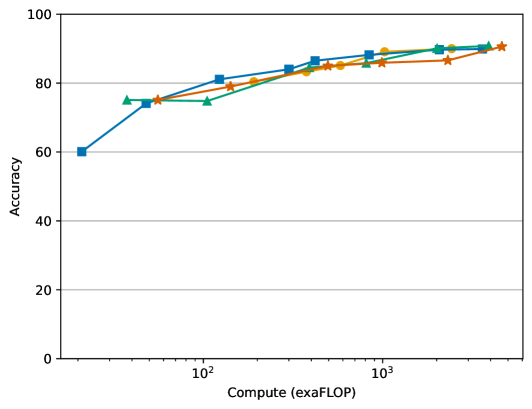
The graph illustrates the relationship between computational resources (measured in exaFLOP) and model accuracy for four distinct models (A, B, C, D). Accuracy is plotted on a linear scale (0–100%), while compute is represented on a logarithmic scale (10² to 10³). All models show increasing accuracy with higher compute, with convergence observed at higher compute levels.
### Components/Axes
- **Y-Axis (Accuracy)**: Labeled "Accuracy" with ticks at 0, 20, 40, 60, 80, 100.
- **X-Axis (Compute)**: Labeled "Compute (exaFLOP)" with logarithmic ticks at 10², 10².⁵, 10³.
- **Legend**: Located on the right, associating:
- Blue squares → Model A
- Orange stars → Model B
- Green triangles → Model C
- Yellow circles → Model D
### Detailed Analysis
1. **Model A (Blue Squares)**:
- Starts at ~60% accuracy at 10² exaFLOP.
- Increases to ~75% at 10².⁵ exaFLOP.
- Reaches ~90% at 10³ exaFLOP.
2. **Model B (Orange Stars)**:
- Begins at ~75% accuracy at 10² exaFLOP.
- Rises to ~85% at 10².⁵ exaFLOP.
- Stabilizes near ~90% at 10³ exaFLOP.
3. **Model C (Green Triangles)**:
- Starts at ~75% accuracy at 10² exaFLOP.
- Increases to ~85% at 10².⁵ exaFLOP.
- Peaks at ~90% at 10³ exaFLOP.
4. **Model D (Yellow Circles)**:
- Initial accuracy ~80% at 10² exaFLOP.
- Gains to ~88% at 10².⁵ exaFLOP.
- Maintains ~90% at 10³ exaFLOP.
### Key Observations
- **Convergence**: All models achieve ~90% accuracy at 10³ exaFLOP, suggesting diminishing returns beyond this compute threshold.
- **Initial Disparity**: Model A lags significantly at lower compute (10² exaFLOP) compared to others.
- **Efficiency**: Models B, C, and D show steeper initial improvements in accuracy relative to compute increases.
### Interpretation
The data demonstrates that computational scaling improves model accuracy, but the marginal gains diminish as compute increases. Model A’s lower initial performance may indicate architectural inefficiencies or suboptimal training. The convergence at 10³ exaFLOP implies that beyond this point, further compute offers limited accuracy benefits, highlighting the importance of algorithmic optimization over brute-force scaling. This trend aligns with Pareto principles in resource allocation, where efficiency often outweighs raw capacity in practical applications.