\n
## Diagram: AI/ML Wave Progression
### Overview
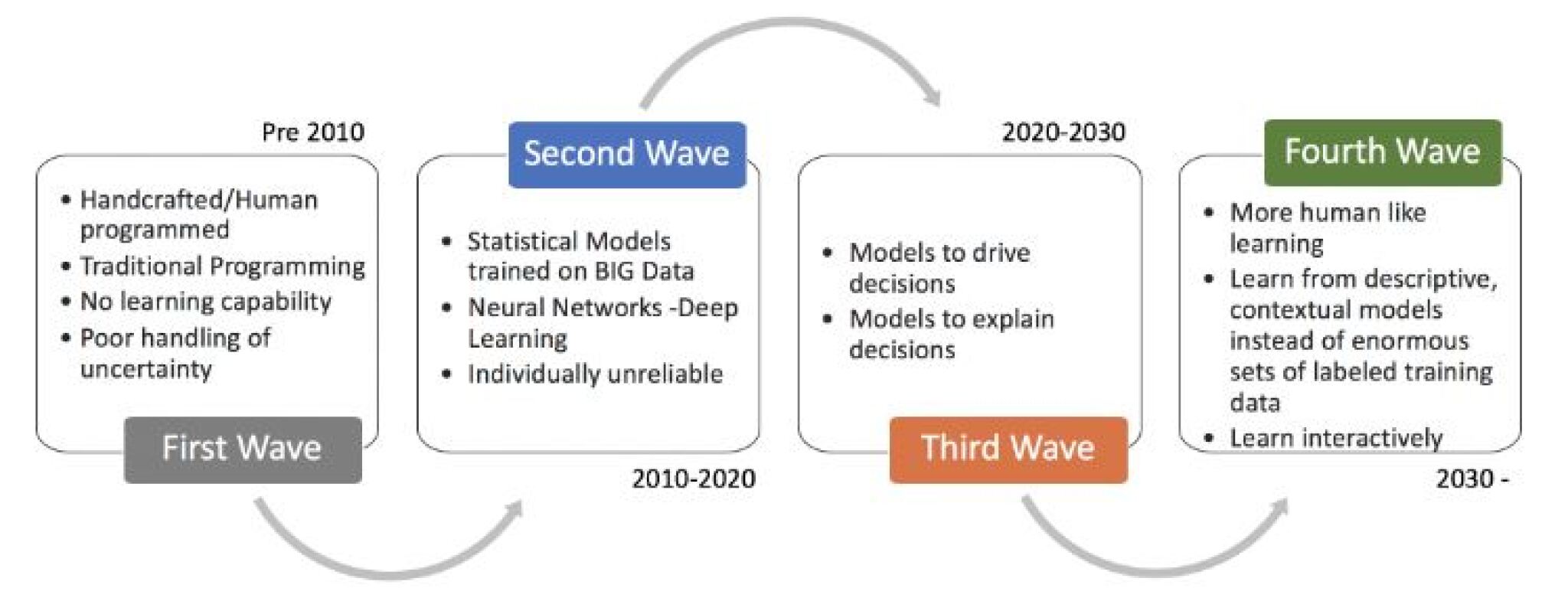
The image is a cyclical diagram illustrating the progression of Artificial Intelligence and Machine Learning through four waves, spanning from before 2010 to 2030 and beyond. Each wave is represented by a colored box with associated characteristics listed as bullet points. Arrows indicate the flow from one wave to the next, suggesting a continuous evolution.
### Components/Axes
The diagram consists of four main components, each representing a "Wave":
* **First Wave (Gray):** Pre 2010
* **Second Wave (Blue):** 2010-2020
* **Third Wave (Orange):** 2020-2030
* **Fourth Wave (Green):** 2030-
The diagram also includes directional arrows indicating the progression between waves. Time periods are indicated alongside the arrows.
### Detailed Analysis or Content Details
**First Wave (Gray): Pre 2010**
* Handcrafted/Human programmed
* Traditional Programming
* No learning capability
* Poor handling of uncertainty
**Second Wave (Blue): 2010-2020**
* Statistical Models trained on BIG Data
* Neural Networks -Deep Learning
* Individually unreliable
**Third Wave (Orange): 2020-2030**
* Models to drive decisions
* Models to explain decisions
**Fourth Wave (Green): 2030-**
* More human like learning
* Learn from descriptive, contextual models instead of enormous sets of labeled training data
* Learn interactively
### Key Observations
The diagram presents a clear progression of AI/ML techniques. The waves build upon each other, with each subsequent wave addressing the limitations of the previous one. The shift from handcrafted programming to data-driven models, and then to more explainable and human-like learning, is a central theme. The diagram highlights the increasing sophistication and capability of AI/ML over time.
### Interpretation
The diagram illustrates a narrative of AI/ML development. The "waves" represent distinct eras characterized by dominant approaches and capabilities. The first wave represents the foundational era of rule-based systems. The second wave marks the rise of data-driven methods, particularly deep learning. The third wave focuses on applying these models to real-world decision-making and understanding their reasoning. The fourth wave envisions a future where AI/ML systems learn more like humans, leveraging contextual understanding and interactive learning.
The cyclical nature of the diagram suggests that this progression is not necessarily linear, and that future developments may revisit or combine elements from earlier waves. The emphasis on "explainability" and "human-like learning" in the later waves reflects a growing concern about the transparency and trustworthiness of AI/ML systems. The diagram implies that the field is moving towards AI that is not only powerful but also understandable and aligned with human values.