## Timeline Diagram: Evolution of AI Waves (Pre-2010 to 2030-)
### Overview
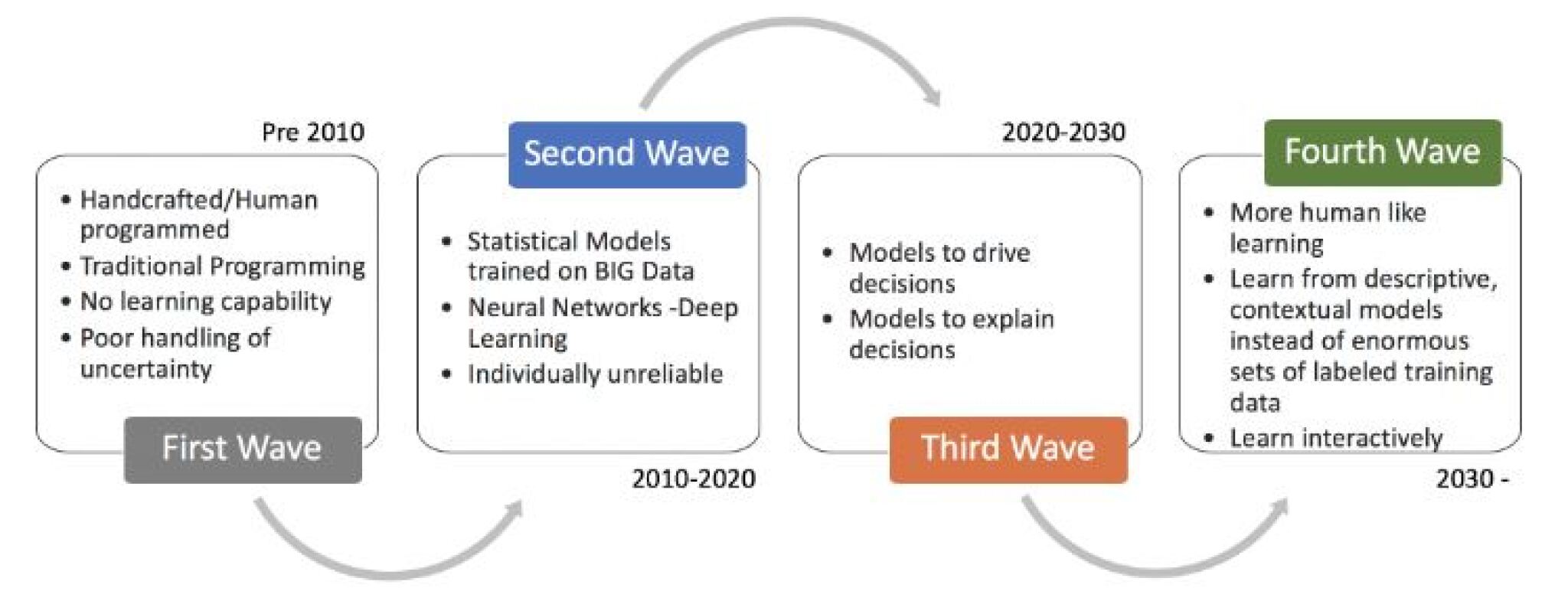
The diagram illustrates the progression of AI development across four distinct waves, spanning from Pre-2010 to 2030-. Each wave is represented by a color-coded box with descriptive bullet points, connected by curved arrows indicating chronological advancement. The timeline is positioned at the top, with wave labels and descriptions aligned vertically below.
### Components/Axes
- **Timeline**: Horizontal axis at the top, labeled with time periods:
- Pre-2010 (First Wave)
- 2010-2020 (Second Wave)
- 2020-2030 (Third Wave)
- 2030- (Fourth Wave)
- **Wave Boxes**: Four vertically stacked boxes with rounded corners, each containing bullet points:
- **First Wave** (Gray): Pre-2010
- **Second Wave** (Blue): 2010-2020
- **Third Wave** (Orange): 2020-2030
- **Fourth Wave** (Green): 2030-
- **Arrows**: Curved gray arrows connect the end of one wave to the start of the next, emphasizing continuity.
### Detailed Analysis
#### First Wave (Pre-2010)
- **Labels**: "First Wave" (gray box)
- **Text**:
- Handcrafted/Human programmed
- Traditional Programming
- No learning capability
- Poor handling of uncertainty
#### Second Wave (2010-2020)
- **Labels**: "Second Wave" (blue box)
- **Text**:
- Statistical Models trained on BIG Data
- Neural Networks - Deep Learning
- Individually unreliable
#### Third Wave (2020-2030)
- **Labels**: "Third Wave" (orange box)
- **Text**:
- Models to drive decisions
- Models to explain decisions
#### Fourth Wave (2030-)
- **Labels**: "Fourth Wave" (green box)
- **Text**:
- More human-like learning
- Learn from descriptive, contextual models instead of enormous sets of labeled training data
- Learn interactively
### Key Observations
1. **Color Coding**: Each wave is distinctly color-coded (gray, blue, orange, green) to differentiate eras.
2. **Progression**: Arrows show a linear flow from First to Fourth Wave, with no branching or regression.
3. **Technical Evolution**:
- Early focus on rule-based systems (First Wave).
- Shift to data-driven models (Second Wave).
- Emphasis on explainability and decision-making (Third Wave).
- Transition to human-like, interactive learning (Fourth Wave).
4. **Temporal Scope**: The timeline spans 70+ years, with the Fourth Wave extending beyond 2030.
### Interpretation
The diagram traces AI's trajectory from rigid, human-programmed systems to adaptive, context-aware models. Key trends include:
- **From Rules to Data**: Early AI relied on explicit programming, while later waves leverage large datasets (BIG Data) and neural networks.
- **Reliability Challenges**: Second Wave systems are noted as "individually unreliable," highlighting early limitations in consistency.
- **Explainability Focus**: The Third Wave addresses the "black box" problem by prioritizing decision transparency.
- **Human-Centric Design**: The Fourth Wave emphasizes learning from descriptive/contextual models and interactive processes, moving beyond labeled data dependency.
This progression reflects advancements in computational power, data availability, and algorithmic sophistication, culminating in AI systems that mimic human-like reasoning and adaptability.