## Diagram: Neural Network Computational Graph
### Overview
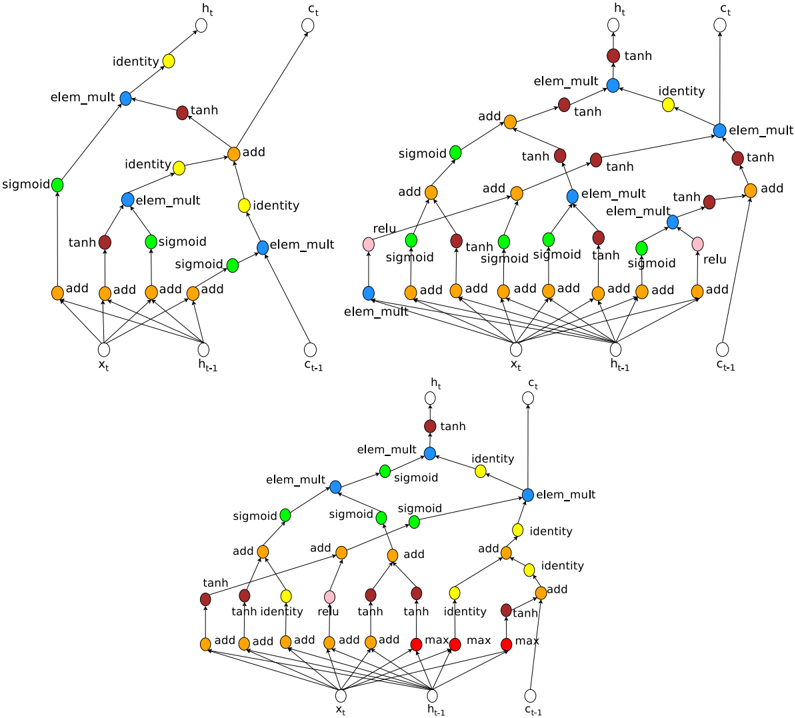
The image depicts three interconnected computational graphs representing neural network operations, likely from a recurrent architecture (e.g., LSTM/GRU). Nodes represent mathematical operations/activations, while edges indicate data flow. Three diagrams are stacked vertically, showing progressive complexity with shared components.
### Components/Axes
- **Nodes**:
- **Red**: `tanh` (hyperbolic tangent activation)
- **Blue**: `elem_mult` (element-wise multiplication)
- **Green**: `sigmoid` (sigmoid activation)
- **Orange**: `add` (element-wise addition)
- **Yellow**: `identity` (no-op operation)
- **Pink**: `relu` (rectified linear unit)
- **Labels**:
- Input: `x_t` (current time step input)
- Hidden states: `h_t` (current), `h_t-1` (previous)
- Cell states: `c_t` (current), `c_t-1` (previous)
- **Flow Direction**: Left-to-right (typical for sequential processing).
### Detailed Analysis
1. **Top Diagram**:
- **Structure**:
- `x_t` → `tanh` (red) → `elem_mult` (blue) → `add` (orange) → `h_t` (output).
- `h_t-1` and `c_t-1` feed into `elem_mult` and `add` operations.
- **Key Connections**:
- `tanh` output is element-wise multiplied with `h_t-1` (blue node).
- Result added to `c_t-1` (orange `add` node) to produce `h_t`.
2. **Middle Diagram**:
- **Structure**:
- Expands on top diagram with additional `sigmoid` (green) and `identity` (yellow) nodes.
- `sigmoid` gates modulate `elem_mult` operations.
- **Key Connections**:
- `sigmoid` outputs control element-wise multiplications (e.g., `sigmoid` → `elem_mult` → `add`).
- `identity` nodes preserve values for skip connections.
3. **Bottom Diagram**:
- **Structure**:
- Most complex, with `max` operations (red) and `relu` (pink).
- Introduces parallel paths for gradient computation.
- **Key Connections**:
- `max` operations aggregate gradients across multiple paths.
- `relu` applied to intermediate states for non-linearity.
### Key Observations
- **Skip Connections**: `identity` nodes enable residual connections, preserving gradients during backpropagation.
- **Temporal Dependency**: `h_t-1` and `c_t-1` propagate information across time steps.
- **Color Consistency**: Node colors align with their labels (e.g., all `tanh` nodes are red).
- **Gradient Flow**: `max` operations in the bottom diagram suggest attention mechanisms or gradient clipping.
### Interpretation
This diagram illustrates the forward and backward passes of a recurrent neural network, likely an LSTM cell. The `tanh` and `sigmoid` gates regulate information flow, while `elem_mult` and `add` combine hidden/cell states. The `max` and `relu` operations in the bottom diagram hint at advanced variants (e.g., attention or gradient regulation). The graphs emphasize modularity, with reusable components (e.g., `elem_mult` blocks) and efficient computation through element-wise operations. The absence of explicit numerical values suggests this is a conceptual representation rather than empirical data.