## Data Flow Diagram: Error Removal and Consistency Check
### Overview
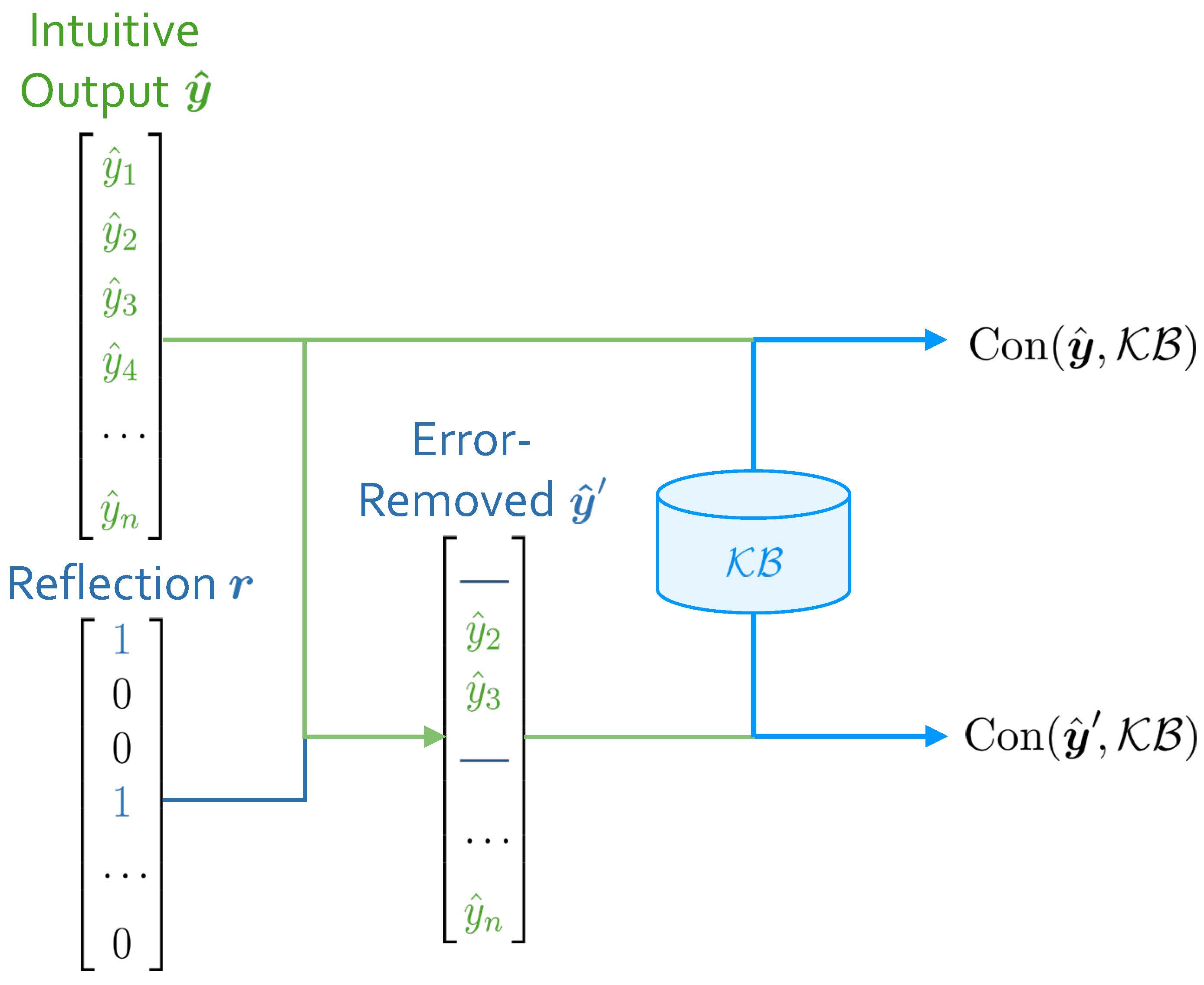
The image is a data flow diagram illustrating a process where an "Intuitive Output" vector `ŷ` is refined by removing errors based on a "Reflection" vector `r`, resulting in an "Error-Removed" vector `ŷ'`. Both the original and refined outputs are then checked for consistency against a knowledge base `KB`.
### Components/Axes
* **Intuitive Output `ŷ`**: A column vector labeled "Intuitive Output `ŷ`" containing elements `ŷ1`, `ŷ2`, `ŷ3`, `ŷ4`, ..., `ŷn`. The vector is represented in green.
* **Reflection `r`**: A column vector labeled "Reflection `r`" containing binary values (1s and 0s). The vector is represented in blue. The values are 1, 0, 0, 1, ..., 0.
* **Error-Removed `ŷ'`**: A column vector labeled "Error-Removed `ŷ'`" containing elements `ŷ2`, `ŷ3`, ..., `ŷn`. The vector is represented in green.
* **Knowledge Base `KB`**: A cylindrical database labeled "KB" in blue.
* **Consistency Check `Con(ŷ, KB)`**: A function or process that checks the consistency of the "Intuitive Output `ŷ`" against the knowledge base `KB`. The output is labeled "Con(ŷ, KB)" and is represented in blue.
* **Consistency Check `Con(ŷ', KB)`**: A function or process that checks the consistency of the "Error-Removed `ŷ'`" against the knowledge base `KB`. The output is labeled "Con(ŷ', KB)" and is represented in blue.
### Detailed Analysis or ### Content Details
1. **Intuitive Output `ŷ`**: The initial output vector contains `n` elements, denoted as `ŷ1` to `ŷn`.
2. **Reflection `r`**: The reflection vector `r` acts as a filter. A value of '1' in `r` seems to indicate that the corresponding element in `ŷ` is retained or used, while a '0' indicates it is removed or ignored.
3. **Error Removal Process**: The green arrow indicates that the "Intuitive Output `ŷ`" is processed along with the "Reflection `r`" to produce the "Error-Removed `ŷ'`". The elements in `ŷ'` are a subset of those in `ŷ`, specifically `ŷ2`, `ŷ3`, ..., `ŷn`. The first element `ŷ1` is missing.
4. **Knowledge Base Interaction**: Both the original output `ŷ` and the error-removed output `ŷ'` are fed into a consistency check process, "Con(ŷ, KB)" and "Con(ŷ', KB)" respectively, which uses the knowledge base `KB`.
5. **Data Flow**: The green line connects the "Intuitive Output `ŷ`" to the "Error-Removed `ŷ'`" vector. The blue lines connect the "Intuitive Output `ŷ`" and "Error-Removed `ŷ'`" vectors to the knowledge base `KB` and the consistency checks.
### Key Observations
* The "Reflection `r`" vector appears to be used to filter or select elements from the "Intuitive Output `ŷ`" vector.
* The knowledge base `KB` is used to validate both the original and refined outputs.
* The diagram suggests an iterative process of error removal and consistency checking.
### Interpretation
The diagram illustrates a system for refining an initial output `ŷ` by removing errors based on a reflection vector `r`. This refined output `ŷ'` and the original `ŷ` are then validated against a knowledge base `KB` to ensure consistency. The process likely aims to improve the accuracy and reliability of the output by leveraging external knowledge and filtering out potentially erroneous elements. The absence of `ŷ1` in the "Error-Removed `ŷ'`" vector suggests that the first element of the "Intuitive Output `ŷ`" was identified as an error and removed based on the "Reflection `r`" vector. The consistency checks, "Con(ŷ, KB)" and "Con(ŷ', KB)", likely return a measure of how well the outputs align with the information stored in the knowledge base.