\n
## Diagram: Intuitive Output and Reflection Process
### Overview
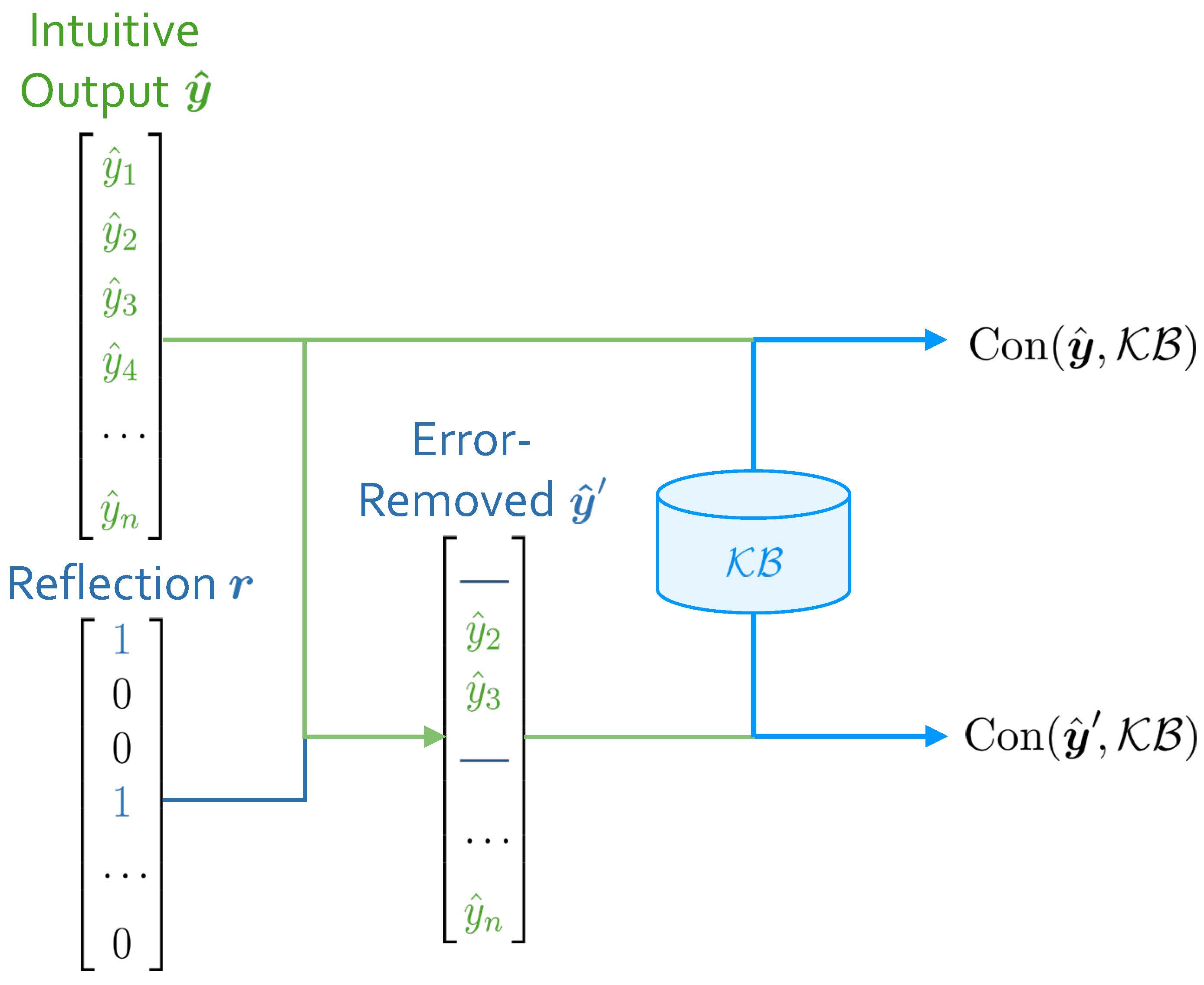
This diagram illustrates a process involving an "Intuitive Output" (ŷ), a "Reflection" (r), an "Error-Removed Output" (ŷ'), and a "Knowledge Base" (KB). The diagram depicts a flow of information from the Intuitive Output and Reflection to the Knowledge Base, resulting in two "Con" operations. It appears to be a conceptual model of a feedback or refinement process.
### Components/Axes
The diagram consists of the following labeled components:
* **Intuitive Output ŷ:** Represented as a vertical array with elements ŷ₁, ŷ₂, ŷ₃, ŷ₄, and continuing to ŷₙ.
* **Reflection r:** Represented as a vertical array with elements 1, 0, 1, and continuing to 0.
* **Error-Removed ŷ':** Represented as a vertical array with elements ŷ₂, ŷ₃, and continuing to ŷₙ.
* **KB:** A cylindrical shape representing a "Knowledge Base".
* **Con(ŷ, KB):** A label indicating a function or operation applied to the Intuitive Output and the Knowledge Base.
* **Con(ŷ', KB):** A label indicating a function or operation applied to the Error-Removed Output and the Knowledge Base.
The diagram uses arrows to indicate the flow of information. A large rectangular block connects the Intuitive Output and Reflection to the Error-Removed Output.
### Detailed Analysis or Content Details
The diagram shows the following information flow:
1. **Intuitive Output (ŷ):** The array ŷ contains elements from ŷ₁ to ŷₙ.
2. **Reflection (r):** The array r contains a sequence of 1s and 0s, starting with 1, 0, 1, and ending with 0. The length of this array is not explicitly defined, but it appears to be related to the length of the Intuitive Output array.
3. **Error-Removed Output (ŷ'):** The array ŷ' contains elements from ŷ₂ to ŷₙ. This suggests that ŷ₁ is removed or modified in the process.
4. **Knowledge Base (KB):** The Knowledge Base is a central component.
5. **Con Operations:**
* The Intuitive Output (ŷ) is fed into the first "Con" operation along with the Knowledge Base (KB), resulting in Con(ŷ, KB).
* The Error-Removed Output (ŷ') is fed into the second "Con" operation along with the Knowledge Base (KB), resulting in Con(ŷ', KB).
The rectangular block connecting Intuitive Output and Reflection to Error-Removed Output suggests a transformation or filtering process. The specific nature of this process is not detailed in the diagram.
### Key Observations
* The Reflection array (r) consists of alternating 1s and 0s. This could represent a selection or masking mechanism.
* The Error-Removed Output (ŷ') omits the first element (ŷ₁) of the Intuitive Output (ŷ).
* The Knowledge Base (KB) is used in both "Con" operations, suggesting it plays a crucial role in the overall process.
* The diagram does not provide any numerical values or specific details about the "Con" operations.
### Interpretation
This diagram likely represents a system for refining an initial "Intuitive Output" (ŷ) using a "Reflection" (r) and a "Knowledge Base" (KB). The Reflection array might act as a filter, selecting or weighting certain elements of the Intuitive Output. The "Error-Removed Output" (ŷ') represents the result of this filtering process. The "Con" operations likely involve comparing the outputs (ŷ and ŷ') with the Knowledge Base to assess their validity or consistency.
The diagram suggests a feedback loop where the initial Intuitive Output is refined based on the Knowledge Base and the Reflection, leading to a more accurate or reliable Error-Removed Output. The specific meaning of "Con" is unknown without further context, but it likely represents a consistency check or a constraint satisfaction process. The diagram is abstract and conceptual, focusing on the flow of information rather than the specific implementation details. It could represent a cognitive process, a machine learning algorithm, or a control system.