## Diagram: Error Correction via Reflection and Knowledge Base Consistency Check
### Overview
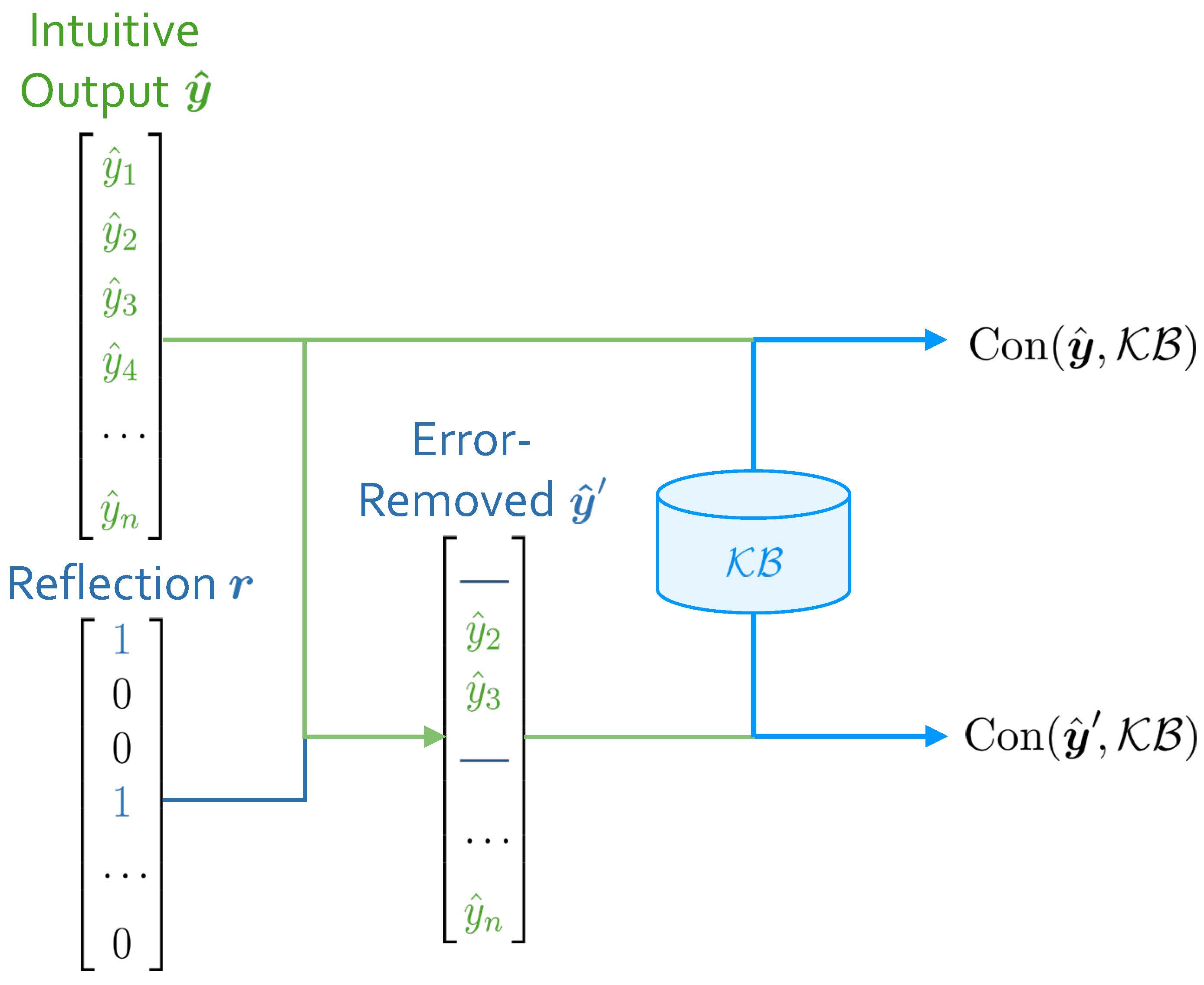
The image is a technical flowchart illustrating a conceptual process for refining an initial output vector (`ŷ`) by removing errors using a reflection vector (`r`), resulting in a corrected output (`ŷ'`). Both the original and corrected outputs are then checked for consistency against a knowledge base (`KB`). The diagram uses color-coding (green for intuitive output, blue for reflection and error-removed components) and directional arrows to show data flow and operations.
### Components/Axes
The diagram is composed of the following labeled components, arranged spatially:
1. **Intuitive Output `ŷ` (Top-Left, Green):**
* A vertical vector containing elements: `ŷ₁`, `ŷ₂`, `ŷ₃`, `ŷ₄`, `...`, `ŷₙ`.
* This represents the initial, potentially erroneous output sequence.
2. **Reflection `r` (Bottom-Left, Blue):**
* A vertical binary vector containing elements: `1`, `0`, `0`, `1`, `...`, `0`.
* This vector appears to act as a mask or selector, where a `1` likely indicates an element in `ŷ` that is flagged for correction or removal.
3. **Error-Removed `ŷ'` (Center, Blue):**
* A vertical vector containing elements: `—`, `ŷ₂`, `ŷ₃`, `—`, `...`, `ŷₙ`.
* The dashes (`—`) in the first and fourth positions correspond to the `1`s in the `Reflection r` vector, indicating those elements (`ŷ₁` and `ŷ₄`) have been removed or nullified.
4. **Knowledge Base `KB` (Center-Right, Blue Cylinder):**
* Represented by a standard database cylinder icon labeled `KB`.
* This symbolizes a repository of established facts or rules used for validation.
5. **Consistency Check Functions (Right Side, Black Text):**
* `Con(ŷ, KB)`: An arrow points from the `Intuitive Output ŷ` to this function label.
* `Con(ŷ', KB)`: An arrow points from the `Error-Removed ŷ'` to this function label.
* These represent operations that evaluate the consistency of an output vector with the knowledge base.
### Detailed Analysis
**Data Flow and Relationships:**
1. A green arrow originates from the `Intuitive Output ŷ` vector. It splits into two paths:
* **Path 1 (Top):** Continues directly to the right, feeding into the `Con(ŷ, KB)` consistency check.
* **Path 2 (Bottom):** Turns downward and then right, entering the `Error-Removed ŷ'` vector. This path is combined with a blue arrow coming from the `Reflection r` vector.
2. A blue arrow originates from the `Reflection r` vector and merges with the green path from `ŷ` to form the input for the `Error-Removed ŷ'` vector. This visually represents the application of the reflection mask to the intuitive output.
3. A green arrow exits the `Error-Removed ŷ'` vector and points right to the `Con(ŷ', KB)` consistency check.
4. Blue lines connect the `KB` database cylinder to both consistency check functions (`Con(ŷ, KB)` and `Con(ŷ', KB)`), indicating that the knowledge base is queried or used by both operations.
**Component Isolation:**
* **Header/Left Region:** Contains the input data structures (`ŷ` and `r`).
* **Main/Center Region:** Contains the processing step (creation of `ŷ'`) and the core knowledge resource (`KB`).
* **Footer/Right Region:** Contains the output operations (the two consistency checks).
### Key Observations
* The process is **parallel**: The original output `ŷ` and the error-corrected output `ŷ'` are evaluated for consistency against the same `KB` simultaneously or in equivalent steps.
* The **Reflection `r` vector is a precise mask**. Its binary values directly map to the elements removed in `ŷ'`. In this specific example, `r = [1, 0, 0, 1, ..., 0]` leads to `ŷ' = [—, ŷ₂, ŷ₃, —, ..., ŷₙ]`.
* The diagram implies a **comparative analysis**. The system likely compares the results of `Con(ŷ, KB)` and `Con(ŷ', KB)` to determine if removing the reflected elements improved consistency with the knowledge base.
### Interpretation
This diagram models a **knowledge-grounded refinement or verification loop**, common in AI systems, particularly those involving reasoning or fact-checking.
* **What it demonstrates:** The process suggests that an initial AI-generated output (`ŷ`) may contain errors or inconsistencies. A separate "reflection" mechanism (`r`) identifies specific problematic components. These are filtered out to produce a candidate correction (`ŷ'`). The core validation step is checking both versions against a trusted `KB`. The system's goal is likely to produce an output that is more consistent with established knowledge.
* **Relationships:** The `Reflection r` is the control mechanism that acts upon the data (`ŷ`). The `KB` is the authoritative reference. The `Con` functions are the evaluators. The entire flow is a pipeline from generation (`ŷ`) to correction (`ŷ'`) to validation (both `Con` checks).
* **Notable Implications:** The architecture implies that error correction is not a black box but a targeted process based on identifiable flags (`r`). The parallel consistency checks allow for a direct A/B comparison: "Was the original output consistent? Is the modified version more consistent?" This is a foundational pattern for iterative improvement and self-correction in AI models. The use of vectors suggests the outputs are structured sequences (e.g., text tokens, data points).