## Diagram: Error-Corrected Output Generation Process
### Overview
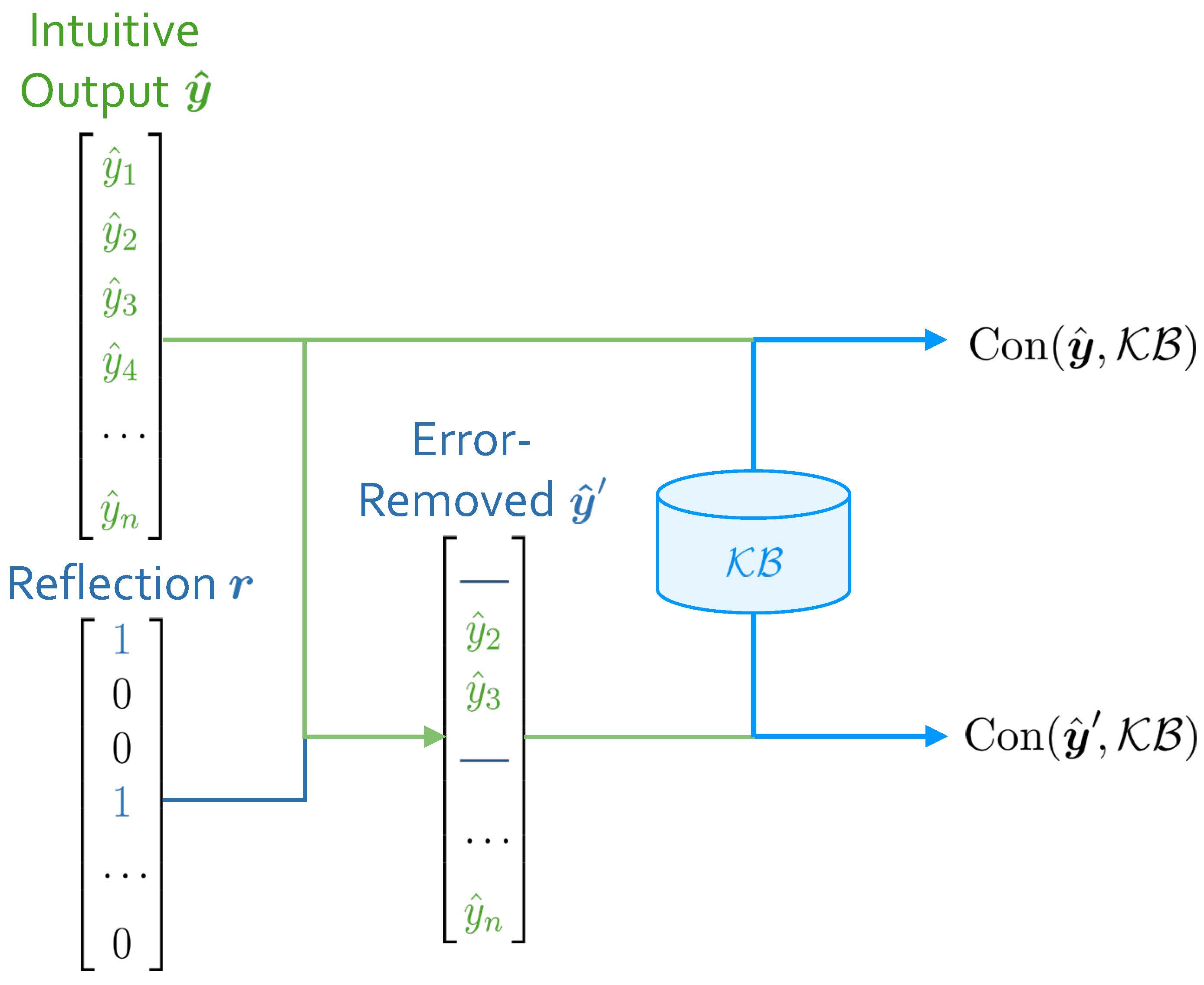
The diagram illustrates a technical process for refining an intuitive output through error removal and integration with a knowledge base (KB). It shows the flow from raw predictions to a corrected output combined with domain knowledge.
### Components/Axes
1. **Intuitive Output ŷ**
- Vertical green box containing elements: ŷ₁, ŷ₂, ŷ₃, ŷ₄, ..., ŷₙ
- Represents initial predictions or hypotheses
2. **Reflection r**
- Binary vector: [1, 0, 0, 1, ..., 0]
- Acts as a filter/mask for error correction
3. **Error-Removed ŷ'**
- Vertical green box with crossed-out elements (ŷ₁, ŷ₄, etc.)
- Contains retained elements: ŷ₂, ŷ₃, ..., ŷₙ
4. **Knowledge Base (KB)**
- Blue cylinder labeled "KB"
- Represents domain-specific knowledge
5. **Concatenation Operations**
- Green arrow: Con(ŷ, KB)
- Blue arrow: Con(ŷ', KB)
### Flow and Relationships
1. **Error Correction**
- Reflection r (binary vector) filters ŷ to produce ŷ'
- Crossed-out elements in ŷ' indicate removed errors
2. **Knowledge Integration**
- Corrected output ŷ' is concatenated with KB (blue arrow)
- Original output ŷ is also concatenated with KB (green arrow)
### Key Observations
- **Selective Error Removal**: Only specific elements (ŷ₁, ŷ₄) are removed, suggesting context-dependent error patterns
- **Dual Pathway**: Both raw and corrected outputs are integrated with KB, implying iterative refinement
- **Binary Reflection**: The reflection vector r uses sparse 1s (e.g., positions 1 and 4) to control error removal
### Interpretation
This diagram represents a hybrid AI/ML pipeline where:
1. **Initial predictions** (ŷ) are probabilistically refined using a **sparse binary mask** (r) to remove errors
2. The **error-corrected output** (ŷ') retains high-confidence predictions while discarding low-confidence/erroneous elements
3. Both outputs are **contextualized** through concatenation with a knowledge base (KB), suggesting:
- KB provides domain constraints or priors
- Final output combines statistical predictions with expert knowledge
4. The **dual concatenation paths** imply:
- Raw predictions may still contain valuable information
- Error correction and knowledge integration are parallel processes
The sparse reflection vector r indicates a **targeted error removal strategy** rather than blanket filtering, preserving potentially useful but noisy predictions. This aligns with modern ML approaches that balance statistical learning with symbolic knowledge systems.