## Equation: Probability Formula
### Overview
The image presents a mathematical equation, specifically a probability formula. It defines the probability of an event based on combinations.
### Components/Axes
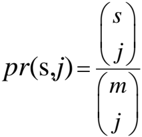
The equation is:
```
pr(s,j) = (s choose j) / (m choose j)
```
Where:
- `pr(s,j)` represents the probability of an event.
- `s` and `m` are variables used in the combination formula.
- `j` is another variable used in the combination formula.
- `(s choose j)` represents the number of combinations of choosing `j` items from a set of `s` items.
- `(m choose j)` represents the number of combinations of choosing `j` items from a set of `m` items.
### Detailed Analysis or ### Content Details
The equation calculates the probability as the ratio of two combinations. The numerator is the number of ways to choose `j` items from a set of `s` items, and the denominator is the number of ways to choose `j` items from a set of `m` items.
### Key Observations
The equation is a standard formula for calculating probability in certain combinatorial scenarios.
### Interpretation
The equation likely represents a probability calculation where you are interested in the likelihood of selecting a specific subset of items from a larger set. The variables `s` and `m` likely represent the sizes of different sets, and `j` represents the number of items being chosen from each set. The probability is the ratio of the number of ways to choose `j` items from the smaller set (`s`) to the number of ways to choose `j` items from the larger set (`m`).