\n
## Mathematical Formula: Probability Calculation
### Overview
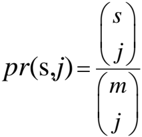
The image presents a mathematical formula representing a probability calculation. It appears to be a formula for calculating the probability of an event, likely within a statistical or machine learning context.
### Components/Axes
The formula consists of the following elements:
* `pr(s,j)`: This represents the probability of events 's' and 'j' occurring.
* `s`: A variable, likely representing a specific state or event.
* `j`: A variable, likely representing a specific item or category.
* `m`: A variable, likely representing the total number of items or categories.
* Parentheses: Used to group the variables and denote the numerator and denominator of the fraction.
* Equal sign (=): Indicates that the expression on the right side defines the value of the expression on the left side.
### Detailed Analysis or Content Details
The formula is:
`pr(s,j) = (s / j) / (m / j)`
This can be simplified to:
`pr(s,j) = s/m`
The formula calculates the probability of 's' and 'j' by dividing 's' by 'm'. The intermediate step `(s/j) / (m/j)` suggests that the original calculation might involve a conditional probability or a ratio of counts within categories.
### Key Observations
The formula is relatively simple and suggests a basic probability calculation. The presence of 's', 'j', and 'm' implies that the calculation is likely related to counting occurrences or proportions within a defined set.
### Interpretation
The formula likely represents the probability of selecting a specific item 's' from a total set of 'm' items. The intermediate step involving 'j' suggests that 'j' might represent the number of items in a specific category, and the formula calculates the probability of 's' belonging to that category. The simplification to `s/m` indicates that the category 'j' is irrelevant to the final probability calculation, and the probability is simply the proportion of 's' within the total set 'm'. This could be a simplified model or a specific case within a larger probabilistic framework. The formula is a fundamental concept in probability theory and is used in various applications, including statistics, machine learning, and data analysis.