## Mathematical Formula: Probability Expression
### Overview
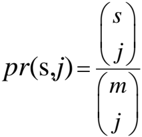
The image displays a single mathematical formula presented in standard typesetting. The formula defines a probability function, denoted as `pr(s, j)`, expressed as a ratio of two binomial coefficients (combinations). The notation is clear and unambiguous, using parentheses to denote "n choose k" combinatorial notation.
### Components/Axes
The formula is composed of the following elements, arranged vertically:
* **Left-hand side:** `pr(s, j) =`
* **Right-hand side (Numerator):** A binomial coefficient: `(s choose j)`, written as `s` over `j` within parentheses.
* **Right-hand side (Denominator):** A binomial coefficient: `(m choose j)`, written as `m` over `j` within parentheses.
The entire expression is centered within the image frame. There are no axes, legends, or additional labels.
### Detailed Analysis
The formula is transcribed precisely as:
**pr(s, j) = (s choose j) / (m choose j)**
In standard mathematical notation, this is:
`pr(s, j) = C(s, j) / C(m, j)`
or
`pr(s, j) = (s! / (j! * (s-j)!)) / (m! / (j! * (m-j)!))`
**Component Breakdown:**
* `pr(s, j)`: A probability function dependent on two variables, `s` and `j`.
* `s`: A variable, likely representing a subset size or number of successes.
* `j`: A variable, likely representing a specific count or number of selected items. It appears in both the numerator and denominator.
* `m`: A variable, likely representing a total population size or total number of trials.
* `(n choose k)`: The binomial coefficient, calculating the number of ways to choose `k` items from a set of `n` items without regard to order.
### Key Observations
1. **Structural Symmetry:** The variable `j` is the lower argument in both binomial coefficients, creating a direct relationship between the numerator and denominator.
2. **Conditional Probability Interpretation:** The structure `C(s, j) / C(m, j)` is characteristic of a hypergeometric probability or a conditional probability. It calculates the probability of drawing `j` specific items from a subset of size `s`, given that the items are drawn from a total population of size `m`.
3. **Constraints (Implied):** For the binomial coefficients to be defined, the following inequalities must hold: `0 ≤ j ≤ s` and `0 ≤ j ≤ m`. Typically, `s ≤ m`.
### Interpretation
This formula defines a probability `pr(s, j)` based on combinatorial selection. It answers the question: "If I randomly select `j` items from a total pool of `m` items, what is the probability that all `j` selected items belong to a specific, pre-defined subset of size `s` within that pool?"
**What it demonstrates:** The formula models a scenario of sampling without replacement. The probability is determined by the ratio of the number of ways to choose `j` items from the favorable subset `s` to the total number of ways to choose `j` items from the entire population `m`.
**Notable Anomalies:** There are no anomalies in the formula itself; it is a standard mathematical expression. The primary source of uncertainty is the lack of context for the variables `s`, `j`, and `m`. Their specific meanings (e.g., successes, trials, population) would be defined in the surrounding technical document from which this formula was extracted.
**Underlying Pattern:** The formula is a core component of the **hypergeometric distribution**, which describes the probability of `j` successes in `s` draws, without replacement, from a finite population of size `m` that contains exactly `s` successes.