## Data Structure: Counter Object
### Overview
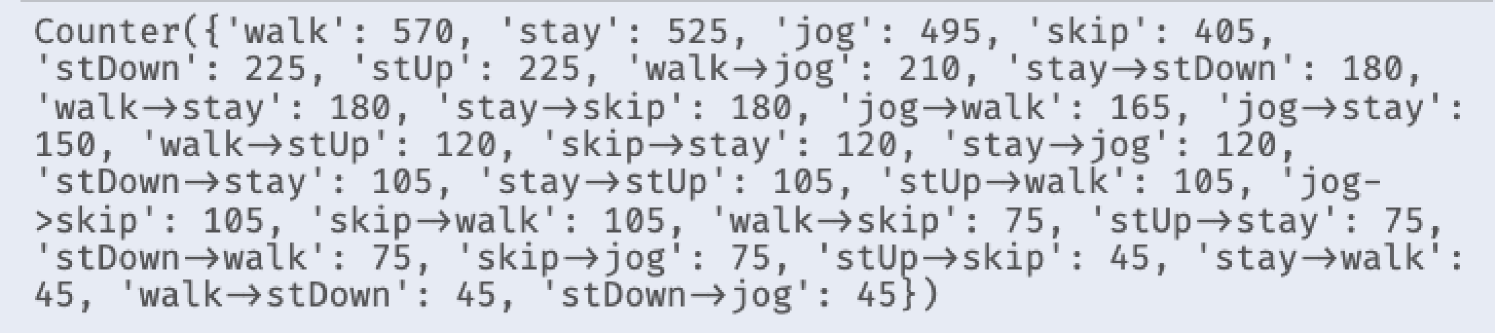
The image shows a Python `Counter` object, which is a dictionary-like structure that stores elements as keys and their counts as values. The data represents counts associated with different activities ('walk', 'stay', 'jog', 'skip', 'stDown', 'stUp') and transitions between them (e.g., 'walk→stay').
### Components/Axes
* **Keys:** Strings representing activities or transitions between activities. Activities include 'walk', 'stay', 'jog', 'skip', 'stDown' (presumably "step down"), and 'stUp' (presumably "step up"). Transitions are represented as 'activity1→activity2'.
* **Values:** Integers representing the counts or frequencies of each activity or transition.
### Detailed Analysis or ### Content Details
The `Counter` object contains the following key-value pairs:
* `'walk'`: 570
* `'stay'`: 525
* `'jog'`: 495
* `'skip'`: 405
* `'stDown'`: 225
* `'stUp'`: 225
* `'walk→jog'`: 210
* `'stay→stDown'`: 180
* `'walk→stay'`: 180
* `'stay→skip'`: 180
* `'jog→walk'`: 165
* `'jog→stay'`: 150
* `'walk→stUp'`: 120
* `'skip→stay'`: 120
* `'stay→jog'`: 120
* `'stDown→stay'`: 105
* `'stay→stUp'`: 105
* `'stUp→walk'`: 105
* `'jog→skip'`: 105
* `'skip→walk'`: 105
* `'walk→skip'`: 75
* `'stUp→stay'`: 75
* `'stDown→walk'`: 75
* `'skip→jog'`: 75
* `'stUp→skip'`: 45
* `'stay→walk'`: 45
* `'walk→stDown'`: 45
* `'stDown→jog'`: 45
### Key Observations
* The activities 'walk', 'stay', 'jog', and 'skip' have significantly higher counts than 'stDown' and 'stUp'.
* The transition counts are generally lower than the individual activity counts.
* The most frequent transition is 'walk→jog' with a count of 210.
* Several transitions have the same count (e.g., 'stay→stDown', 'walk→stay', 'stay→skip' all have a count of 180).
* The least frequent transitions are 'stUp→skip', 'stay→walk', 'walk→stDown', and 'stDown→jog', all with a count of 45.
### Interpretation
The data suggests the relative frequency of different activities and transitions between them. 'Walk' is the most frequent activity, followed by 'stay', 'jog', and 'skip'. The transitions indicate how often the subject switches between these activities. The higher counts for 'walk', 'stay', 'jog', and 'skip' compared to 'stDown' and 'stUp' suggest that the subject spends more time in these activities than stepping up or down. The transition counts provide insights into the common sequences of activities. For example, the relatively high count for 'walk→jog' suggests that jogging often follows walking. The low counts for transitions involving 'stDown' and 'stUp' may indicate that these actions are less common or occur in specific contexts not captured by the other transitions.