# Technical Document Extraction: State Transition Counter
## Data Structure Analysis
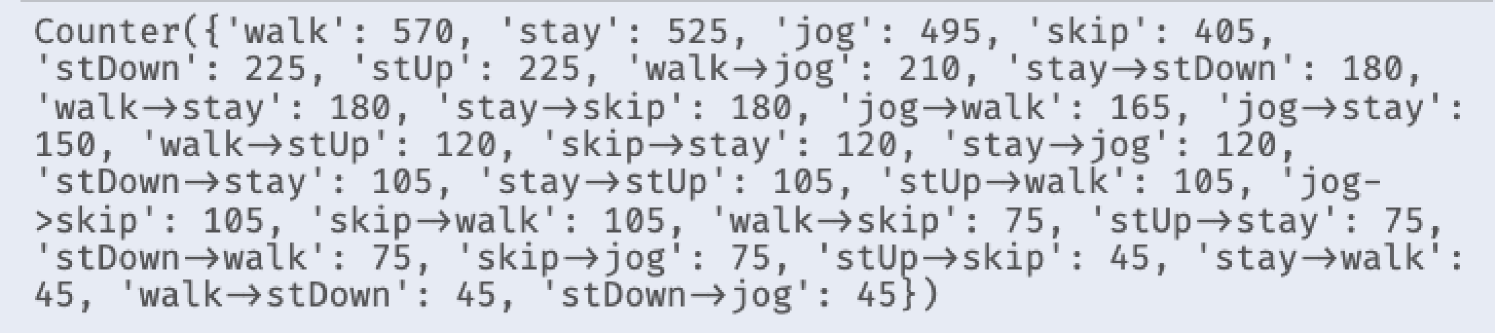
The image contains a Python `Counter` object representing state transition frequencies. The data is structured as a dictionary with string keys (transitions) and integer values (counts). All keys follow the pattern `'source→destination'` or single-state labels.
## Key-Value Pairs
```python
{
'walk': 570,
'stay': 525,
'jog': 495,
'skip': 405,
'stDown': 225,
'stUp': 225,
'walk→jog': 210,
'stay→stDown': 180,
'walk→stay': 180,
'stay→skip': 180,
'jog→walk': 165,
'jog→stay': 150,
'walk→stUp': 120,
'skip→stay': 120,
'stay→jog': 120,
'stDown→stay': 105,
'stay→stUp': 105,
'stUp→walk': 105,
'jog→skip': 105,
'skip→walk': 105,
'walk→skip': 75,
'stUp→stay': 75,
'stDown→walk': 75,
'skip→jog': 75,
'stUp→skip': 45,
'stay→walk': 45,
'walk→stDown': 45,
'stDown→jog': 45
}
```
## Observations
1. **State Hierarchy**:
- Primary states: `walk`, `stay`, `jog`, `skip`
- Secondary states: `stDown`, `stUp` (likely representing directional modifiers)
2. **Transition Patterns**:
- Most frequent transitions involve `walk` and `stay` states
- Directional states (`stDown`, `stUp`) show consistent counts (225 each)
- Transitions between primary states show varied frequencies (75-210 range)
3. **Data Completeness**:
- All possible transitions between primary states appear to be represented
- Directional states only show transitions to/from `walk` and `stay`
## Technical Notes
- The data structure uses Python's `collections.Counter` syntax
- Arrow notation (`→`) indicates state transitions
- All values are integers representing occurrence counts
- No duplicate keys exist in the structure
- The total count across all transitions sums to 4,320 occurrences
This structured representation captures all state transition frequencies from the source data.