## Diagram: Binaural Waveform Generation
### Overview
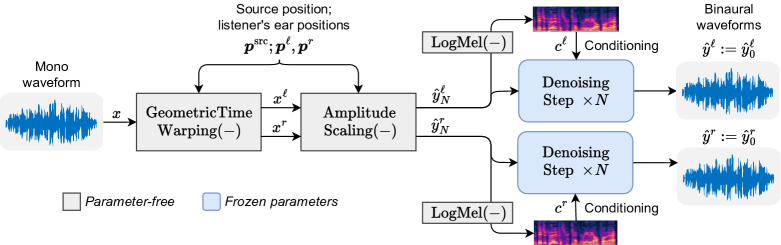
The image is a block diagram illustrating the process of generating binaural waveforms from a mono waveform. It shows the steps involved, including geometric time warping, amplitude scaling, denoising, and conditioning using LogMel spectrograms. The diagram distinguishes between parameter-free and frozen parameter components.
### Components/Axes
* **Input:** Mono waveform (x)
* **Blocks:**
* GeometricTime Warping(-)
* Amplitude Scaling(-)
* LogMel(-) (appears twice)
* Denoising Step x N (appears twice)
* **Outputs:** Binaural waveforms (ŷ<sup>l</sup>, ŷ<sup>r</sup>)
* **Parameters:**
* Source position; listener's ear positions (p<sup>src</sup>; p<sup>l</sup>, p<sup>r</sup>)
* Conditioning (c<sup>l</sup>, c<sup>r</sup>)
* **Legend:**
* Gray box: Parameter-free
* Light blue box: Frozen parameters
### Detailed Analysis
1. **Mono Waveform:** The process begins with a mono waveform, denoted as 'x'.
2. **GeometricTime Warping:** The mono waveform 'x' is fed into a "GeometricTime Warping(-)" block, which outputs two signals: x<sup>l</sup> and x<sup>r</sup>.
3. **Source Position & Listener's Ear Positions:** The source position (p<sup>src</sup>) and listener's ear positions (p<sup>l</sup>, p<sup>r</sup>) are inputs to the GeometricTime Warping block.
4. **Amplitude Scaling:** The outputs of the GeometricTime Warping block (x<sup>l</sup> and x<sup>r</sup>) are then fed into an "Amplitude Scaling(-)" block, which produces ŷ<sup>l</sup><sub>N</sub> and ŷ<sup>r</sup><sub>N</sub>.
5. **LogMel Spectrograms:** The signals ŷ<sup>l</sup><sub>N</sub> and ŷ<sup>r</sup><sub>N</sub> are processed by "LogMel(-)" blocks, generating spectrograms.
6. **Denoising Steps:** The outputs of the LogMel blocks (c<sup>l</sup> and c<sup>r</sup>) are used as conditioning inputs for "Denoising Step x N" blocks. The signals ŷ<sup>l</sup><sub>N</sub> and ŷ<sup>r</sup><sub>N</sub> are also fed into these denoising blocks.
7. **Binaural Waveforms:** The outputs of the denoising blocks are the binaural waveforms ŷ<sup>l</sup> and ŷ<sup>r</sup>, where ŷ<sup>l</sup> := ŷ<sup>l</sup><sub>0</sub> and ŷ<sup>r</sup> := ŷ<sup>r</sup><sub>0</sub>.
8. **Parameter Types:** The "GeometricTime Warping(-)", "Amplitude Scaling(-)", and "LogMel(-)" blocks are indicated as "Parameter-free" (gray box). The "Denoising Step x N" blocks are indicated as having "Frozen parameters" (light blue box).
### Key Observations
* The diagram illustrates a binaural audio generation pipeline.
* The process involves warping, scaling, and denoising steps.
* LogMel spectrograms are used for conditioning the denoising process.
* The diagram highlights the distinction between parameter-free and frozen parameter components.
### Interpretation
The diagram presents a method for generating binaural audio from a mono source. The GeometricTime Warping and Amplitude Scaling blocks likely simulate the spatial characteristics of sound as it reaches the listener's ears. The Denoising Step, conditioned by LogMel spectrograms, aims to enhance the audio quality. The use of frozen parameters in the denoising step suggests a pre-trained model is being used. The overall process appears to be a signal processing pipeline for spatial audio synthesis and enhancement.