## Flowchart: Binaural Waveform Generation Process
### Overview
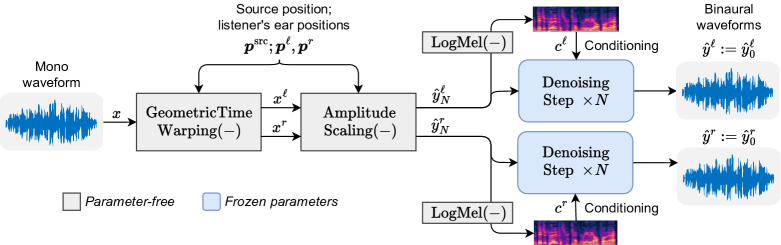
The diagram illustrates a technical workflow for generating binaural waveforms from a mono input signal. It incorporates geometric transformations, amplitude adjustments, spectral feature extraction, and iterative denoising steps conditioned on listener/environmental parameters.
### Components/Axes
1. **Input**:
- Mono waveform (`x`) represented as a blue waveform
2. **Core Processing Blocks**:
- **GeometricTime Warping**: Parameter-free block (gray) with inputs:
- Source position (`p^src`)
- Listener's ear positions (`p^l`, `p^r`)
- Outputs: Warped time coordinates (`x^l`, `x^r`)
- **Amplitude Scaling**: Parameter-free block (gray) with inputs:
- Warped coordinates (`x^l`, `x^r`)
- Outputs: Scaled amplitudes (`y^l_N`, `y^r_N`)
3. **Spectral Processing**:
- **LogMel**: Parameter-free block (gray) with inputs:
- Scaled amplitudes (`y^l_N`, `y^r_N`)
- Outputs: Log-mel spectrogram features (`c^l`, `c^r`)
4. **Denoising**:
- **Denoising Step × N**: Frozen parameters (blue) with inputs:
- Log-mel features (`c^l`, `c^r`)
- Outputs: Denoised binaural waveforms (`ŷ^l`, `ŷ^r`)
5. **Output**:
- Binaural waveforms conditioned on:
- Left ear: `ŷ^l := ŷ^l_0`
- Right ear: `ŷ^r := ŷ^r_0`
### Legend
- **Parameter-free**: Gray blocks (GeometricTime Warping, Amplitude Scaling, LogMel)
- **Frozen parameters**: Blue blocks (Denoising Step × N)
### Spatial Grounding
- **Legend**: Bottom-left corner
- **Flow Direction**: Left-to-right with top-to-bottom branching
- **Color Consistency**:
- All gray blocks match "Parameter-free" legend
- All blue blocks match "Frozen parameters" legend
### Detailed Analysis
1. **GeometricTime Warping**:
- Transforms mono waveform using spatial coordinates
- No learnable parameters (gray)
2. **Amplitude Scaling**:
- Adjusts signal strength based on warped coordinates
- No learnable parameters (gray)
3. **LogMel Feature Extraction**:
- Converts time-domain signals to spectral features
- No learnable parameters (gray)
4. **Denoising**:
- Iterative process (×N) with fixed parameters (blue)
- Uses log-mel features as conditioning input
5. **Output Conditioning**:
- Final waveforms initialized from denoising outputs
### Key Observations
1. **Parameter Architecture**:
- First three stages use parameter-free processing
- Denoising stage employs frozen parameters
2. **Spatial Conditioning**:
- Listener position (`p^l`, `p^r`) directly influences time warping
- Source position (`p^src`) affects amplitude scaling
3. **Iterative Denoising**:
- N repetitions suggest multi-stage refinement
- Maintains fixed parameters during denoising
### Interpretation
This architecture models binaural hearing through:
1. **Physical Simulation**: Geometric time warping mimics sound propagation delays
2. **Amplitude Adjustment**: Accounts for head-related transfer functions
3. **Spectral Processing**: Log-mel features capture human auditory perception
4. **Denoising**: Iterative refinement with fixed parameters suggests pre-trained denoising models
The separation of parameter-free spatial processing from frozen denoising implies a two-phase approach: first simulating acoustic properties, then applying learned denoising patterns. The use of identical initialization (`ŷ^l_0`, `ŷ^r_0`) for both ears suggests symmetric processing of left/right channels.