## Hexagonal Grid Pattern: Binary Classification Visualization
### Overview
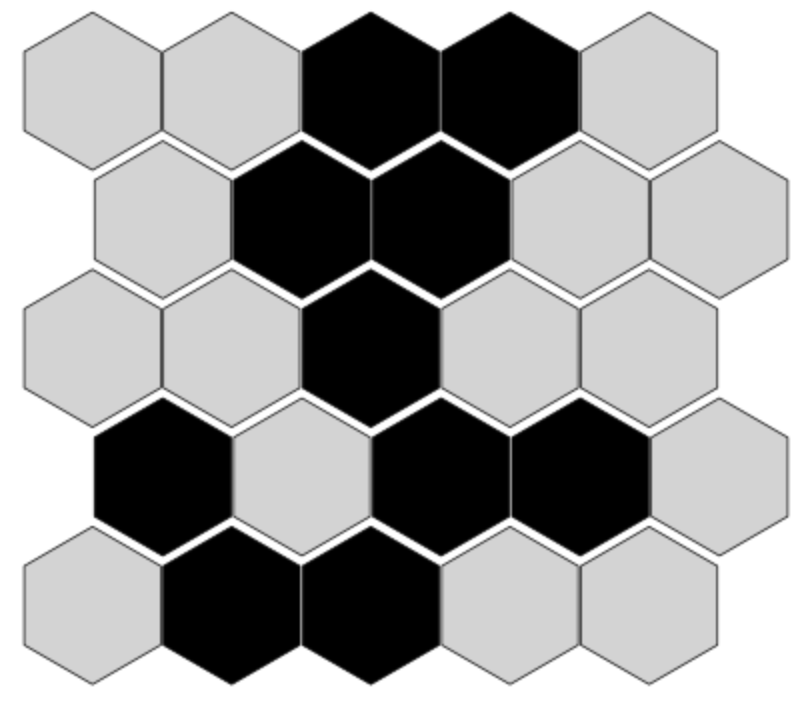
The image depicts a hexagonal grid composed of alternating black and gray hexagons. There are no textual labels, legends, axes, or numerical data present. The grid appears to be a static pattern with no discernible spatial or categorical relationships between the colored regions.
### Components/Axes
- **Grid Structure**:
- Hexagonal cells arranged in a staggered, honeycomb-like pattern.
- No axis titles, scales, or legends are visible.
- No numerical or categorical labels are present.
- **Color Coding**:
- Two distinct colors: black and gray.
- No legend or key to interpret the color significance.
### Data Analysis
- **No quantitative data** is embedded in the image.
- **No trends, distributions, or outliers** can be identified due to the absence of numerical or categorical annotations.
- **No spatial grounding** (e.g., [x, y] coordinates) is provided for the colored regions.
### Key Observations
1. The grid alternates between black and gray hexagons without a clear repeating pattern.
2. The arrangement suggests a potential binary classification system (e.g., "active" vs. "inactive" regions), but this is speculative without contextual labels.
3. The lack of textual or numerical information implies the image may serve as a placeholder, template, or abstract representation.
### Interpretation
The image likely represents a conceptual or structural framework rather than a data-driven visualization. The binary color scheme could symbolize dichotomies (e.g., presence/absence, true/false), but without explicit labels, this remains an assumption. The absence of axes or legends suggests the grid is not intended to convey quantitative relationships but may instead emphasize spatial organization or aesthetic design.
**Note**: This description is based solely on visible elements. The image contains no factual or data-driven content to extract.