## Diagram: Labeled Octahedron
### Overview
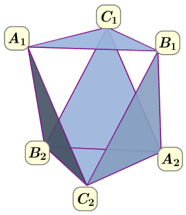
The image displays a three-dimensional geometric shape, specifically an octahedron, rendered in a 2D perspective. The shape is composed of eight triangular faces, six vertices, and twelve edges. The vertices are labeled with alphanumeric identifiers, and the edges are highlighted in a distinct color. Some faces are shaded to provide a sense of depth and three-dimensionality.
### Components
**Vertices (Labeled Points):**
The six vertices are labeled as follows, with their approximate spatial positions in the 2D rendering:
* **Top Layer:**
* `A1`: Top-left vertex.
* `B1`: Top-right vertex.
* `C1`: Top-center vertex, positioned slightly behind the line connecting A1 and B1.
* **Bottom Layer:**
* `A2`: Bottom-right vertex.
* `B2`: Bottom-left vertex.
* `C2`: Bottom-center vertex, positioned slightly in front of the line connecting A2 and B2.
**Edges:**
All edges of the polyhedron are drawn as solid, purple lines. Each vertex is connected to four others, forming the characteristic structure of an octahedron.
**Faces:**
The octahedron has eight triangular faces. The rendering uses shading to imply depth:
* The face defined by vertices `A1`, `B1`, and `C1` (the top face) is a light blue.
* The face defined by vertices `A2`, `B2`, and `C2` (the bottom face) is a light blue.
* The four side faces connecting the top and bottom layers are also light blue, but their apparent shading varies based on the perspective.
* One face, defined by vertices `A1`, `B2`, and `C2`, is shaded a significantly darker blue-gray, suggesting it is oriented away from the implied light source or is a back face in this projection.
### Detailed Analysis
**Spatial Relationships and Structure:**
The diagram represents a regular octahedron. The labeling scheme (`A1`, `B1`, `C1` and `A2`, `B2`, `C2`) suggests a conceptual division into two sets of three vertices, likely corresponding to two opposing triangular faces (e.g., a "top" and "bottom" pyramid base). In a regular octahedron, these two sets of vertices are coplanar and form equilateral triangles that are parallel to each other.
**Connectivity:**
Each vertex in the top set (`A1`, `B1`, `C1`) is connected to every vertex in the bottom set (`A2`, `B2`, `C2`), and vice-versa. For example:
* Vertex `A1` is connected to `B1`, `C1` (within its set) and to `A2`, `B2`, `C2` (the opposite set).
* This creates the twelve edges of the octahedron.
**Visual Projection:**
The shape is drawn in a perspective or oblique projection. The relative sizes and angles are distorted to create the illusion of depth on a 2D surface. The darker shading on the `A1-B2-C2` face is a key visual cue for interpreting the 3D form.
### Key Observations
1. **Symmetry:** The diagram exhibits a high degree of symmetry, consistent with a regular octahedron. The labeling (`A`, `B`, `C` with `1` and `2` suffixes) reinforces this symmetrical, dual-pyramid structure.
2. **Depth Cue:** The use of a single, distinctly darker face is the primary visual element that transforms the drawing from a flat hexagon with internal lines into a recognizable 3D object.
3. **Label Placement:** Labels are placed in yellow rectangular boxes with black text, positioned just outside the vertices they identify to avoid obscuring the geometry.
### Interpretation
This diagram is a technical illustration of an **octahedron**, one of the five Platonic solids. Its purpose is to clearly show the relationship between its vertices, edges, and faces in a 2D medium.
* **What it Demonstrates:** It visually defines the octahedron's structure: two square pyramids joined at their bases. The `A1-B1-C1` and `A2-B2-C2` triangles represent the bases of these two pyramids (which are the same square, viewed edge-on in this projection), and the other vertices (`C1`/`C2`, etc.) are the apexes.
* **Relationships:** The diagram emphasizes the **connectivity** (which vertices are linked by edges) and the **spatial arrangement** (how the vertices are positioned relative to each other in three dimensions). The labeling system is likely pedagogical, helping to track corresponding points on the two opposing pyramids.
* **Potential Context:** Such a diagram is fundamental in fields like geometry, crystallography (where octahedron is a common crystal habit), molecular chemistry (e.g., describing the geometry of a molecule like sulfur hexafluoride, SF₆), and computer graphics (as a basic 3D primitive). The specific labeling (`A1`, `B1`, etc.) might be part of a larger problem set or explanation involving symmetry operations, vector mathematics, or graph theory applied to polyhedra.