## Diagram: Limitations and Mitigations in Retrieval Systems
### Overview
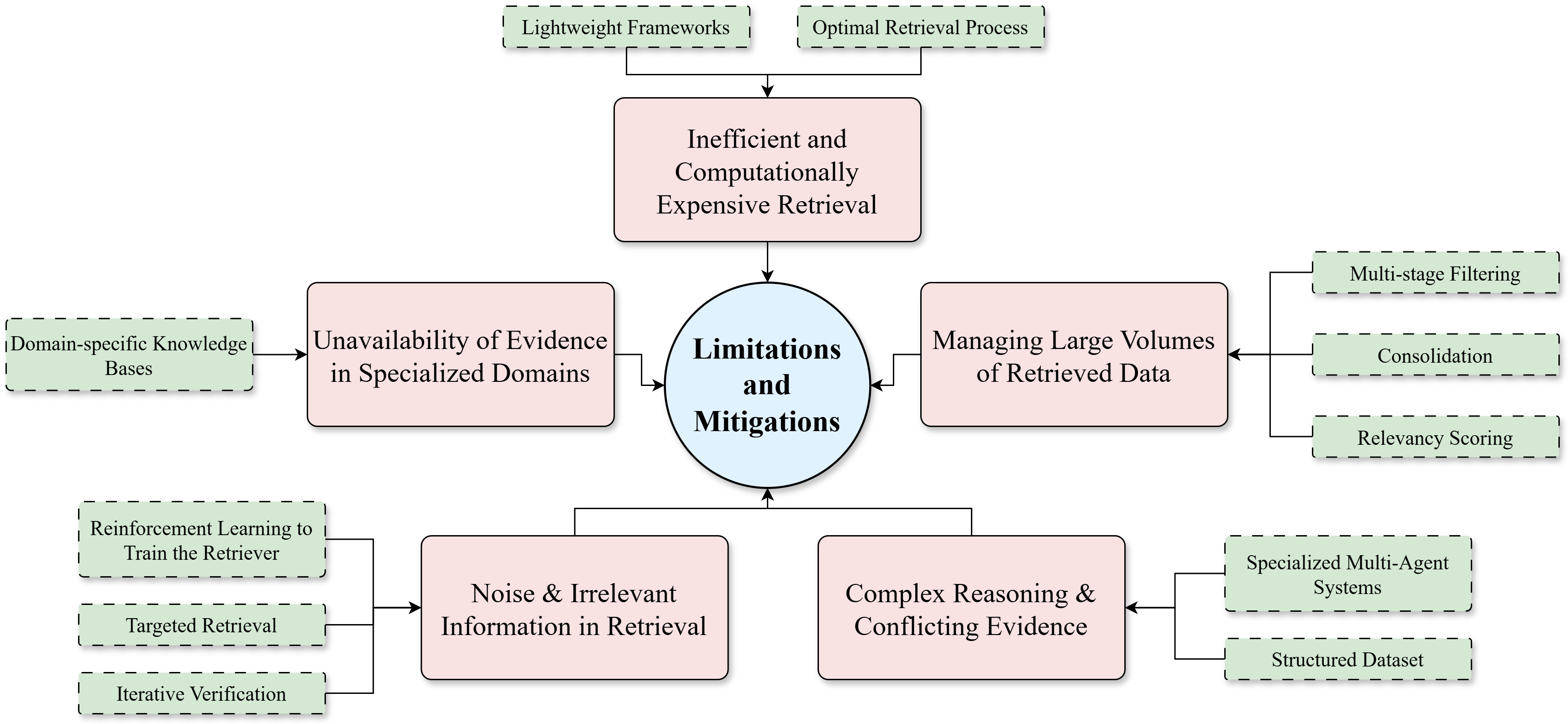
The image is a diagram illustrating the limitations of retrieval systems and potential mitigations. It presents a central node labeled "Limitations and Mitigations" connected to several problem areas, each of which is further linked to specific solutions or approaches. The diagram uses rounded rectangles and a circle to represent different concepts and their relationships.
### Components/Axes
* **Central Node:** A light blue circle labeled "Limitations and Mitigations".
* **Problem Areas:** Represented by light red rounded rectangles. These include:
* "Inefficient and Computationally Expensive Retrieval" (top center)
* "Unavailability of Evidence in Specialized Domains" (center left)
* "Managing Large Volumes of Retrieved Data" (center right)
* "Noise & Irrelevant Information in Retrieval" (bottom left)
* "Complex Reasoning & Conflicting Evidence" (bottom right)
* **Mitigations/Solutions:** Represented by light green rounded rectangles with dashed borders. These are connected to the problem areas and include:
* For "Inefficient and Computationally Expensive Retrieval":
* "Lightweight Frameworks" (top left)
* "Optimal Retrieval Process" (top right)
* For "Unavailability of Evidence in Specialized Domains":
* "Domain-specific Knowledge Bases" (left)
* For "Managing Large Volumes of Retrieved Data":
* "Multi-stage Filtering" (top right)
* "Consolidation" (center right)
* "Relevancy Scoring" (bottom right)
* For "Noise & Irrelevant Information in Retrieval":
* "Reinforcement Learning to Train the Retriever" (top left)
* "Targeted Retrieval" (center left)
* "Iterative Verification" (bottom left)
* For "Complex Reasoning & Conflicting Evidence":
* "Specialized Multi-Agent Systems" (top right)
* "Structured Dataset" (bottom right)
### Detailed Analysis or ### Content Details
The diagram shows a central theme of "Limitations and Mitigations" in retrieval systems. Each of the five limitations listed is connected to the central theme. Each limitation is then connected to a set of mitigations or solutions.
* **Inefficient and Computationally Expensive Retrieval:** This limitation is addressed by "Lightweight Frameworks" and "Optimal Retrieval Process".
* **Unavailability of Evidence in Specialized Domains:** This limitation is addressed by "Domain-specific Knowledge Bases".
* **Managing Large Volumes of Retrieved Data:** This limitation is addressed by "Multi-stage Filtering", "Consolidation", and "Relevancy Scoring".
* **Noise & Irrelevant Information in Retrieval:** This limitation is addressed by "Reinforcement Learning to Train the Retriever", "Targeted Retrieval", and "Iterative Verification".
* **Complex Reasoning & Conflicting Evidence:** This limitation is addressed by "Specialized Multi-Agent Systems" and "Structured Dataset".
### Key Observations
* The diagram provides a high-level overview of common limitations in retrieval systems and potential strategies to mitigate them.
* The use of different shapes and colors helps to distinguish between problems and solutions.
* The connections between the elements illustrate the relationships between limitations and their corresponding mitigations.
### Interpretation
The diagram illustrates a structured approach to understanding and addressing the challenges in retrieval systems. It highlights that various limitations, such as computational expense, data scarcity, and noise, can be tackled using specific techniques. The diagram suggests that a comprehensive approach to retrieval system design involves identifying potential limitations and proactively implementing appropriate mitigation strategies. The diagram emphasizes the importance of tailored solutions, as each limitation requires a different set of techniques for effective mitigation.