\n
## Diagram: Limitations and Mitigations in Retrieval Systems
### Overview
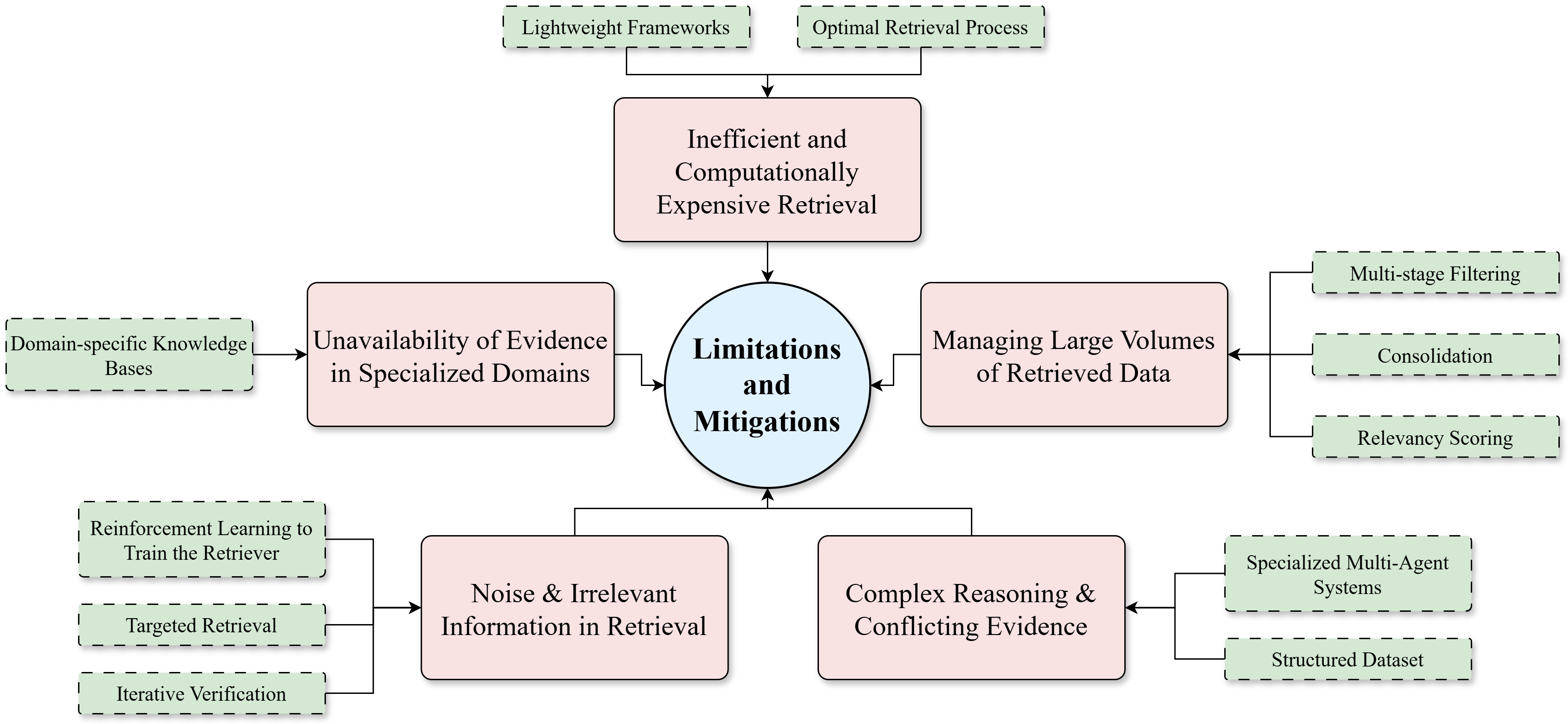
This diagram illustrates the limitations encountered in retrieval systems and the corresponding mitigations employed to address them. It's a flow diagram showing the relationships between problems and solutions, with "Limitations and Mitigations" as the central concept. The diagram uses boxes and arrows to represent these relationships.
### Components/Axes
The diagram is structured around a central box labeled "Limitations and Mitigations". Arrows point *to* this central box from three sources: "Inefficient and Computationally Expensive Retrieval", "Unavailability of Evidence in Specialized Domains", and "Noise & Irrelevant Information in Retrieval". Arrows also point *from* the central box to "Managing Large Volumes of Retrieved Data" and "Complex Reasoning & Conflicting Evidence". Each of these has further sub-components.
### Detailed Analysis or Content Details
**Top Level:**
* **Lightweight Frameworks** -> "Inefficient and Computationally Expensive Retrieval"
* **Optimal Retrieval Process** -> "Inefficient and Computationally Expensive Retrieval"
* **Domain-specific Knowledge Bases** -> "Unavailability of Evidence in Specialized Domains"
* **Reinforcement Learning to Train the Retriever** -> "Noise & Irrelevant Information in Retrieval"
* **Targeted Retrieval** -> "Noise & Irrelevant Information in Retrieval"
* **Iterative Verification** -> "Noise & Irrelevant Information in Retrieval"
**Second Level:**
* "Inefficient and Computationally Expensive Retrieval" -> "Limitations and Mitigations"
* "Unavailability of Evidence in Specialized Domains" -> "Limitations and Mitigations"
* "Noise & Irrelevant Information in Retrieval" -> "Limitations and Mitigations"
**Third Level:**
* "Limitations and Mitigations" -> "Managing Large Volumes of Retrieved Data"
* "Limitations and Mitigations" -> "Complex Reasoning & Conflicting Evidence"
**Fourth Level (Sub-components of "Managing Large Volumes of Retrieved Data"):**
* **Multi-stage Filtering**
* **Consolidation**
* **Relevancy Scoring**
**Fifth Level (Sub-components of "Complex Reasoning & Conflicting Evidence"):**
* **Specialized Multi-Agent Systems**
* **Structured Dataset**
### Key Observations
The diagram highlights that limitations in retrieval systems stem from computational cost, lack of specialized knowledge, and data quality issues. The mitigations focus on managing data volume and improving reasoning capabilities. The diagram suggests a hierarchical approach to problem-solving, where initial limitations lead to broader mitigation strategies, which then branch into specific techniques.
### Interpretation
This diagram represents a system-level view of challenges and solutions in information retrieval. The central "Limitations and Mitigations" box acts as a bottleneck, indicating that addressing these limitations is crucial for effective retrieval. The diagram suggests that a multi-faceted approach is necessary, combining techniques to improve efficiency, knowledge representation, and data quality. The branching structure implies that different mitigation strategies are appropriate for different types of limitations. The inclusion of "Reinforcement Learning" and "Multi-Agent Systems" suggests a move towards more sophisticated and adaptive retrieval systems. The diagram doesn't provide quantitative data, but it clearly articulates the relationships between problems and solutions in a retrieval context. It's a conceptual model rather than a data-driven analysis.